

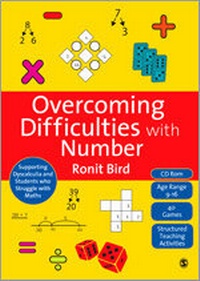
Overcoming Difficulties with Number
Supporting Dyscalculia and Students who Struggle with Maths
1st Edition
Published on 18. September 2009
Book
Hardback
168 pages
978-1-84860-710-1 (ISBN)
Description
In writing this practical book, Ronit Bird has drawn on her teaching and training experience to create teaching plans for key numeracy topics, aimed at those working with students aged 9-16.
She provides detailed strategies for teaching numeracy skills through a progression of practical activities and visualisation techniques which build the self-esteem of students who need extra help and give them a basic foundation in number. While the plans cover the National Numeracy Strategy, they can also be used in any setting where maths is being taught.
Topics covered include:
- games and puzzles for learning number components
- bridging
- multiplication
- division
- reasoning strategies
A bank of accompanying resources, games, activities and Su-Doku puzzles is available on the companion website for the book.
This is an ideal resource for both class teachers and maths subject teachers, and is equally useful for teaching assistants and learning support assistants
She provides detailed strategies for teaching numeracy skills through a progression of practical activities and visualisation techniques which build the self-esteem of students who need extra help and give them a basic foundation in number. While the plans cover the National Numeracy Strategy, they can also be used in any setting where maths is being taught.
Topics covered include:
- games and puzzles for learning number components
- bridging
- multiplication
- division
- reasoning strategies
A bank of accompanying resources, games, activities and Su-Doku puzzles is available on the companion website for the book.
This is an ideal resource for both class teachers and maths subject teachers, and is equally useful for teaching assistants and learning support assistants
Reviews / Votes
'She really knows what she is talking about when it comes to maths and dyscalculia and can provide the right type games and help for both teachers and parents. This is fast becoming my maths bible in my work with pupils who are struggling with maths' -Amazon Review
'The beauty of this book is that it provides so many well-sequenced activities in one easy-to-use resource...[This book] would be a valuable addition to the shelves of both the numeracy co-ordinator of a primary school and the secondary mathematics department [as well as] a most useful resource for those involved with the recently launched One to One Tuition Programme'
Support for Learning
'Ronit Bird is one of the most skilled and experienced teachers of learners suffering from dyscalculia. Her approach is based on years of reflective practice but also a deep understanding of the roots of numerical difficulties and disabilities. She stresses the importance of starting with concrete and manipulable materials before moving on to more symbolic materials. Her teaching scheme building systematically on the basis of the learner's current understanding, rather than on mechanical measures of performance. This seems to me of fundamental importance. Overcoming Difficulties with Number provides a wealth of numerical activities and games, taking the most effective from a range of sources, including Cuisenaire rods and domino patterns for the earliest stages where learners are still counting in ones. As learners progress, clear methods for reasoning about more complex numbers are introduced. She provides very lucid methods for areas where many children, not just dyscalculics, have great difficulty, such as solving 51/2 x 11/2 or (x+1)(x+3) using grids. I highly recommend this book for teachers and teaching assistants who deal with children who have number troubles, but I also believe that most teachers of early maths will find much that is helpful with all learners' - Professor Brian Butterworth, University College London
'I have tried some of the activities with pairs in a whole class situation and they work very well, particularly with children struggling to remember facts through traditional methods (that are not always particularly successful with many) or with younger children learning to count and memorize number facts for the first time' - Mike Eatwell, Deputy Headteacher, Bristol
'The best part of the book for me is the range of resources in the appendices and the discussion of classroom activities. I like the way the activities are tightly focused on the four operations and yet have a wide variety of approaches e.g. Suduko, Connect 4 etc.' - Clare Creasor, Senior Lecturer in Mathematics Education, Edge Hill University
More details
Language
English
Place of publication
London
United Kingdom
Target group
Professional and scholarly
Dimensions
Height: 297 mm
Width: 210 mm
Weight
686 gr
ISBN-13
978-1-84860-710-1 (9781848607101)
Copyright in bibliographic data and cover images is held by Nielsen Book Services Limited or by the publishers or by their respective licensors: all rights reserved.
Schweitzer Classification
Other editions
New editions
Book
11/2021
2nd Edition
SAGE Publications Ltd
€188.66
Shipment within 15-20 days
Person
Ronit Bird is a teacher whose interest in pupils with specific learning difficulties began with a focus on dyslexia. She qualified as a teacher at London University and subsequently gained a further qualification as a specialist teacher of learners with SpLD. While working with dyslexic pupils in a mainstream school, Ronit started to develop strategies and teaching activities to help support the learning of pupils who were experiencing difficulties in maths.
Ronit has taught in both primary and secondary settings, and has worked as a SENCO in both the independent and state sectors. As part of the Harrow Dyscalculia Project in 2006-2010, Ronit ran training courses on dyscalculia for subject leaders, teachers and teaching assistants, later working in an advisory capacity with participating schools across the Harrow LEA.
Ronit currently works as a teacher and continues to create and deliver professional development courses for teachers. Over the past few years Ronit has developed a growing interest in making demonstration videos for teachers and parents.
Ronit has taught in both primary and secondary settings, and has worked as a SENCO in both the independent and state sectors. As part of the Harrow Dyscalculia Project in 2006-2010, Ronit ran training courses on dyscalculia for subject leaders, teachers and teaching assistants, later working in an advisory capacity with participating schools across the Harrow LEA.
Ronit currently works as a teacher and continues to create and deliver professional development courses for teachers. Over the past few years Ronit has developed a growing interest in making demonstration videos for teachers and parents.
Content
Introduction
PART ONE: HOW TO HELP PUPILS STOP COUNTING IN ONES
More Than 50 Ideas to Help Pupils Stop Counting in Ones
PART TWO: THE BRIDGING TECHNIQUE
Pre-Skills for Learning the Bridging Technique
Bridging through 10
Bridging through Multiples of 10
PART THREE: THE AREA MODEL OF MULTIPLICATION AND DIVISION
Pre-Skills for the Area Model of Multiplication and Division
The Area Model of Multiplication and Division
Making the Transition from the Area Model to Standard Written Algorithms for Short and Long Multiplication
Making the Transition from the Area Model to Standard Written Algorithms for Short and Long Division
PART FOUR: REASONING STRATEGIES
Reasoning Strategies
PART ONE: HOW TO HELP PUPILS STOP COUNTING IN ONES
More Than 50 Ideas to Help Pupils Stop Counting in Ones
PART TWO: THE BRIDGING TECHNIQUE
Pre-Skills for Learning the Bridging Technique
Bridging through 10
Bridging through Multiples of 10
PART THREE: THE AREA MODEL OF MULTIPLICATION AND DIVISION
Pre-Skills for the Area Model of Multiplication and Division
The Area Model of Multiplication and Division
Making the Transition from the Area Model to Standard Written Algorithms for Short and Long Multiplication
Making the Transition from the Area Model to Standard Written Algorithms for Short and Long Division
PART FOUR: REASONING STRATEGIES
Reasoning Strategies