

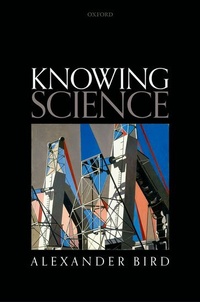
Knowing Science
Published on 6. October 2022
Book
Hardback
304 pages
978-0-19-960665-8 (ISBN)
Description
In Knowing Science, Alexander Bird presents an epistemology of science that rejects empiricism and gives a central place to the concept of knowledge. Science aims at knowledge and progresses when it adds to the stock of knowledge. That knowledge is social knowing--it is known by the scientific community as a whole. Evidence is that from which knowledge can be obtained by inference. From this, it follows that evidence is knowledge, and is not limited to perception, nor to observation. Observation supplies evidence that is basic relative to a field of enquiry and can be highly non-perceptual. Theoretical knowledge is typically gained by inference to the only explanation, in which competing plausible hypotheses are falsified by the evidence. In cases where not all competing hypotheses are refuted, scientific hypotheses are not known but instead possess varying degrees of plausibility. Plausibilities in the light of the evidence are probabilities and link eliminative explanationism to Bayesian conditionalization. Bird argues that scientific realism and anti-realism as global metascientific claims should be rejected-the track record gives us only local metascientific claims.
Reviews / Votes
At every point, Bird brings a fresh eye to his material, cutting through tired presuppositions and reshaping the way we should think about problems...It is an important work that should be studied carefully by all philosophers of science. * David Papineau, Metascience symposium * Bird's carefully argued and thought-provoking new book Knowing Science breaks new ground with respect to a wide range of issues in general philosophy of science. * Ludwig Fahrbach, Metascience symposium * It is an achievement of the book that it offers a complete and very detailed picture of modern science. For someone who wants to understand how scientists observe the world, develop theories, and gather evidence, this is a very good book to do so. * Vanessa A. Seifert, Journal for General Philosophy of Science * It is an achievement of the book that it offers a complete and very detailed picture of modern science. For someone who wants to understand how scientists observe the world, develop theories, and gather evidence, this is a very good book to do so. * Vanessa A. Seifert, Journal for General Philosophy of Science *More details
Language
English
Place of publication
Oxford
United Kingdom
Product notice
sewn/stitched
Cloth over boards
Illustrations
10 black-and-white illustrations
Dimensions
Height: 226 mm
Width: 165 mm
Thickness: 38 mm
Weight
612 gr
ISBN-13
978-0-19-960665-8 (9780199606658)
Copyright in bibliographic data and cover images is held by Nielsen Book Services Limited or by the publishers or by their respective licensors: all rights reserved.
Schweitzer Classification
Other editions
Additional editions
Person
Alexander Bird was a Queen's Scholar at Westminster School and a Thomas White Scholar at St John's College, Oxford. He studied at the Ludwig Maximilians Universitaet in Munich and then at the University of Cambridge for his MPhil (St Edmund's College) and PhD (King's College). Thereafter, he was a civil servant in the Ministry of Agriculture, Fisheries, and Food. His subsequent academic career includes permanent positions at the University of Edinburgh, University of Bristol, King's College London (Peter Sowerby Professor of Philosophy and Medicine), and the University of Cambridge (Bertrand Russell Professor). He has held visiting positions at Dartmouth College, Monash University, St Louis University, and at All Souls College, Oxford and Exeter College, Oxford.
Content
- 1: Introduction: Science and the pursuit of knowledge
- 2: The aim of science
- 3: Scientific progress
- 4: Science as social knowing
- 5: Evidence
- 6: Observation
- 7: Abductive knowledge
- 8: Probability and plausibility
- 9: Metascientific knowledge?