

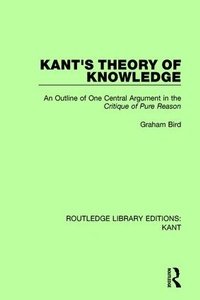
Kant's Theory of Knowledge
An Outline of One Central Argument in the 'Critique of Pure Reason'
1st Edition
Published on 19. April 2016
Book
Hardback
218 pages
978-1-138-65203-3 (ISBN)
Description
First published in 1962. Kant's philosophical works, and especially the Critique of Pure Reason, have had some influence on recent British philosophy. But the complexities of Kant's arguments, and the unfamiliarity of his vocabulary, inhibit understanding of his point of view. In Kant's Theory of Knowledge an attempt is made to relate Kant's arguments in the Critique of Pure Reason to contemporary issues by expressing them in a more modern idiom.
The selection of issues discussed is intended to present a continuous argument, of an epistemological kind, which runs centrally through the Critique. The argument deals with essentially with the problems, raised in the Transcendental Analytic, about the status of categories. It deals with certain preliminary assumptions made in setting these problems, and discusses the way in which the various sections of the Analytic contribute to their solution. It also deals with Kant's criticisms of traditional metaphysics, and ends with an account of his effort in the Third Antinomy to resolve the conflict between freedom and causality, and so to effect a transition of knowledge to moral philosophy.
The selection of issues discussed is intended to present a continuous argument, of an epistemological kind, which runs centrally through the Critique. The argument deals with essentially with the problems, raised in the Transcendental Analytic, about the status of categories. It deals with certain preliminary assumptions made in setting these problems, and discusses the way in which the various sections of the Analytic contribute to their solution. It also deals with Kant's criticisms of traditional metaphysics, and ends with an account of his effort in the Third Antinomy to resolve the conflict between freedom and causality, and so to effect a transition of knowledge to moral philosophy.
More details
Series
Language
English
Place of publication
London
United Kingdom
Publishing group
Taylor & Francis Ltd
Target group
College/higher education
Dimensions
Height: 234 mm
Width: 156 mm
Weight
460 gr
ISBN-13
978-1-138-65203-3 (9781138652033)
Copyright in bibliographic data and cover images is held by Nielsen Book Services Limited or by the publishers or by their respective licensors: all rights reserved.
Schweitzer Classification
Other editions
Additional editions
Graham Bird
Kant's Theory of Knowledge
An Outline of One Central Argument in the 'Critique of Pure Reason'
Book
10/2017
1st Edition
Routledge
€72.03
Shipment within 10-20 days
Graham Bird
Kant's Theory of Knowledge
An Outline of One Central Argument in the 'Critique of Pure Reason'
E-Book
05/2016
Routledge
€59.49
Available for download
Graham Bird
Kant's Theory of Knowledge
An Outline of One Central Argument in the 'Critique of Pure Reason'
E-Book
05/2016
Routledge
€59.49
Available for download
Person
Content
Preface;1. Phenomena and Phenomenalism2. Noumena and Noumenalism3. Transcendental and Empirical4. Sensibility and Understanding5. Intelligible Objects6. The Transcendental Analytic7. Categories and Judgements8. The Transcendental Deduction9. The Transcendental Deduction (Continued) 10. The First and Second Analogies 11. Personality 12. The Transition to Moral Philosophy; List of Books; Index