

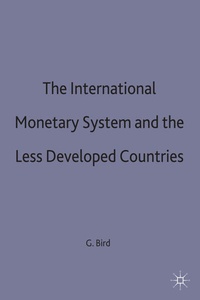
The International Monetary System and the Less Developed Countries
2nd Edition
Published on 28. October 1982
Book
Hardback
XI, 352 pages
978-0-333-33002-9 (ISBN)
Description
In this book the author investigates the relationship between the international monetary system and the less developed countries of the world. In the period since 1945 growing concern has been shown over the international monetary problems which LDCs face, and since 1971 LDCs have been significant participants in the reform of the international monetary system. After tracing the evolution of the relationship between LDCs and the International Monetary Fund, the book goes on to examine, with full reference to the available empirical evidence, the major causes and consequences of LDCs' international monetary problems. Topics covered include: export instability; the terms of trade; the demand for reserves and reserve adequacy; and adjustment difficulties. A thorough examination is then made of the ways in which financial assistance has been provided to LDCs through the IMF and the Eurocurrency market. Finally, certain key policy issues are discussed: the commodity problem; the link between the creation of international liquidity and the provision of development aid; and exchange rate policy. Each chapter is followed by an extensive bibliography which is designed to help the reader to pursue further any topic of particular interest. The presentation, which is non-mathematical, is in the form of a textbook. The issues are surveyed, the main arguments discussed, and the available empirical evidence presented. It is revealed, however, that on many issues it is at present difficult to draw firm conclusions. The book will be of interest to students of international, monetary, and development economics.
More details
Edition
Second Edition 1982
Language
English
Place of publication
London
United Kingdom
Target group
Professional and scholarly
Product notice
sewn/stitched
Cloth over boards
Illustrations
XI, 352 p.
Dimensions
Height: 216 mm
Width: 140 mm
Thickness: 24 mm
Weight
612 gr
ISBN-13
978-0-333-33002-9 (9780333330029)
DOI
10.1007/978-1-349-16903-0
Schweitzer Classification
Other editions
Additional editions
Book
10/1982
2nd Edition
Palgrave Macmillan
€160.49
Shipment within 15-20 days
E-Book
10/1982
2nd Edition
Palgrave Macmillan
€149.79
Available for download
Person
GRAHAM BIRD is a graduate of the University of Cambridge, is Senior Lecturer and Course Director in Economics at the University of Surrey. He is the author of numerous publications dealing mainly with aspects of international finance and economic development, and is currently preparing two further books in this general area. Mr Bird is also a Reseach Associate at the Overseas Development Institute, where he is working on a project entitled
The International Monetary Fund and Economic Management in Developing Countries
.
Content
Preface INTRODUCTION Background Balance-of-Payments Problems and International Monetary Issues in LDCs Alternative Policy Approaches LDCs and the Reform of the International Monetary System RELATIONS BETWEEN THE IMF AND LDCs The Relationship between Development and Stabilisation Relations between the IMF and LDCs: A Historical Perspective Concluding Remarks PRIMARY-PRODUCT PRICE INSTABILITY AND EXPORT INSTABILITY IN LDCs The Causes of Export Instability: Theoretical Analysis Export Concentration The Causes of Export Instability: Empirical Evidence The Consequences of Export Instability: Theoretical Analysis Empirical Evidence and Interpretation Empirical Evidence of the Extent of Export Instability Concluding Remarks TRENDS IN THE TERMS OF TRADE, EXPORT EARNINGS AND IMPORT PAYMENTS OF LDCs Theoretical Analysis Empirical Evidence on LDCs' Terms of Trade The Impact of Adverse Movements in Terms of Trade Foreign Trade Elasticities Concluding Remarks THE DEMAND FOR INTERNATIONAL RESERVES IN LDCs International Reserves and Liquidity: Demand and Need The Theory of the Demand for International Reserves LDCs' Demand for International Reserves Concluding Remarks BALANCE-OF-PAYMENTS ADJUSTMENT IN LDCs The Causes of Balance-of-Payments Disequilibria Basic Policy Alternatives: Adjustment and Financing The Objectives of Adjustment Adjustment Policy in LDCs: Theoretical Analysis Optimal Adjustment Strategy in LDCs Adjustment Policy in LDCs: Empirical Evidence Devaluation and the Balance of Payments Concluding Remarks THE IMF AS A SOURCE OF INTERNATIONAL LIQUIDITY FOR LDCs Normal Facilities Special Facilities Concluding Remarks AN EVALUATION OF IMF-BASED SOURCES OF INTERNATIONAL LIQUIDITY FOR LDCs The Facilities in the General Account Evaluation of General Account Sources of International Finance The SDR Account The Trust Fund Concluding Remarks PRIVATE SOURCES OF INTERNATIONAL FINANCE FOR LDCs Reasons for the Growth of Commercial Borrowing by LDCs Benefits Associated with Commercial Borrowing Problems Associated with Commercial Borrowing Concluding Remarks THE COMMODITIES PROBLEM AND THE INTERNATIONAL MONETARY SYSTEM Compensatory Financing Buffer Stocks The Role of the International Monetary System The Commodity-Reserve Currency SDRs and the Financing of Commodity Stabilisation The Size of the Financing Problem Implications for World Economic Stability Concluding Remarks THE LINK BETWEEN SDRs AND AID The Theory of Social Saving and Seigniorage SDRs and the Informal Aid Link Forerunners of the SDR-Aid Link Types of SDR-Aid Link Some other considerations Relevant to the Choice of SDR-Aid Link The Burden-Sharing Implications of the Link Arguments For and Against the Link A Summary Assessment of the SDR-Aid Lik EXCHANGE-RATE POLICY AND LDCs LDCs' Attitude to Generalised Floating LDCs' Own Exchange-Rate Behaviour in LDCs: Empirical Evidence Concluding Remarks POSTSCRIPT TO THE SECOND EDITION Notes Chapter Bibliographies Index of Names