

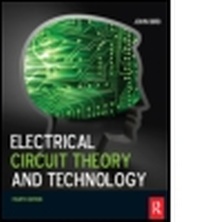
Electrical Circuit Theory and Technology
4th Edition
Published on 16. June 2010
Book
Paperback/Softback
740 pages
978-1-85617-770-2 (ISBN)
Description
A fully comprehensive text for courses in electrical principles, circuit theory, and electrical technology, providing 800 worked examples and over 1000 further problems for students to work through at their own pace. This book is ideal for students studying engineering for the first time as part of BTEC National and other pre-degree vocational courses (especially where progression to higher levels of study is likely), as well as Higher Nationals, Foundation Degrees and first year undergraduate modules.
Now in its fourth edition, this best-selling textbook has been updated with developments in key areas such as semiconductors, transistors, and fuel cells, along with brand new material on ABCD parameters and Fourier's Analysis. Greater emphasis is placed on real-world situations in order to ensure the reader can relate the theory to actual engineering practice. In addition, the text has been restructured throughout so that 175 Exercises now appear at regular intervals, which the student can work through to test their learning of essential concepts and check their progress.
Now in its fourth edition, this best-selling textbook has been updated with developments in key areas such as semiconductors, transistors, and fuel cells, along with brand new material on ABCD parameters and Fourier's Analysis. Greater emphasis is placed on real-world situations in order to ensure the reader can relate the theory to actual engineering practice. In addition, the text has been restructured throughout so that 175 Exercises now appear at regular intervals, which the student can work through to test their learning of essential concepts and check their progress.
Reviews / Votes
"I like the book very much and I would recommend it as a reference. The detailed analysis presented in the book is excellent. The coverage of each topic is excellent. It provides over a thousand sample problems and answers. The answers are given in an orderly step by step manner. The topics are easy to find. The content is concise as it should be in any text book. I highly recommend for electrical engineering students as well as electrical engineers."--Associated ContentMore details
Edition
4th New edition
Language
English
Place of publication
Oxford
United Kingdom
Publishing group
Taylor & Francis Ltd
Target group
College/higher education
First year university students of electrical and electronic engineering, and similar level qualifications such as HNC / HND - 2,971 students in 2008, and Foundation Degree - approx. 5,000 students in 2008.
Typical module titles: Electrical Circuits; Electrical Systems; Radio Frequency Engineering; Communications Systems Principles; Electrical Drives; Power Systems Principles; Networks & Fields; Electrical Principles; Measurement & Analysis; Introduction to Electronics; Transmission Structures; Signals & Systems.
Edition type
New edition
Dimensions
Height: 279 mm
Width: 219 mm
Weight
2200 gr
ISBN-13
978-1-85617-770-2 (9781856177702)
Copyright in bibliographic data and cover images is held by Nielsen Book Services Limited or by the publishers or by their respective licensors: all rights reserved.
Schweitzer Classification
Other editions
New editions
Book
11/2013
5th Edition
Routledge
€70.75
Article exhausted; check for reprint
Previous edition
John Bird
Electrical Circuit Theory and Technology
Book
05/2007
3rd Edition
Newnes
€30.94
Article exhausted; check for reprint
Person
John Bird, the author of over 100 textbooks on engineering and mathematical subjects, is the former Head of Applied Electronics in the Faculty of Technology at Highbury College, Portsmouth, U.K. More recently, he has combined freelance lecturing at Portsmouth University, with technical writing and Chief Examiner responsibilities for City and Guilds Telecommunication Principles and Mathematics, and examining for the International Baccalaureate Organisation. John Bird is currently a Senior Training Provider at the Royal Naval School of Marine Engineering in the Defence College of Marine and Air Engineering at H.M.S. Sultan, Gosport, Hampshire, U.K. The school, which serves the Royal Navy, is one of Europe's largest engineering training establishments.
Content
Preface; Section 1 Basic Electrical Engineering Principles; Units associated with basic electrical quantities; An introduction to electric circuits; Resistance variation; Batteries and alternative sources of energy; Series and parallel networks; Capacitors and capacitance; Magnetic circuits. Electromagnetism; Electromagnetic induction; Electrical measuring instruments and measurements; Semiconductor diodes; Transistors; Main formulae for Part 1; Section 2 Electrical Principles and Technology; D.c. circuit theory; Alternating voltages and currents; Single-phase series a.c. circuits; Single-phase parallel a.c. circuits; D.c. transients; Operational amplifiers; Three phase systems; Transformers; D.c. machines; Three-phase induction motors; Main formulae for Part 2; Part 3 Advanced Circuit Theory and Technology; Revision of complex numbers; Application of complex numbers to series a.c. circuits; Application of complex numbers to parallel a.c. circuits; Power in a.c. circuits; A.c. bridges; Series resonance and Q-factor; Parallel resonance and Q-factor; Introduction to network analysis; Mesh-current and nodal analysis; The superposition theorem; Thevenin's and Norton's theorems; Delta-star and star-delta transformations; Maximum power transfer theorems and impedance matching; Complex waveforms; A numerical method of harmonic analysis; Magnetic materials; Dielectrics and dielectric loss; Field theory; Attenuators; Filter networks; Magnetically coupled circuits; Transmission lines; Transients and Laplace transforms; Main formulae for Part 3; Part 4 General reference; Standard electrical quantities - their symbols and units; Greek alphabet; Common prefixes; Resistor colour coding and ohmic values; Index