

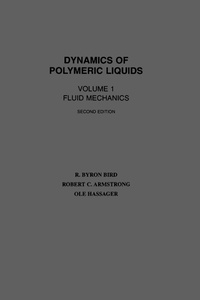
Dynamics of Polymeric Liquids, Volume 1
Fluid Mechanics
2nd Edition
Published on 23. June 1987
Book
Hardback
672 pages
978-0-471-80245-7 (ISBN)
Description
This two-volume work is detailed enough to serve as a text and comprehensive enough to stand as a reference. Volume 1, Fluid Mechanics, summarizes the key experiments that show how polymeric fluids differ from structurally simple fluids, then presents, in rough historical order, various methods for solving polymer fluid dynamics problems. Volume 2, Kinetic Theory, uses molecular models and the methods of statistical mechanics to obtain relations between bulk flow behavior and polymer structure. Includes end-of-chapter problems and extensive appendixes.
More details
Edition
2nd edition
Language
English
Place of publication
United States
Publishing group
John Wiley & Sons Inc
Target group
College/higher education
Professional and scholarly
Product notice
sewn/stitched
Cloth over boards
Dimensions
Height: 260 mm
Width: 183 mm
Thickness: 40 mm
Weight
1440 gr
ISBN-13
978-0-471-80245-7 (9780471802457)
Copyright in bibliographic data and cover images is held by Nielsen Book Services Limited or by the publishers or by their respective licensors: all rights reserved.
Schweitzer Classification
Other editions
Previous edition

R. Byron Bird | etc.
Dynamics of Polymeric Liquids: Fluid Mechanics v.1
Book
02/1977
Wiley
€101.64
Article exhausted; check for reprint
Persons
R. Byron Bird is Vilas Professor of Chemical Engineering at the University of Wisconsin-Madison. He is a coauthor of Dynamics of Polymeric Liquids, 2nd Edition, Volume 2 (Wiley 1987), Molecular Theory of Gases and Liquids, (Wiley, 1954), Transport Phenomena, (Wiley, 1960), and several other books. He received his BS in chemical engineering at the University of Illinois in 1947, and his PhD in physical chemistry at the University of Wisconsin in 1950.
Robert C. Armstrong is Associate Professor of Chemical Engineering at the Massachusetts Institute of Technology. He is a coauthor of Dynamics of Polymeric Liquids, 2nd Edition, Volume 2 (Wiley, 1987). He received his BChE at Georgia Institute of Technology in 1970 and his PhD at the University of Wisconsin in 1973.
Ole Hassager is Lektor at the Danmarks tekniske Hjskole in Lyngby, Denmark. He is a coauthor of Dynamics of Polymeric Liquids, 2nd Edition, Volume 2 (Wiley, 1987). He received his MSc in chemical engineering at the Danmarks tekniske H?jskole in 1970 and his PhD in chemical engineering at the University of Wisconsin in 1973.
Robert C. Armstrong is Associate Professor of Chemical Engineering at the Massachusetts Institute of Technology. He is a coauthor of Dynamics of Polymeric Liquids, 2nd Edition, Volume 2 (Wiley, 1987). He received his BChE at Georgia Institute of Technology in 1970 and his PhD at the University of Wisconsin in 1973.
Ole Hassager is Lektor at the Danmarks tekniske Hjskole in Lyngby, Denmark. He is a coauthor of Dynamics of Polymeric Liquids, 2nd Edition, Volume 2 (Wiley, 1987). He received his MSc in chemical engineering at the Danmarks tekniske H?jskole in 1970 and his PhD in chemical engineering at the University of Wisconsin in 1973.
Content
Newtonian vs Non-Newtonian Behavior.
Elementary Constitutive Equations and Their Use in Solving FluidDynamics Problems.
Nonlinear Viscoelastic Constitutive Equations and Their Use inSolving Fluid Dynamics Problems.
Continuum Mechanics and Its Use in Solving Fluid DynamicsProblems.
Polymer Models and Equilibrium Properties.
Elementary Approach to Kinetic Theory.
A General Phase-Space Kinetic Theory.
Elementary Kinetic Theory for Networks Models.
Elementary Constitutive Equations and Their Use in Solving FluidDynamics Problems.
Nonlinear Viscoelastic Constitutive Equations and Their Use inSolving Fluid Dynamics Problems.
Continuum Mechanics and Its Use in Solving Fluid DynamicsProblems.
Polymer Models and Equilibrium Properties.
Elementary Approach to Kinetic Theory.
A General Phase-Space Kinetic Theory.
Elementary Kinetic Theory for Networks Models.