

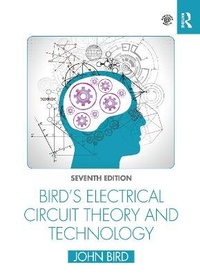
Bird's Electrical Circuit Theory and Technology
7th Edition
Published on 1. October 2021
Book
Hardback
912 pages
978-0-367-67224-9 (ISBN)
Description
Now in its seventh edition, Bird's Electrical Circuit Theory and Technology explains electrical circuit theory and associated technology topics in a straightforward manner, supported by practical engineering examples and applications to ensure that readers can relate theory to practice.
The extensive and thorough coverage, containing over 800 worked examples, makes this an excellent text for a range of courses, in particular for Degree and Foundation Degree in electrical principles, circuit theory, telecommunications, and electrical technology. The text includes some essential mathematics revision, together with all the essential electrical and electronic principles for BTEC National and Diploma syllabuses and City & Guilds Technician Certificate and Diploma syllabuses in engineering. This material will be a great revision for those on higher courses.
This edition includes several new sections, including glass batteries, climate change, the future of electricity production, and discussions concerning everyday aspects of electricity, such as watts and lumens, electrical safety, AC vs DC, and trending technologies.
Its companion website at www.routledge.com/cw/bird provides resources for both students and lecturers, including full solutions for all 1400 further questions, multiple choice questions, lists of essential formulae and bios of famous engineers; as well as full solutions to revision tests, lab experiments, and illustrations for adopting course instructors.
The extensive and thorough coverage, containing over 800 worked examples, makes this an excellent text for a range of courses, in particular for Degree and Foundation Degree in electrical principles, circuit theory, telecommunications, and electrical technology. The text includes some essential mathematics revision, together with all the essential electrical and electronic principles for BTEC National and Diploma syllabuses and City & Guilds Technician Certificate and Diploma syllabuses in engineering. This material will be a great revision for those on higher courses.
This edition includes several new sections, including glass batteries, climate change, the future of electricity production, and discussions concerning everyday aspects of electricity, such as watts and lumens, electrical safety, AC vs DC, and trending technologies.
Its companion website at www.routledge.com/cw/bird provides resources for both students and lecturers, including full solutions for all 1400 further questions, multiple choice questions, lists of essential formulae and bios of famous engineers; as well as full solutions to revision tests, lab experiments, and illustrations for adopting course instructors.
More details
Edition
7th edition
Language
English
Place of publication
London
United Kingdom
Publishing group
Taylor & Francis Ltd
Target group
College/higher education
Adult education
Adult education, Further/Vocational Education, and Undergraduate Core
Illustrations
1109 s/w Abbildungen, 52 s/w Photographien bzw. Rasterbilder, 1057 s/w Zeichnungen, 66 farbige Tabellen
66 Tables, color; 1057 Line drawings, black and white; 52 Halftones, black and white; 1109 Illustrations, black and white
Dimensions
Height: 280 mm
Width: 210 mm
Weight
8720 gr
ISBN-13
978-0-367-67224-9 (9780367672249)
Copyright in bibliographic data and cover images is held by Nielsen Book Services Limited or by the publishers or by their respective licensors: all rights reserved.
Schweitzer Classification
Other editions
Additional editions
Book
10/2021
7th Edition
Routledge
€69.50
Shipment within 15-20 days
E-Book
09/2021
7th Edition
Routledge
€73.99
Available for download
E-Book
09/2021
7th Edition
Routledge
€73.99
Available for download
Previous edition
John Bird
Electrical Circuit Theory and Technology
Book
07/2017
6th Edition
Routledge
€252.55
Withdrawn from sale
Person
John Bird, BSc (Hons), CEng, CMath, CSci, FIMA, FIET, FCollT, is the former Head of Applied Electronics in the Faculty of Technology at Highbury College, Portsmouth, UK. More recently, he has combined freelance lecturing at the University of Portsmouth, with Examiner responsibilities for Advanced Mathematics with City and Guilds and examining for the International Baccalaureate Organisation. He has over 45 years' experience of successfully teaching, lecturing, instructing, training, educating, and planning of trainee engineers study programmes. He is the author of 146 textbooks on engineering, science, and mathematical subjects, with worldwide sales of over one million copies. He is a chartered engineer, a chartered mathematician, a chartered scientist and a Fellow of three professional institutions. He has recently retired from lecturing at the Royal Navy's Defence College of Marine Engineering in the Defence College of Technical Training at H.M.S. Sultan, Gosport, Hampshire, UK, one of the largest engineering training establishments in Europe.
Content
Section 1 Revision of Some Basic Mathematics 1. Some Mathematics Revisio 2. Further Mathematics Revision
Section 2 Basic Electrical and Electronic Engineering Principles 3. Units associated with basic electrical quantities 4. An introduction to electric circuits 5. Resistance variation 6. Batteries and alternative sources of energy 7. Series and parallel networks 8. Capacitors and capacitance 9. Magnetic circuits 10. Electromagnetism 11. Electromagnetic induction 12. Electrical measuring instruments and measurements 13. Semiconductor diodes 14. Transistors Section 3 Electrical Principles and Technology 15. D.c. circuit theory 16. Alternating voltages and currents 17. Single-phase series a.c. circuits 18. Single-phase parallel a.c. circuits 19. D.c. transients 20. Operational amplifiers 21. Global climate change and the future of electricity generation 22. Three-phase systems
23. Transformers 24. D.c. machines 25. Three-phase induction motors Section 4 Advanced circuit theory and technology 26. Revision of complex numbers 27. Application of complex numbers to series a.c. circuits 28. Application of complex numbers to parallel a.c. circuits 29. Power in a.c. circuits 30. A.c. bridges 31. Series resonance and Q-factor 32. Parallel resonance and Q-factor 33. Introduction to network analysis 34. Mesh-current and nodal analysis 35. The superposition theorem 36. Thevenin's and Norton's theorems 37. Delta-star and star-delta transformations 38. Maximum power transfer theorems and impedance matching 39. Complex waveforms 40. A numerical method of harmonic analysis 41. Magnetic materials 42. Dielectrics and dielectric loss 43. Field theory 44. Attenuators 45. Filter networks 46. Magnetically coupled circuits 47. Transmission lines 48. Transients and Laplace transforms Section 5 General reference
Section 2 Basic Electrical and Electronic Engineering Principles 3. Units associated with basic electrical quantities 4. An introduction to electric circuits 5. Resistance variation 6. Batteries and alternative sources of energy 7. Series and parallel networks 8. Capacitors and capacitance 9. Magnetic circuits 10. Electromagnetism 11. Electromagnetic induction 12. Electrical measuring instruments and measurements 13. Semiconductor diodes 14. Transistors Section 3 Electrical Principles and Technology 15. D.c. circuit theory 16. Alternating voltages and currents 17. Single-phase series a.c. circuits 18. Single-phase parallel a.c. circuits 19. D.c. transients 20. Operational amplifiers 21. Global climate change and the future of electricity generation 22. Three-phase systems
23. Transformers 24. D.c. machines 25. Three-phase induction motors Section 4 Advanced circuit theory and technology 26. Revision of complex numbers 27. Application of complex numbers to series a.c. circuits 28. Application of complex numbers to parallel a.c. circuits 29. Power in a.c. circuits 30. A.c. bridges 31. Series resonance and Q-factor 32. Parallel resonance and Q-factor 33. Introduction to network analysis 34. Mesh-current and nodal analysis 35. The superposition theorem 36. Thevenin's and Norton's theorems 37. Delta-star and star-delta transformations 38. Maximum power transfer theorems and impedance matching 39. Complex waveforms 40. A numerical method of harmonic analysis 41. Magnetic materials 42. Dielectrics and dielectric loss 43. Field theory 44. Attenuators 45. Filter networks 46. Magnetically coupled circuits 47. Transmission lines 48. Transients and Laplace transforms Section 5 General reference