

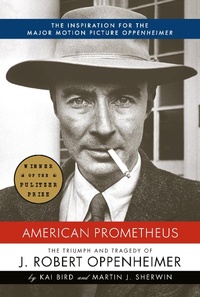
American Prometheus
The Triumph and Tragedy of J. Robert Oppenheimer
Published on 5. April 2005
Book
Hardback
736 pages
978-0-375-41202-8 (ISBN)
Description
"American Prometheus is the first full-scale biography of J. Robert Oppenheimer, "father of the atomic bomb," the brilliant, charismatic physicist who led the effort to capture the awesome fire of the sun for his country in time of war. Immediately after Hiroshima, he became the most famous scientist of his generation-one of the iconic figures of the twentieth century, the embodiment of modern man confronting the consequences of scientific progress.
He was the author of a radical proposal to place international controls over atomic materials-an idea that is still relevant today. He opposed the development of the hydrogen bomb and criticized the Air Force's plans to fight an infinitely dangerous nuclear war. In the now almost-forgotten hysteria of the early 1950s, his ideas were anathema to powerful advocates of a massive nuclear buildup, and, in response, Atomic Energy Commission chairman Lewis Strauss, Superbomb advocate Edward Teller and FBI director J. Edgar Hoover worked behind the scenes to have a hearing board find that Oppenheimer could not be trusted with America's nuclear secrets.
"American Prometheus sets forth Oppenheimer's life and times in revealing and unprecedented detail. Exhaustively researched, it is based on thousands of records and letters gathered from archives in America and abroad, on massive FBI files and on close to a hundred interviews with Oppenheimer's friends, relatives and colleagues.
We follow him from his earliest education at the turn of the twentieth century at New York City's Ethical Culture School, through personal crises at Harvard and Cambridge universities. Then to Germany, where he studied quantum physics with the world's mostaccomplished theorists; and to Berkeley, California, where he established, during the 1930s, the leading American school of theoretical physics, and where he became deeply involved with social justice causes and their advocates, many of whom were communists. Then to Los Alamos, New Mexico, where he transformed a bleak mesa into the world's most potent nuclear weapons laboratory-and where he himself was transformed. And finally, to the Institute for Advanced Study in Princeton, which he directed from 1947 to 1966.
"American Prometheus is a rich evocation of America at midcentury, a new and compelling portrait of a brilliant, ambitious, complex and flawed man profoundly connected to its major events-the Depression, World War II and the Cold War. It is at once biography and history, and essential to our understanding of our recent past-and of our choices for the future.
He was the author of a radical proposal to place international controls over atomic materials-an idea that is still relevant today. He opposed the development of the hydrogen bomb and criticized the Air Force's plans to fight an infinitely dangerous nuclear war. In the now almost-forgotten hysteria of the early 1950s, his ideas were anathema to powerful advocates of a massive nuclear buildup, and, in response, Atomic Energy Commission chairman Lewis Strauss, Superbomb advocate Edward Teller and FBI director J. Edgar Hoover worked behind the scenes to have a hearing board find that Oppenheimer could not be trusted with America's nuclear secrets.
"American Prometheus sets forth Oppenheimer's life and times in revealing and unprecedented detail. Exhaustively researched, it is based on thousands of records and letters gathered from archives in America and abroad, on massive FBI files and on close to a hundred interviews with Oppenheimer's friends, relatives and colleagues.
We follow him from his earliest education at the turn of the twentieth century at New York City's Ethical Culture School, through personal crises at Harvard and Cambridge universities. Then to Germany, where he studied quantum physics with the world's mostaccomplished theorists; and to Berkeley, California, where he established, during the 1930s, the leading American school of theoretical physics, and where he became deeply involved with social justice causes and their advocates, many of whom were communists. Then to Los Alamos, New Mexico, where he transformed a bleak mesa into the world's most potent nuclear weapons laboratory-and where he himself was transformed. And finally, to the Institute for Advanced Study in Princeton, which he directed from 1947 to 1966.
"American Prometheus is a rich evocation of America at midcentury, a new and compelling portrait of a brilliant, ambitious, complex and flawed man profoundly connected to its major events-the Depression, World War II and the Cold War. It is at once biography and history, and essential to our understanding of our recent past-and of our choices for the future.
More details
Language
English
Place of publication
New York
United States
Product notice
Rough front
Illustrations
5 PHOTOS IN TXT;32 PP OF PHOTO
Dimensions
Height: 158 mm
Width: 241 mm
Thickness: 49 mm
Weight
992 gr
ISBN-13
978-0-375-41202-8 (9780375412028)
Copyright in bibliographic data and cover images is held by Nielsen Book Services Limited or by the publishers or by their respective licensors: all rights reserved.
Schweitzer Classification
Other editions
New editions
Kai Bird | Martin J. Sherwin
American Prometheus
The Inspiration for the Major Motion Picture OPPENHEIMER
Book
04/2006
Random House USA Inc
€15.50
Available immediately
Additional editions
Kai Bird | Martin J. Sherwin
American Prometheus (Pulitzer Prize Winner)
The Inspiration for the Major Motion Picture OPPENHEIMER
E-Book
12/2007
Vintage
€16.99
Available for download
Kai Bird | Martin J. Sherwin
American Prometheus
The Inspiration for the Major Motion Picture OPPENHEIMER
Book
04/2006
Random House USA Inc
€15.50
Available immediately
Persons
Kai Bird is the author of The Chairman: John J. McCloy, The Making of the American Establishment and The Color of Truth: McGeorge Bundy and William Bundy, Brothers in Arms. He coedited with Lawrence Lifschultz Hiroshima’s Shadow: Writings on the Denial of History and the Smithsonian Controversy. A contributing editor of The Nation, he lives in Washington, D.C., with his wife and son.
Martin J. Sherwin is the Walter S. Dickson Professor of English and American History at Tufts University and author of A World Destroyed: Hiroshima and Its Legacies, which won the Stuart L. Bernath Prize, as well as the American History Book Prize. He and his wife live in Boston and Washington, D.C.
Martin J. Sherwin is the Walter S. Dickson Professor of English and American History at Tufts University and author of A World Destroyed: Hiroshima and Its Legacies, which won the Stuart L. Bernath Prize, as well as the American History Book Prize. He and his wife live in Boston and Washington, D.C.