


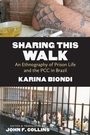
Sharing This Walk
An Ethnography of Prison Life and the PCC in Brazil
Published on 30. November 2016
Book
Hardback
192 pages
978-1-4696-3030-4 (ISBN)
Description
The Primeiro Comando do Capital (PCC) is a Sao Paulo prison gang thatsince the 1990s has expanded into the most powerful criminal network inBrazil. Karina Biondi's rich ethnography of the PCC is uniquely informedby her insider-outsider status. Prior to his acquittal, Biondi's husband wasincarcerated in a PCC-dominated prison for several years. During the periodof Biondi's intense and intimate visits with her husband and her extensivefieldwork in prisons and on the streets of Sao Paulo, the PCC effectively controlledmore than 90 percent of Sao Paulo's 147 prison facilities.
Available for the first time in English, Biondi's riveting portrait of thePCC illuminates how the organisation operates inside and outside of prison,creatively elaborating on a decentered, non-hierarchical, and far-reachingcommand system. This system challenges both the police forces againstwhich the PCC has declared war and the methods and analytic concepts traditionallyemployed by social scientists concerned with crime, incarceration,and policing. Biondi posits that the PCC embodies a "politics of transcendence,"a group identity that is braided together with, but also autonomousfrom, its decentralized parts. Biondi also situates the PCC in relation toredemocratization and rampant socioeconomic inequality in Brazil, as wellas to counter-state movements, crime, and punishment in the Americas.
Available for the first time in English, Biondi's riveting portrait of thePCC illuminates how the organisation operates inside and outside of prison,creatively elaborating on a decentered, non-hierarchical, and far-reachingcommand system. This system challenges both the police forces againstwhich the PCC has declared war and the methods and analytic concepts traditionallyemployed by social scientists concerned with crime, incarceration,and policing. Biondi posits that the PCC embodies a "politics of transcendence,"a group identity that is braided together with, but also autonomousfrom, its decentralized parts. Biondi also situates the PCC in relation toredemocratization and rampant socioeconomic inequality in Brazil, as wellas to counter-state movements, crime, and punishment in the Americas.
More details
Series
Language
English
Place of publication
Chapel Hill
United States
Target group
College/higher education
Illustrations
3 halftones, 1 map
Dimensions
Height: 240 mm
Width: 161 mm
Thickness: 18 mm
Weight
546 gr
ISBN-13
978-1-4696-3030-4 (9781469630304)
Copyright in bibliographic data and cover images is held by Nielsen Book Services Limited or by the publishers or by their respective licensors: all rights reserved.
Schweitzer Classification
Other editions
Additional editions
E-Book
10/2016
The University of North Carolina Press
€23.49
Available for download
Persons
Karina Biondi holds a doctorate in social anthropology from the Federal University of Sao Carlos in Sao Paulo.
Editor and translator John F. Collins is associate professor of anthropology at Queens College and the Graduate Center of the City University of New York and the author of Revolt of the Saints: Memory and Redemption in the Twilight of Brazilian Racial Democracy.
Editor and translator John F. Collins is associate professor of anthropology at Queens College and the Graduate Center of the City University of New York and the author of Revolt of the Saints: Memory and Redemption in the Twilight of Brazilian Racial Democracy.