

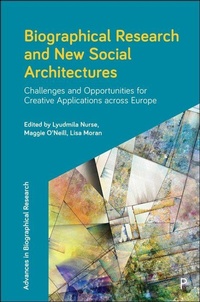
Biographical Research and New Social Architectures
Challenges and Opportunities for Creative Applications across Europe
Policy Press
1st Edition
Published on 23. April 2024
Book
Hardback
246 pages
978-1-4473-6890-8 (ISBN)
Description
What are the building blocks of the new societal architectures after COVID-19? What are the evolving lifestyle patterns, social connections and relationality, and what can biographical research bring to explore these unprecedented societal circumstances?
This first book in the new series Advances in Biographical Research focuses on the place of biographical research in analysing and shaping social futures characterised by physical distancing and isolation, social fragmentation, trauma and vulnerability, including breaks in biographical trajectories.
Written by experienced and early career researchers, it demonstrates how biographical research responds to new societal architectures: theoretically and empirically.
This first book in the new series Advances in Biographical Research focuses on the place of biographical research in analysing and shaping social futures characterised by physical distancing and isolation, social fragmentation, trauma and vulnerability, including breaks in biographical trajectories.
Written by experienced and early career researchers, it demonstrates how biographical research responds to new societal architectures: theoretically and empirically.
Reviews / Votes
"Offering a new lens on the growing literature of biographical research, this book forces us to ask ourselves what living through a pandemic teaches us about exploring the lives of others, especially those who are 'vulnerable' and/or 'at risk'." Molly Andrews, Association for Narrative Research and PracticeMore details
Series
Edition
First Edition
Language
English
Place of publication
Bristol
United Kingdom
Publishing group
Bristol University Press
Target group
Professional and scholarly
Illustrations
5 s/w Abbildungen
5 Illustrations, black and white
Dimensions
Height: 161 mm
Width: 241 mm
Thickness: 20 mm
Weight
514 gr
ISBN-13
978-1-4473-6890-8 (9781447368908)
Copyright in bibliographic data and cover images is held by Nielsen Book Services Limited or by the publishers or by their respective licensors: all rights reserved.
Schweitzer Classification
Other editions
Additional editions
Biographical Research and New Social Architectures
Challenges and Opportunities for Creative Applications across Europe
E-Book
04/2024
1st Edition
Policy Press
€40.99
Available for download
Biographical Research and New Social Architectures
Challenges and Opportunities for Creative Applications across Europe
E-Book
04/2024
1st Edition
Policy Press
€231.99
Available for download
Persons
Lyudmila Nurse is Honorary Research Fellow in the Department of Education at the University of Oxford, and Research Director of Oxford XXI think tank.
Maggie O'Neill is Professor in Sociology and Criminology and Director of the Institute for Social Sciences in the 21st Century and UCC Futures: Collective Social Futures at University College Cork.
Lisa Moran is Dean of Graduate Studies and Head of the Graduate School at the Technological University of the Shannon.
Maggie O'Neill is Professor in Sociology and Criminology and Director of the Institute for Social Sciences in the 21st Century and UCC Futures: Collective Social Futures at University College Cork.
Lisa Moran is Dean of Graduate Studies and Head of the Graduate School at the Technological University of the Shannon.
Contributions
Oxford Brookes University
Maynooth University
Karlsruhe University of Education
Instytut Historii Sztuki UW
Nova University of Lisbon
Instituto Universitario de Lisboa (ISCTE)
Instituto Universitario de Lisboa
Instituto Universitario de Lisboa
Co Director for Pavee Point
Carinthia University of Applied Sciences
Content
Overview: Theorising the New Social Futures through the Lens of the Past.
Part I Facing the New Turn in Biographical Research: Methodological Adaptations to the New Social Context
Chapter 1. Creative Applications of Biographical Research: Time-Space Interactions in Walking Biographical Methods - Maggie O'Neill and Lyudmila Nurse
Chapter 2. Touching from a Distance: Gaining Intimacy with Research Participants during the COVID-19 Pandemic - Ana Caetano, Magda Nico, Anabela Pereira and Sonia Bernardo Correia
Chapter 3. Collaborative (Auto)ethnography (CAE) for Researching (in) New Social Contexts: Reflections from COVID-19 Lockdown Times in Europe - Lisa Moran and Katerina Sidiropulu-Janku
Chapter 4. Technological Mediation of Biographical Research and Its Risks - Jerzy Stachowiak
Part II Creative, Inter-disciplinary and Comparative Approaches
Chapter 5. Walking New Horizons for Critically Reflexive Pedagogy and Research- Jerry O'Neill
Chapter 6. The 'New Normal' for Oral History? Challenge and Opportunities of Interviewing During the Global Pandemic and Its Aftermath - Jakub Galeziowski
Chapter 7. Relations Between Biographical Dispositions and Teaching Strategies of Computer Science Teachers During Lockdown: Application of Triangulation in Biographical Research - Andre Epp
Part III the Multidimensionality of Vulnerability and Risk in Biographical Research: Ethics, Vulnerabilities and Trauma
Chapter 8. Sharing Biographical Vulnerabilities in the Focus Group Setting: Building Solidarities, De-individualising Racism and Protective Silences-Tamsin Barber and Diana Yeh
Chapter 9. Revising the Researcher's "Borders": The Narrator Demands Expansion of the Researcher's "Presence" in Storytelling - Oksana Zabko
Chapter 10. - Research Opportunities and Challenges During COVID-19 - The Case of Volunteer Firefighters - Fabienne Seifert (Germany)
Chapter 11. Challenging Inequalities with Critical Biographical Research Methods - Ciara Bradley & Lynsey Kavanagh
Epilogue: Biographical Futures: Responding to the New Challenges - Lyudmila Nurse, Maggie O'Neill & Lisa Moran
Part I Facing the New Turn in Biographical Research: Methodological Adaptations to the New Social Context
Chapter 1. Creative Applications of Biographical Research: Time-Space Interactions in Walking Biographical Methods - Maggie O'Neill and Lyudmila Nurse
Chapter 2. Touching from a Distance: Gaining Intimacy with Research Participants during the COVID-19 Pandemic - Ana Caetano, Magda Nico, Anabela Pereira and Sonia Bernardo Correia
Chapter 3. Collaborative (Auto)ethnography (CAE) for Researching (in) New Social Contexts: Reflections from COVID-19 Lockdown Times in Europe - Lisa Moran and Katerina Sidiropulu-Janku
Chapter 4. Technological Mediation of Biographical Research and Its Risks - Jerzy Stachowiak
Part II Creative, Inter-disciplinary and Comparative Approaches
Chapter 5. Walking New Horizons for Critically Reflexive Pedagogy and Research- Jerry O'Neill
Chapter 6. The 'New Normal' for Oral History? Challenge and Opportunities of Interviewing During the Global Pandemic and Its Aftermath - Jakub Galeziowski
Chapter 7. Relations Between Biographical Dispositions and Teaching Strategies of Computer Science Teachers During Lockdown: Application of Triangulation in Biographical Research - Andre Epp
Part III the Multidimensionality of Vulnerability and Risk in Biographical Research: Ethics, Vulnerabilities and Trauma
Chapter 8. Sharing Biographical Vulnerabilities in the Focus Group Setting: Building Solidarities, De-individualising Racism and Protective Silences-Tamsin Barber and Diana Yeh
Chapter 9. Revising the Researcher's "Borders": The Narrator Demands Expansion of the Researcher's "Presence" in Storytelling - Oksana Zabko
Chapter 10. - Research Opportunities and Challenges During COVID-19 - The Case of Volunteer Firefighters - Fabienne Seifert (Germany)
Chapter 11. Challenging Inequalities with Critical Biographical Research Methods - Ciara Bradley & Lynsey Kavanagh
Epilogue: Biographical Futures: Responding to the New Challenges - Lyudmila Nurse, Maggie O'Neill & Lisa Moran