

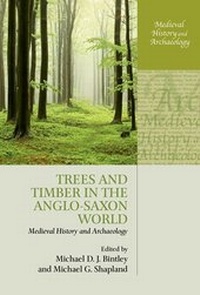
Trees and Timber in the Anglo-Saxon World
Published on 3. October 2013
Book
Hardback
272 pages
978-0-19-968079-5 (ISBN)
Description
Trees were of fundamental importance in Anglo-Saxon society. Anglo-Saxons dwelt in timber houses, relied on woodland as an economic resource, and created a material culture of wood which was at least as meaningfully-imbued, and vastly more prevalent, than the sculpture and metalwork with which we associate them today. Trees held a central place in Anglo-Saxon belief systems, which carried into the Christian period, not least in the figure of the cross itself. Despite this, the transience of trees and timber in comparison to metal and stone has meant that the subject has received comparatively little attention from scholars.
Trees and Timber in the Anglo-Saxon World constitutes the very first collection of essays written about the role of trees in early medieval England, bringing together established specialists and new voices to present an interdisciplinary insight into the complex relationship between the early English and their woodlands. The woodlands of England were not only deeply rooted in every aspect of Anglo-Saxon material culture, as a source of heat and light, food and drink, wood and timber for the construction of tools, weapons, and materials, but also in their spiritual life, symbolic vocabulary, and sense of connection to their beliefs and heritage. These essays do not merely focus on practicalities, such as carpentry techniques and the extent of woodland coverage, but rather explore the place of trees and timber in the intellectual lives of the early medieval inhabitants of England, using evidence from archaeology, place-names, landscapes, and written sources.
Trees and Timber in the Anglo-Saxon World constitutes the very first collection of essays written about the role of trees in early medieval England, bringing together established specialists and new voices to present an interdisciplinary insight into the complex relationship between the early English and their woodlands. The woodlands of England were not only deeply rooted in every aspect of Anglo-Saxon material culture, as a source of heat and light, food and drink, wood and timber for the construction of tools, weapons, and materials, but also in their spiritual life, symbolic vocabulary, and sense of connection to their beliefs and heritage. These essays do not merely focus on practicalities, such as carpentry techniques and the extent of woodland coverage, but rather explore the place of trees and timber in the intellectual lives of the early medieval inhabitants of England, using evidence from archaeology, place-names, landscapes, and written sources.
Reviews / Votes
Overall, this is a fascinating collection, and the editors are to be congratulated on bringing together such an interdisciplinary group of scholars, and maintaining such a tight focus throughout. * Stephen Rippon, Medieval Settlement Research * extremely wide-ranging volume ... presents many intriguing aspects of wood in Anglo-Saxon contexts * Nat Alcock, Society for Medieval Archaeology * This is an important book, nicely structured and well edited. It is fantastic to see such an interdisciplinary approach to Anglo-Saxon studies breaking new ground in our understanding of Early Medieval Britain ... there is much here to fascinate and intrigue * Ethan Doyle White, Time & Mind: The Journal of Archaeology, Consciousness and Culture *More details
Series
Language
English
Place of publication
Oxford
United Kingdom
Target group
College/higher education
Illustrations
39 black and white figures/illustrations
Dimensions
Height: 248 mm
Width: 178 mm
Thickness: 21 mm
Weight
714 gr
ISBN-13
978-0-19-968079-5 (9780199680795)
Copyright in bibliographic data and cover images is held by Nielsen Book Services Limited or by the publishers or by their respective licensors: all rights reserved.
Schweitzer Classification
Other editions
Additional editions
Michael D. J. Bintley | Michael G. Shapland
Trees and Timber in the Anglo-Saxon World
Book
02/2020
Oxford University Press
€52.07
Shipment within 15-20 days
Michael D. J. Bintley | Michael G. Shapland
Trees and Timber in the Anglo-Saxon World
E-Book
10/2013
1st Edition
OUP eBook
€26.49
Available for download
Persons
Michael D. J. Bintley studied a BA in English and an MA in Medieval Literature at UCL, before writing an interdisciplinary PhD thesis on Trees and Woodland in Anglo-Saxon Culture (2009). He lectured at University College London, Birkbeck College, and Corpus Christi College, Oxford, before being appointed Lecturer in Medieval Literature at Canterbury Christ Church University in 2012. His research is interdisciplinary, and focuses primarily on landscapes, religion, and society in early medieval England and Scandinavia.
Michael G. Shapland recently completed his PhD thesis at the Institute of Archaeology, University College London, entitled Buildings of Secular and Religious Lordship: Anglo-Saxon Tower-Nave Churches. He has a background in field archaeology, is an excavator and buildings specialist, and lectures part-time at the University of Winchester. His research focusses on Anglo-Saxon churches and aristocratic practice.
Michael G. Shapland recently completed his PhD thesis at the Institute of Archaeology, University College London, entitled Buildings of Secular and Religious Lordship: Anglo-Saxon Tower-Nave Churches. He has a background in field archaeology, is an excavator and buildings specialist, and lectures part-time at the University of Winchester. His research focusses on Anglo-Saxon churches and aristocratic practice.
Content
TIMBER IN ANGLO-SAXON BUILDING PRACTICE ; PERCEPTIONS OF WOOD AND WOODEN OBJECTS ; TREES AND WOODLAND IN ANGLO-SAXON BELIEF