

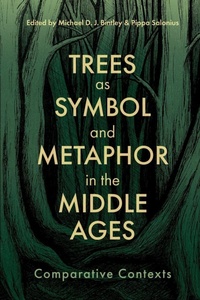
Trees as Symbol and Metaphor in the Middle Ages
Comparative Contexts
Will be published approx. on 7. July 2026
Book
Paperback/Softback
308 pages
978-1-84384-780-9 (ISBN)
Description
WINNER: AFCEMS Prize 2024
Highlights human encounters with the forest and its trees at the time of the European Middle Ages, when their lofty boughs were weighted with meaning.
Forests, with their interlacing networks of trees and secret patterns of communication, are powerful entities for thinking-with. A majestic terrestrial community of arboreal others, their presence echoes, entangles, and resonates deeply with the human world. The essays collected here aim to highlight human encounters with the forest and its trees at the time of the European Middle Ages, when, whether symbol and metaphor, or actual and real, their lofty boughs were weighted with meaning.
The chapters interrogate the pre-Anthropocene environment, reflecting on trees as metaphors for kinship and knowledge as they appear in literary, historical, art-historical, and philosophical sources. They examine images of trees and trees in-themselves across a range of environmental, material, and intellectual contexts, and consider how humans used arboreal and rhizomatic forms to negotiate bodies of knowledge and processes of transition. Looking beyond medieval Europe, they include discussion of parallel developments in the Islamic world and that of the Maori, the indigenous people of New Zealand.
Highlights human encounters with the forest and its trees at the time of the European Middle Ages, when their lofty boughs were weighted with meaning.
Forests, with their interlacing networks of trees and secret patterns of communication, are powerful entities for thinking-with. A majestic terrestrial community of arboreal others, their presence echoes, entangles, and resonates deeply with the human world. The essays collected here aim to highlight human encounters with the forest and its trees at the time of the European Middle Ages, when, whether symbol and metaphor, or actual and real, their lofty boughs were weighted with meaning.
The chapters interrogate the pre-Anthropocene environment, reflecting on trees as metaphors for kinship and knowledge as they appear in literary, historical, art-historical, and philosophical sources. They examine images of trees and trees in-themselves across a range of environmental, material, and intellectual contexts, and consider how humans used arboreal and rhizomatic forms to negotiate bodies of knowledge and processes of transition. Looking beyond medieval Europe, they include discussion of parallel developments in the Islamic world and that of the Maori, the indigenous people of New Zealand.
Reviews / Votes
This profoundly researched, well written, and clearly composed book has been deemed outstanding for its stimulating contribution to a nuanced and profound understanding of the nexus between nature and human creativity as expressed through various media in the visual arts and literature as well as theology and cosmology. * THE JURY OF AFCEMS PRIZE 2024 * Trees as Symbol and Metaphor in the Middle Ages is a milestone in medieval environmental history. A solid work of scholarship, with extensive notes and a full bibliography, it draws together a rich and varied literature on the subject, immersing readers in a world in which the intellectual and spiritual connection between humans and the green "life force" around them was much closer than it is today. * H-NET REVIEWS / H-ENVIRONMENT * Overall, the publication impresses with its diversity of perspectives, which illuminate the arboreal as an aesthetic, material, and epistemological principle of the Middle Ages. Particularly strong are those contributions that productively explore the connection between materiality and idea, or that open up new approaches through intercultural comparisons and epistemic models.Insgesamt besticht die Publikation durch ihre Vielfalt anPerspektiven, mit denen das Arboreal als aesthetisches, materiellesund erkenntnistheoretisches Prinzip des Mittelalters beleuchtetwird. Besonders stark sind jene Beitraege, die die Verbindung vonMaterialitaet und Idee produktiv machen oder durch interkulturelleVergleiche und epistemische Modelle neue Zugaenge eroeffnen. * FRANCIA RECENSIO *
More details
Series
Language
English
Place of publication
Cambridge
United Kingdom
Publishing group
Boydell & Brewer Ltd
Target group
Professional and scholarly
Product notice
Paperback (trade)
Illustrations
4 graphs, 15 colour and 22 b/w illus.
Dimensions
Height: 234 mm
Width: 156 mm
ISBN-13
978-1-84384-780-9 (9781843847809)
Copyright in bibliographic data and cover images is held by Nielsen Book Services Limited or by the publishers or by their respective licensors: all rights reserved.
Schweitzer Classification
Other editions
Additional editions
Michael Bintley | Pippa Salonius
Trees as Symbol and Metaphor in the Middle Ages
Comparative Contexts
Book
03/2024
D.S. Brewer
€138.80
Shipment within 3-4 weeks
Persons
MICHAEL BINTLEY is Associate Professor in Medieval English Literature at the University of Southampton. He is author of Trees in the Religions of Early Medieval England (2015), and Settlements and Strongholds in Early Medieval England: Texts, Landscapes, and Material Culture (2020), and co-author of Landscapes and Environments of the Middle Ages (2023). PIPPA SALONIUS is a medieval art historian and independent scholar who lives in Christchurch, New Zealand.
Content
Introduction: The Surrounding Forest - Michael D. J. Bintley and Pippa Salonius
1. Mother Earth, Sister Moon and the Great Forest of Tane - Pippa Salonius
2. Beowulf's Foliate Margins: The Surrounding Forest in Early Medieval England - Michael D. J. Bintley
3. Bone, Stone, Wood: Encountering Material Ecologies in Early Medieval Sculpture - Meg Boulton
4. 'Mervoillous fu li engineres que croix fist de fust, non de pierre': Materiality and Vernacular Theology in the Wood of the Cross Legend - Laura Chuhan Campbell
5. The Evolution of Relational Tree-Diagrams from the Twelfth to Fourteenth Century: Visual Devices and Models of Knowledge - Jose Higuera Rubio
6. From Forest to Orchard: Arboreal Areas as Mnemotechnic Supports in the Middle Ages - Nais Virenque
7. The Vegetal Imaginary in Exemplary Literature: The Case of the Ci nous dit - Pauline Leplongeon
8. Adam's Sister: Tree Symbolism in Premodern Mystical Islamic Cosmology - Samer Akkach
Concluding Reflections
1. Mother Earth, Sister Moon and the Great Forest of Tane - Pippa Salonius
2. Beowulf's Foliate Margins: The Surrounding Forest in Early Medieval England - Michael D. J. Bintley
3. Bone, Stone, Wood: Encountering Material Ecologies in Early Medieval Sculpture - Meg Boulton
4. 'Mervoillous fu li engineres que croix fist de fust, non de pierre': Materiality and Vernacular Theology in the Wood of the Cross Legend - Laura Chuhan Campbell
5. The Evolution of Relational Tree-Diagrams from the Twelfth to Fourteenth Century: Visual Devices and Models of Knowledge - Jose Higuera Rubio
6. From Forest to Orchard: Arboreal Areas as Mnemotechnic Supports in the Middle Ages - Nais Virenque
7. The Vegetal Imaginary in Exemplary Literature: The Case of the Ci nous dit - Pauline Leplongeon
8. Adam's Sister: Tree Symbolism in Premodern Mystical Islamic Cosmology - Samer Akkach
Concluding Reflections