

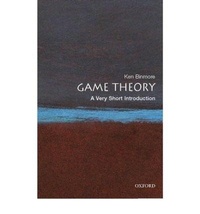
Game Theory: A Very Short Introduction
A Very Short Introduction
Published on 25. October 2007
Book
Paperback/Softback
200 pages
978-0-19-921846-2 (ISBN)
Description
Games are played everywhere: from economics and online auctions to social interactions, and game theory is about how to play such games in a rational way, and how to maximize their outcomes. This VSI reveals, without mathematical equations, the insights the theory can bring to everything from how to play poker optimally to the sex ratio among bees.
More details
Other editions
Additional editions
Person
Ken Binmore is Emeritus Professor of Economics at University College, London. He has held Chairs in Economics at LSE, the University of Michigan and UCL, and is a Visiting Professor of Economics at the University of Bristol and a Fellow of the Centre for Philosophy at LSE. He began his academic career as a pure mathematician before becoming interested in game theory. Since that time, he has devoted himself to the subject, in particular designing major telecom
auctions in many countries across the world. As a consequence of the £23.4 billion pounds raised by the telecom auction he organized in the UK, he was described by Newsweek magazine as the "ruthless, poker-playing economist who destroyed the telecom industry ". But he nowadays devotes his time to applying
game theory to the problem of the evolution of morality. The most recent of his numerous books is Playing for Real (Oxford, 2007).
Content
Preface ; 1. The Name of the Game ; 2. Chance ; 3. Time ; 4. Convention ; 5. Reciprocity ; 6. Information ; 7. Auctions ; 8. Biology ; 9. Bargaining and Coalitions ; 10. Puzzles and Paradoxes