

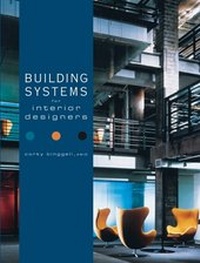
Building Systems for Interior Designers
1st Edition
Published on 2. December 2002
Book
Hardback
464 pages
978-0-471-41733-0 (ISBN)
Description
* Examines engineering issues to make them accessible to interior designers.
* Covered material includes acoustics, fire protection, and universal design.
More details
Edition
1., Auflage
Language
English
Place of publication
New York
United States
Publishing group
John Wiley and Sons Ltd
Target group
College/higher education
Professional and scholarly
Edition type
New edition
Illustrations
Illustrations
Dimensions
Height: 28.6 cm
Width: 22.1 cm
Weight
1304 gr
ISBN-13
978-0-471-41733-0 (9780471417330)
Schweitzer Classification
Other editions
New editions
Corky Binggeli
Building Systems for Interior Designers
Book
06/2009
2nd Edition
Wiley
€102.00
Article exhausted; check for reprint
Additional editions
Corky Binggeli
Building Systems for Interior Designers
E-Book
01/2003
Wiley
€63.99
Available for download
Person
CORKY BINGGELI, ASID, is a principal at Corky Binggeli Interior Design in Boston and an adjunct lecturer at Wentworth Institute of Technology in Boston.
Content
Preface.
Acknowledgments.
PART I: THE BIG PICTURE.
Chapter 1 Natural Resources.
Chapter 2 Building Site Conditions.
Chapter 3 Designing for Building Functions.
Chapter 4 The Human Body and the Built Environment.
Chapter 5 Building Codes.
PART II: WATER AND WASTES.
Chapter 6 Sources of Water.
Chapter 7 Water Quality.
Chapter 8 Water Distribution.
Chapter 9 Hot Water.
Chapter 10 Waste Plumbing.
Chapter 11 Treating and Recycling Water.
Chapter 12 Recycling Solid Wastes.
Chapter 13 Plumbing Fixtures.
Chapter 14 Designing Bath and Toilet Rooms.
PART III: THERMAL COMFORT.
Chapter 15 Principles of Thermal Comfort.
Chapter 16 Thermal Capacity and Resistance.
Chapter 17 Humidity.
Chapter 18 Mechanical Engineering Design Process.
Chapter 19 Indoor Air Contaminants.
Chapter 20 Designing for Indoor Air Quality.
Chapter 21 Ventilation.
Chapter 22 Fenestration.
Chapter 23 Solar Heating.
PART IV: HEATING AND COOLING SYSTEMS.
Chapter 24 Heating Systems.
Chapter 25 Cooling.
Chapter 26 Heating,Ventilating, and Air-Conditioning (HVAC) Systems.
PART V: ELECTRICITY.
Chapter 27 How Electrical Systems Work.
Chapter 28 Electrical Service Equipment.
Chapter 29 Electrical Circuit Design.
Chapter 30 Electrical Wiring and Distribution.
Chapter 31 Receptacles and Switches.
Chapter 32 Residential Appliances.
PART VI: LIGHTING.
Chapter 33 Daylighting.
Chapter 34 Lighting Design.
Chapter 35 Lighting for Specific Spaces.
PART VII: SECURITY AND COMMUNICATIONS SYSTEMS.
Chapter 36 Communications and Control Systems.
Chapter 37 Securing the Building.
Chapter 38 Systems for Private Residences.
Chapter 39 Other Security and Communications Applications.
Chapter 40 Office Communications Systems.
PART VIII: FIRE SAFETY.
Chapter 41 Principles of Fire Safety.
Chapter 42 Design for Fire Safety.
Chapter 43 Escape Routes.
Chapter 44 Limiting Fuels.
Chapter 45 Fire Suppression.
Chapter 46 Fire Detection and Alarms.
PART IX: CONVEYING SYSTEMS.
Chapter 47 Elevators.
Chapter 48 Escalators.
Chapter 49 Materials Handling.
PART X: ACOUSTICS.
Chapter 50 Acoustic Principles.
Chapter 51 Acoustic Design.
Chapter 52 Sound Absorption Within a Space.
Chapter 53 Sound Transmission Between Spaces.
Chapter 54 Acoustic Applications.
Chapter 55 Electronic Sound Systems.
Index.