

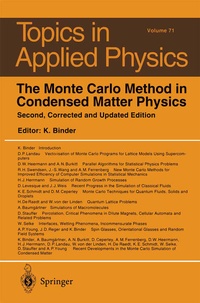
The Monte Carlo Method in Condensed Matter Physics
2nd Edition
Published on 1. December 1995
Book
Paperback/Softback
XX, 420 pages
978-3-540-60174-6 (ISBN)
Description
Alongside experimental and theoretical work, computer simulation now forms one of the major tools of research in physics. The Monte Carlo method is the most important simulation method in the area of condensed matter physics. This book, written by foremost experts in the field, describes the state of the art of simulation methods in solid state physics. It also reviews selected applications in areas of particular current interest like simulations of growth processes far from equilibrium, interfacial phenomena, quantum and classical fluids, polymers, quantum problems on lattices, and random systems. A new chapter on recent developments in the Monte Carlo simulation of condensed matter has been attached.
More details
Series
Edition
2nd ed. 1995
Language
English
Place of publication
Berlin
Germany
Publishing group
Springer Berlin
Target group
Professional and scholarly
Research
Edition type
Revised edition
Illustrations
43 s/w Abbildungen
XX, 420 p. 43 illus.
Dimensions
Height: 235 mm
Width: 155 mm
Thickness: 24 mm
Weight
668 gr
ISBN-13
978-3-540-60174-6 (9783540601746)
DOI
10.1007/3-540-60174-0
Schweitzer Classification
Other editions
Previous edition

Book
03/1992
Springer
€85.59
Article exhausted; check for reprint
Content
Vectorisation of Monte Carlo programs for lattice models using supercomputers.- Parallel algorithms for statistical physics problems.- New monte carlo methods for improved efficiency of computer simulations in statistical mechanics.- Simulation of random growth processes.- Recent progress in the simulation of classical fluids.- Monte Carlo techniques for quantum fluids, solids and droplets.- Quantum lattice problems.- Simulations of macromolecules.- Percolation, critical phenomena in dilute magnets, cellular automata and related problems.- Interfaces, wetting phenomena, incommensurate phases.- Spin glasses, orientational glasses and random field systems.- Recent developments in the Monte Carlo simulation of condensed matter.