

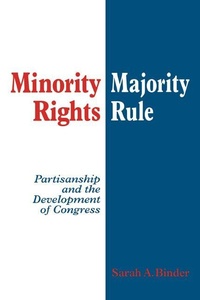
Minority Rights, Majority Rule
Partisanship and the Development of Congress
Published on 13. June 1997
Book
Paperback/Softback
256 pages
978-0-521-58792-1 (ISBN)
Description
Minority Rights, Majority Rule seeks to explain a phenomenon evident to most observers of the US Congress. In the House of Representatives, majority parties rule and minorities are seldom able to influence national policy making. In the Senate, minorities quite often call the shots, empowered by the filibuster to frustrate the majority. Why did the two chambers develop such distinctive legislative styles? Conventional wisdom suggests that differences in the size and workload of the House and Senate led the two chambers to develop very different rules of procedure. Sarah Binder offers an alternative, partisan theory to explain the creation and suppression of minority rights, showing that contests between partisan coalitions have throughout congressional history altered the distribution of procedural rights. Most importantly, new majorities inherit procedural choices made in the past. This institutional dynamic has fuelled the power of partisan majorities in the House but stopped them in their tracks in the Senate.
Reviews / Votes
"This is an extremely interesting book and one in which the author makes a convincing case for her various positions. It will I am sure, be accepted for a long time as an important contribution to the history of the U.S. Congress, to the study of American Congressional Politics, and to our understanding of institutionalization processes in the United States." Allen G. Bogue, H-Net Reviews "Binder's use of history makes the development of minority party rights come alive." Alison D. Howard, LSS Newsletter "In an age when partisan politics and congressional gridlock are under attack, Sarah A. Binder's stufy of procedural change in the House of Representatives and the Senate is most timely. Political historians will find this succinct, never overstated study valuable. Scrupulously documented, it is based on a thorough study of congressional sources such as the Congressional Globe and the Congressional Record, as well as works in political science." Donald B. Cole, The Journal of American HistoryMore details
Language
English
Place of publication
Cambridge
United Kingdom
Target group
Professional and scholarly
College/higher education
Product notice
Paperback (trade)
Illustrations
23 Tables, unspecified; 15 Line drawings, unspecified
Dimensions
Height: 229 mm
Width: 152 mm
Thickness: 15 mm
Weight
421 gr
ISBN-13
978-0-521-58792-1 (9780521587921)
Copyright in bibliographic data and cover images is held by Nielsen Book Services Limited or by the publishers or by their respective licensors: all rights reserved.
Schweitzer Classification
Other editions
Additional editions
Book
06/1997
Cambridge University Press
€124.60
Shipment within 15-20 days
Person
Content
1. The partisan basis of procedural choice; 2. The evolving concepts of house and Senate minority rights; 3. Procedural choice in the early congress: the case of the Previous Question; 4. Allocating minority rights in the house, 1789-1990; 5. Institutionalizing party in the nineteenth century house; 6. Stacking the partisan decks in the twentieth century house; 7. Inherited rules and procedural choice in the Senate; 8. Assessing the partisan theory; Appendices; References.