

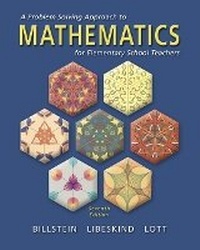
A Problem Solving Approach to Mathematics for Elementary School Teachers
7th Edition
Published on 25. September 2000
Book
Hardback
928 pages
978-0-201-34730-2 (ISBN)
Description
This best-selling text emphasizes solid mathematics content, problem-solving skills, and analytical techniques. The seventh edition focuses on the National Council of Teachers of Mathematics (NCTM) Principles and Standards 2000. The text allows for a variety of approaches to teaching, encourages discussion and collaboration among students and with their instructors, allows for the integration of projects into the curriculum, and promotes discovery and active learning. Students using this text will receive solid preparation in mathematics, develop confidence in their math skills and benefit from teaching and learning techniques that really work.
More details
Edition
7th edition
Language
English
Place of publication
United States
Publishing group
Pearson Education (US)
Target group
Professional and scholarly
Dimensions
Height: 260 mm
Width: 210 mm
Thickness: 30 mm
Weight
1688 gr
ISBN-13
978-0-201-34730-2 (9780201347302)
Copyright in bibliographic data and cover images is held by Nielsen Book Services Limited or by the publishers or by their respective licensors: all rights reserved.
Schweitzer Classification
Other editions
Previous edition

Rick Billstein | Shlomo Libeskind | Johnny Lott
Problem Solving Approach to Mathematics for Elementary School Teachers
Book
10/1998
6th Edition
Pearson
€80.46
Article exhausted; check for reprint
Content
(Each chapter begins with a "Preliminary Problem" and concludes with a "Hint for Solution to the Preliminary Problem," "Questions from the Classroom," "Chapter Outline," "Chapter Review," and a "Selected Biography.")(*indicates optional section.)
1. An Introduction to Problem Solving.
Explorations with Patterns.
Mathematics and Problem Solving.
Algebraic Thinking.
*Logic: An Introduction.
2. Sets, Whole Numbers and Functions.
Describing Sets.
Other Set Operations and Their Properties.
Addition and Subtraction of Whole-Numbers.
Multiplication and Division of Whole-Numbers.
Functions.
3. Whole Number Computation.
Numeration Systems.
Algorithms for Whole-Number Addition and Subtraction.
Algorithms for Whole-Number Multiplication and Division.
Mental Mathematics and Estimation for Whole-Number Operations.
4. Integers and Number Theory.
Integers and the Operations of Addition and Subtraction.
Multiplication and Division of Integers.
Divisibility.
Prime and Composite Numbers.
Greatest Common Divisor and Least Common Multiple.
*Clock and Modular Arithmetic.
5. Rational Numbers as Fractions.
The Set of Rational Numbers.
Addition and Subtraction of Rational Numbers.
Multiplication and Division of Rational Numbers.
Proportional Reasoning.
6. Decimals, Percents, and Real Numbers.
Introduction to Decimals.
Operations on Decimals.
Nonterminating Decimals.
Percents.
*Computing Interest.
Real Numbers.
7. Probability.
How Probabilities Are Determined.
Multistage Experiments with Tree Diagrams and Geometric Probabilities.
Using Simulations in Probability.
Odds and Expected Value.
Methods of Counting.
8. Statistics: An Introduction.
Statistical Graphs.
Measures of Central Tendency and Variation.
Abuses of Statistics.
9. Introductory Geometry.
Basic Notions.
Polygons.
More About Angles.
Geometry in Three Dimensions.
*Networks.
10. Constructions, Congruence and Similarity.
Congruence Through Constructions.
Other Congruence Properties.
Other Constructions.
Similar Triangles and Similar Figures.
Lines in a Cartesian Coordinate System.
11. Concepts of Measurement.
Linear Measure.
Areas of Polygons and Circles.
The Pythagorean Theorem.
Surface Areas.
Volume, Mass, and Temperature.
12. Motion Geometry and Tessellations.
Translations and Rotations.
Reflections and Glide Reflections.
Size Transformations.
Symmetries.
*Tessellations of the Plane.
Appendix I. Logo Turtle Graphics.
Appendix II. Graphing Calculators.
Appendix III. Using a Geometry Drawing Utility.
Appendix IV. Using a Spreadsheet.
Answers to Selected Problems.
Index.
1. An Introduction to Problem Solving.
Explorations with Patterns.
Mathematics and Problem Solving.
Algebraic Thinking.
*Logic: An Introduction.
2. Sets, Whole Numbers and Functions.
Describing Sets.
Other Set Operations and Their Properties.
Addition and Subtraction of Whole-Numbers.
Multiplication and Division of Whole-Numbers.
Functions.
3. Whole Number Computation.
Numeration Systems.
Algorithms for Whole-Number Addition and Subtraction.
Algorithms for Whole-Number Multiplication and Division.
Mental Mathematics and Estimation for Whole-Number Operations.
4. Integers and Number Theory.
Integers and the Operations of Addition and Subtraction.
Multiplication and Division of Integers.
Divisibility.
Prime and Composite Numbers.
Greatest Common Divisor and Least Common Multiple.
*Clock and Modular Arithmetic.
5. Rational Numbers as Fractions.
The Set of Rational Numbers.
Addition and Subtraction of Rational Numbers.
Multiplication and Division of Rational Numbers.
Proportional Reasoning.
6. Decimals, Percents, and Real Numbers.
Introduction to Decimals.
Operations on Decimals.
Nonterminating Decimals.
Percents.
*Computing Interest.
Real Numbers.
7. Probability.
How Probabilities Are Determined.
Multistage Experiments with Tree Diagrams and Geometric Probabilities.
Using Simulations in Probability.
Odds and Expected Value.
Methods of Counting.
8. Statistics: An Introduction.
Statistical Graphs.
Measures of Central Tendency and Variation.
Abuses of Statistics.
9. Introductory Geometry.
Basic Notions.
Polygons.
More About Angles.
Geometry in Three Dimensions.
*Networks.
10. Constructions, Congruence and Similarity.
Congruence Through Constructions.
Other Congruence Properties.
Other Constructions.
Similar Triangles and Similar Figures.
Lines in a Cartesian Coordinate System.
11. Concepts of Measurement.
Linear Measure.
Areas of Polygons and Circles.
The Pythagorean Theorem.
Surface Areas.
Volume, Mass, and Temperature.
12. Motion Geometry and Tessellations.
Translations and Rotations.
Reflections and Glide Reflections.
Size Transformations.
Symmetries.
*Tessellations of the Plane.
Appendix I. Logo Turtle Graphics.
Appendix II. Graphing Calculators.
Appendix III. Using a Geometry Drawing Utility.
Appendix IV. Using a Spreadsheet.
Answers to Selected Problems.
Index.