

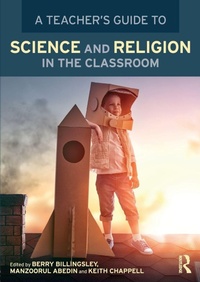
A Teacher's Guide to Science and Religion in the Classroom
1st Edition
Published on 16. February 2018
Book
Paperback/Softback
180 pages
978-1-138-21182-7 (ISBN)
Description
A Teacher's Guide to Science and Religion in the Classroom provides practical guidance on how to help children access positive ways of thinking about the relationship between science and religion. Written for teachers of children from diverse-faith and non-faith backgrounds, it explores key concepts, identifies gaps and common misconceptions in children's knowledge, and offers advice on how to help them form a deeper understanding of both science and religion.
Drawing on the latest research as well as the designs of successful workshops for teachers and for children, there are activities in each chapter that have been shown to help children understand why science and religion do not necessarily conflict. The book highlights children's interest in the so-called "Big Questions" that bridge science and religion and responds to the research finding that most children are missing ideas that are key to an explanation of why science and religion can be harmonious.
The book explores key concepts and ideas including:
Nature of science
Power and limits of science
Evolution, genes and human improvement
Miracles, natural disasters and mystery
Profiles of scientists, including Galileo and Newton
A Teacher's Guide to Science and Religion is an essential companion for preservice and practising teachers, providing session plans and pedagogic strategies, together with a cohesive framework, that will support teachers in fostering children's curiosity and enthusiasm for learning.
Drawing on the latest research as well as the designs of successful workshops for teachers and for children, there are activities in each chapter that have been shown to help children understand why science and religion do not necessarily conflict. The book highlights children's interest in the so-called "Big Questions" that bridge science and religion and responds to the research finding that most children are missing ideas that are key to an explanation of why science and religion can be harmonious.
The book explores key concepts and ideas including:
Nature of science
Power and limits of science
Evolution, genes and human improvement
Miracles, natural disasters and mystery
Profiles of scientists, including Galileo and Newton
A Teacher's Guide to Science and Religion is an essential companion for preservice and practising teachers, providing session plans and pedagogic strategies, together with a cohesive framework, that will support teachers in fostering children's curiosity and enthusiasm for learning.
More details
Language
English
Place of publication
London
United Kingdom
Publishing group
Taylor & Francis Ltd
Target group
Professional and scholarly
Professional and Professional Practice & Development
Illustrations
7 s/w Photographien bzw. Rasterbilder, 24 s/w Zeichnungen, 4 s/w Tabellen
4 Tables, black and white; 24 Line drawings, black and white; 7 Halftones, black and white
Dimensions
Height: 246 mm
Width: 174 mm
Thickness: 11 mm
Weight
360 gr
ISBN-13
978-1-138-21182-7 (9781138211827)
Copyright in bibliographic data and cover images is held by Nielsen Book Services Limited or by the publishers or by their respective licensors: all rights reserved.
Schweitzer Classification
Other editions
Additional editions
Berry Billingsley | Manzoorul Abedin | Keith Chappell
A Teacher's Guide to Science and Religion in the Classroom
Book
02/2018
1st Edition
Routledge
€206.10
Shipment within 10-20 days
Berry Billingsley | Manzoorul Abedin | Keith Chappell
A Teacher's Guide to Science and Religion in the Classroom
E-Book
01/2018
Routledge
€40.99
Available for download
Berry Billingsley | Manzoorul Abedin | Keith Chappell
A Teacher's Guide to Science and Religion in the Classroom
E-Book
01/2018
1st Edition
Routledge
€40.99
Available for download
Persons
Berry Billingsley is Professor of Science Education at Canterbury Christ Church University and Principal Investigator of LASAR (Learning about Science and Religion). Berry has also worked in media producing science shows for children, and has led teacher education programmes in science teaching and related national and international research.
Manzoorul Abedin is a Research Fellow with LASAR at the Faculty of Education, Canterbury Christ Church University. He specialises in designing and presenting teacher education sessions and in addition, children's workshops on questions bridging science and religion.
Keith Chappell is a biologist and theologian. He teaches ecology and evolutionary biology and is currently an Associate Fellow with LASAR, Canterbury Christ Church University.
Manzoorul Abedin is a Research Fellow with LASAR at the Faculty of Education, Canterbury Christ Church University. He specialises in designing and presenting teacher education sessions and in addition, children's workshops on questions bridging science and religion.
Keith Chappell is a biologist and theologian. He teaches ecology and evolutionary biology and is currently an Associate Fellow with LASAR, Canterbury Christ Church University.
Content
Chapter 1: Introduction Chapter 2: All You Need it Science, Or Is It?: Exploring scientific, theological, and other 'ways of knowing' Chapter 3: Creating Linkages: You don't have to reinvent the curriculum! Chapter 4: How science changes over time Chapter 5: Unleashing wonder and mystery in the classroom Chapter 6: Storytelling and Galileo Chapter 7: How scientific is that?: A practical guide to discuss the power and limitations of science in secondary schools Chapter 8: Isaac Newton Chapter 9: Evolution Chapter 10: Miracles Chapter 11: God and Natural Disasters Chapter 12: Science at the Movies: Remediating the Misconceptions and Developing Ethical Reasoning Chapter 13: Beyond Experimentation Chapter 14: Genes, Determinism and Human Improvement Chapter 15: How do I obtain Reliable Knowledge about the World? Chapter 16: Awe and Wonder in Science Chapter 17: Evolution and Religion Chapter 18: Thinking Beyond the Classroom