

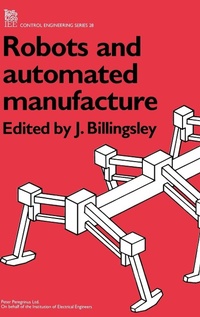
Robots and Automated Manufacture
Published on 30. June 1985
Book
Hardback
248 pages
978-0-86341-053-6 (ISBN)
Description
To serve its purpose, an industrial robot must be harnessed to a manufacturing task, be it welding, assembly, adjustment or the inspection of food products. Complex tasks are likely to require offline programming, both for economy of equipment use and to permit computer simulations for collision avoidance. Vision and other sensory systems are helping to extend the capabilities of robots, while advanced programming techniques are making their use more accessible to the shop floor.
The authors have addressed these and many other subjects in a volume which will be of value to industry and to robotic researchers alike.
The authors have addressed these and many other subjects in a volume which will be of value to industry and to robotic researchers alike.
More details
Series
Language
English
Place of publication
Stevenage
United Kingdom
Target group
College/higher education
Professional and scholarly
Product notice
sewn/stitched
Cloth over boards
Dimensions
Height: 240 mm
Width: 161 mm
Thickness: 18 mm
Weight
542 gr
ISBN-13
978-0-86341-053-6 (9780863410536)
Copyright in bibliographic data and cover images is held by Nielsen Book Services Limited or by the publishers or by their respective licensors: all rights reserved.
Schweitzer Classification
Person
For twenty years and more, John Billingsley's research has concerned the exploitation of on-line computer systems. In Cambridge he led a team pioneering the use of multiple linked single-board minicomputers for control system simulation and for research into the optimisation of hierarchical systems. He now heads a robotics group at Portsmouth Polytechnic researching into such topics as the 'Craftsman Robot' for intelligent adjustment of a factory product, and the development of a six-legged mobile robot base. He maintains a close contact with industry, and a number of his designs are in regular production.
A member of several IEE committees, he has organised many colloquia concerning robotics and microcomputer applications. He is the author of two books on experimental robotics for microcomputer enthusiasts, and for some years has organised the Euromouse Maze contest, for small robot vehicles. He has been a consultant to the BBC television series 'The Computer Programme', and to Thames Television's 'Database'.
A member of several IEE committees, he has organised many colloquia concerning robotics and microcomputer applications. He is the author of two books on experimental robotics for microcomputer enthusiasts, and for some years has organised the Euromouse Maze contest, for small robot vehicles. He has been a consultant to the BBC television series 'The Computer Programme', and to Thames Television's 'Database'.
Content
Chapter 1: A novel steering mechanism for legged robots
Chapter 2: The use of simulation in the off-line programming of robots
Chapter 3: The practical problems involved in off-line programming a robot from a CAD system
Chapter 4: The application of rule based methods to inspection and quality control in a manufacturing process
Chapter 5: Automatic location editing of assembly robot programs
Chapter 6: Dynamic analysis of industrial robots using decentralised control via kinematics
Chapter 7: Collision avoidance between robots operating in the same cell
Chapter 8: Flexible automated assembly systems
Chapter 9: Autonomous assembly devices and related control strategies
Chapter 10: An aid to effective off-line programming of assembly robots
Chapter 11: Robot force sensing using stochastic monitoring of the actuator torque
Chapter 12: Precise measurement of radial dimensions in automatic visual inspection and quality control-a new approach
Chapter 13: Visual feedback control for orientating parts in an assembly robot cycle
Chapter 14: Automation and robotisation in welding-the UK scene
Chapter 15: Practical industrial low cost vision for welding robots and automated welding machines
Chapter 16: A high-speed pattern recognition system for robotic applications
Chapter 17: A vision system for the identification of motor car headlamp reflectors for robotic assembly
Chapter 2: The use of simulation in the off-line programming of robots
Chapter 3: The practical problems involved in off-line programming a robot from a CAD system
Chapter 4: The application of rule based methods to inspection and quality control in a manufacturing process
Chapter 5: Automatic location editing of assembly robot programs
Chapter 6: Dynamic analysis of industrial robots using decentralised control via kinematics
Chapter 7: Collision avoidance between robots operating in the same cell
Chapter 8: Flexible automated assembly systems
Chapter 9: Autonomous assembly devices and related control strategies
Chapter 10: An aid to effective off-line programming of assembly robots
Chapter 11: Robot force sensing using stochastic monitoring of the actuator torque
Chapter 12: Precise measurement of radial dimensions in automatic visual inspection and quality control-a new approach
Chapter 13: Visual feedback control for orientating parts in an assembly robot cycle
Chapter 14: Automation and robotisation in welding-the UK scene
Chapter 15: Practical industrial low cost vision for welding robots and automated welding machines
Chapter 16: A high-speed pattern recognition system for robotic applications
Chapter 17: A vision system for the identification of motor car headlamp reflectors for robotic assembly