

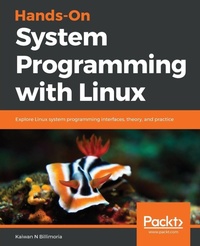
Hands-On System Programming with Linux
Explore Linux system programming interfaces, theory, and practice
Published on 31. October 2018
Book
Paperback/Softback
794 pages
978-1-78899-847-5 (ISBN)
Description
Get up and running with system programming concepts in Linux
Key Features
Acquire insight on Linux system architecture and its programming interfaces
Get to grips with core concepts such as process management, signalling and pthreads
Packed with industry best practices and dozens of code examples
Book DescriptionThe Linux OS and its embedded and server applications are critical components of today's software infrastructure in a decentralized, networked universe. The industry's demand for proficient Linux developers is only rising with time. Hands-On System Programming with Linux gives you a solid theoretical base and practical industry-relevant descriptions, and covers the Linux system programming domain. It delves into the art and science of Linux application programming- system architecture, process memory and management, signaling, timers, pthreads, and file IO.
This book goes beyond the use API X to do Y approach; it explains the concepts and theories required to understand programming interfaces and design decisions, the tradeoffs made by experienced developers when using them, and the rationale behind them. Troubleshooting tips and techniques are included in the concluding chapter.
By the end of this book, you will have gained essential conceptual design knowledge and hands-on experience working with Linux system programming interfaces.What you will learn
Explore the theoretical underpinnings of Linux system architecture
Understand why modern OSes use virtual memory and dynamic memory APIs
Get to grips with dynamic memory issues and effectively debug them
Learn key concepts and powerful system APIs related to process management
Effectively perform file IO and use signaling and timers
Deeply understand multithreading concepts, pthreads APIs, synchronization and scheduling
Who this book is forHands-On System Programming with Linux is for Linux system engineers, programmers, or anyone who wants to go beyond using an API set to understanding the theoretical underpinnings and concepts behind powerful Linux system programming APIs. To get the most out of this book, you should be familiar with Linux at the user-level logging in, using shell via the command line interface, the ability to use tools such as find, grep, and sort. Working knowledge of the C programming language is required. No prior experience with Linux systems programming is assumed.
Key Features
Acquire insight on Linux system architecture and its programming interfaces
Get to grips with core concepts such as process management, signalling and pthreads
Packed with industry best practices and dozens of code examples
Book DescriptionThe Linux OS and its embedded and server applications are critical components of today's software infrastructure in a decentralized, networked universe. The industry's demand for proficient Linux developers is only rising with time. Hands-On System Programming with Linux gives you a solid theoretical base and practical industry-relevant descriptions, and covers the Linux system programming domain. It delves into the art and science of Linux application programming- system architecture, process memory and management, signaling, timers, pthreads, and file IO.
This book goes beyond the use API X to do Y approach; it explains the concepts and theories required to understand programming interfaces and design decisions, the tradeoffs made by experienced developers when using them, and the rationale behind them. Troubleshooting tips and techniques are included in the concluding chapter.
By the end of this book, you will have gained essential conceptual design knowledge and hands-on experience working with Linux system programming interfaces.What you will learn
Explore the theoretical underpinnings of Linux system architecture
Understand why modern OSes use virtual memory and dynamic memory APIs
Get to grips with dynamic memory issues and effectively debug them
Learn key concepts and powerful system APIs related to process management
Effectively perform file IO and use signaling and timers
Deeply understand multithreading concepts, pthreads APIs, synchronization and scheduling
Who this book is forHands-On System Programming with Linux is for Linux system engineers, programmers, or anyone who wants to go beyond using an API set to understanding the theoretical underpinnings and concepts behind powerful Linux system programming APIs. To get the most out of this book, you should be familiar with Linux at the user-level logging in, using shell via the command line interface, the ability to use tools such as find, grep, and sort. Working knowledge of the C programming language is required. No prior experience with Linux systems programming is assumed.
More details
Language
English
Place of publication
Birmingham
United Kingdom
Target group
Professional and scholarly
US School Grade: College Graduate Student
Dimensions
Height: 235 mm
Width: 191 mm
Thickness: 43 mm
Weight
1453 gr
ISBN-13
978-1-78899-847-5 (9781788998475)
Copyright in bibliographic data and cover images is held by Nielsen Book Services Limited or by the publishers or by their respective licensors: all rights reserved.
Schweitzer Classification
Other editions
Additional editions
Kaiwan N. Billimoria | Tigran Aivazian
Hands-On System Programming with Linux
Explore Linux system programming interfaces, theory, and practice
E-Book
09/2024
Packt Publishing
€38.99
Available for download
Persons
Kaiwan N. Billimoria taught himself BASIC programming on his dad's IBM PC back in 1983. He was programming in C and Assembly on DOS until he discovered the joys of Unix, and by around 1997, Linux!
Kaiwan has worked on many aspects of the Linux system programming stack, including Bash scripting, system programming in C, kernel internals, device drivers, and embedded Linux work. He has actively worked on several commercial/FOSS projects. His contributions include drivers to the mainline Linux OS and many smaller projects hosted on GitHub. His Linux passion feeds well into his passion for teaching these topics to engineers, which he has done for well over two decades now. He's also the author of Hands-On System Programming with Linux, Linux Kernel Programming (and its Part 2 book) and Linux Kernel Debugging. It doesn't hurt that he is a recreational ultrarunner too. Tigran Aivazian has a Master's degree in Computer Science and a Master's degree in Theoretical Physics. He has written BFS and Intel Microcode Update drivers which became part of the official Linux kernel. He is the author of a book "Linux 2.4 Kernel Internals" which is available in several languages at the Linux Documentation Project. He worked at VERITAS as a Linux Kernel Architect, improving the kernel and teaching OS internals. For the Bible societies Tigran produced scholarly Bible editions in Hebrew, Greek, Syriac, Slavonic and ancient Armenian. Recently he published "The British Study Edition of the Urantia Papers". He is currently working on the foundations of Quantum Mechanics on a branch of physics called Quantum Infodynamics.
Kaiwan has worked on many aspects of the Linux system programming stack, including Bash scripting, system programming in C, kernel internals, device drivers, and embedded Linux work. He has actively worked on several commercial/FOSS projects. His contributions include drivers to the mainline Linux OS and many smaller projects hosted on GitHub. His Linux passion feeds well into his passion for teaching these topics to engineers, which he has done for well over two decades now. He's also the author of Hands-On System Programming with Linux, Linux Kernel Programming (and its Part 2 book) and Linux Kernel Debugging. It doesn't hurt that he is a recreational ultrarunner too. Tigran Aivazian has a Master's degree in Computer Science and a Master's degree in Theoretical Physics. He has written BFS and Intel Microcode Update drivers which became part of the official Linux kernel. He is the author of a book "Linux 2.4 Kernel Internals" which is available in several languages at the Linux Documentation Project. He worked at VERITAS as a Linux Kernel Architect, improving the kernel and teaching OS internals. For the Bible societies Tigran produced scholarly Bible editions in Hebrew, Greek, Syriac, Slavonic and ancient Armenian. Recently he published "The British Study Edition of the Urantia Papers". He is currently working on the foundations of Quantum Mechanics on a branch of physics called Quantum Infodynamics.
Content
Table of Contents
Linux System Architecture
Virtual Memory
Resource Limits
Dynamic Memory Allocation
Linux Memory Issues
Debugging Tools for Common Memory Issues
Process Credentials
Process Execution
Process Capabilities
Process Creation
Signalling - Part 1
Signalling - Part 2
Timers
Multithreading with Pthreads Part 1-Essentials
Multithreading with Pthreads Part II - Synchronization
Multithreading with Pthreads Part III
CPU Scheduling on Linux
Advanced File I/O
Troubleshooting and Best Practices
File IO Essentials
Daemon Processes
Linux System Architecture
Virtual Memory
Resource Limits
Dynamic Memory Allocation
Linux Memory Issues
Debugging Tools for Common Memory Issues
Process Credentials
Process Execution
Process Capabilities
Process Creation
Signalling - Part 1
Signalling - Part 2
Timers
Multithreading with Pthreads Part 1-Essentials
Multithreading with Pthreads Part II - Synchronization
Multithreading with Pthreads Part III
CPU Scheduling on Linux
Advanced File I/O
Troubleshooting and Best Practices
File IO Essentials
Daemon Processes