

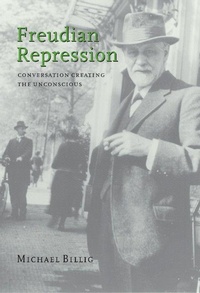
Freudian Repression
Conversation Creating the Unconscious
Published on 4. November 1999
Book
Hardback
300 pages
978-0-521-65052-6 (ISBN)
Description
In Freudian Repression, Michael Billig presents an original reformulation of Freud's concept of repression, showing that in his theory of the unconscious he fails to examine how people actually repress shameful thoughts. Drawing on recent insights from discursive psychology, Billig suggests that in learning to speak we also learn what not to say: language is thus both expressive and repressive. He applies this perspective to some of Freud's classic case histories such as 'Dora' and the 'Rat Man' and the great psychologist's own life to show the importance of small words in speech. By focusing on previously overlooked exchanges, even Freud himself can be seen to be repressing. Freudian Repression also offers insights into the debate about recovered memories and the ideological background to psychoanalysis which will guarantee its interdisciplinary appeal to psychologists, language theorists, discourse analysts, students of psychoanalysis, literary studies and sociologists.
Reviews / Votes
'This insightful book is well worth reading.' The PsychologistMore details
Language
English
Place of publication
Cambridge
United Kingdom
Target group
Professional and scholarly
College/higher education
Dimensions
Height: 235 mm
Width: 157 mm
Thickness: 21 mm
Weight
588 gr
ISBN-13
978-0-521-65052-6 (9780521650526)
Copyright in bibliographic data and cover images is held by Nielsen Book Services Limited or by the publishers or by their respective licensors: all rights reserved.
Schweitzer Classification
Other editions
Additional editions
E-Book
01/2005
1st Edition
Cambridge University Press
€42.99
Available for download
Book
11/1999
Cambridge University Press
€59.60
Shipment within 15-20 days
Person
Content
Acknowledgements; 1. Introduction; 2. The importance of repression; 3. Thinking, speaking and repressing; 4. Language, politeness and desire; 5. Oedipal desires and Oedipal parents; 6. Remembering to forget; 7. Words of unconscious love; 8. Repressing an oppressed identity; 9. Ideological implications; References; Index.