

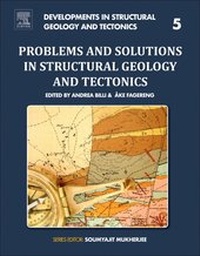
Problems and Solutions in Structural Geology and Tectonics: Volume 5
Published on 6. March 2019
Book
Paperback/Softback
316 pages
978-0-12-814048-2 (ISBN)
Description
Problems and Solutions in Structural Geology and Tectonics, Volume 5, in the series Developments in Structural Geology and Tectonics, presents students, researchers and practitioners with an all-new set of problems and solutions that structural geologists and tectonics researchers commonly face. Topics covered include ductile deformation (such as strain analyses), brittle deformation (such as rock fracturing), brittle-ductile deformation, collisional and shortening tectonics, thrust-related exercises, rift and extensional tectonics, strike slip tectonics, and cross-section balancing exercises. The book provides a how-to guide for students of structural geology and geologists working in the oil, gas and mining industries.
Reviews / Votes
"In short, a commendable work that presents a compendio of varied exercises to get into some of the practical problems associated with structural geology tural and tectonics. The reader will find from theoretical cases to others whose resolution implies solving problems more of interest to society, is to reconstruct how much moves and deforms a region of the earth's surface, assess the significance of the magnitude of an earthquake or reconstruct what shape and characteristics some have structures in the subsoil. In times when we have- We need to encourage our students to understand give the potentiality and practical use of our science, and for society to know and recognize the usefulness of our another profession, this work provides some useful examples for necessary task of training future professionals. As Lynn Fichter and Steven Whitmeyer point out in the book: "all models are wrong, but some of them are useful"." --OTRAS PublicationMore details
Series
Language
English
Place of publication
United States
Target group
Professional and scholarly
College/higher education
Both Graduate and Postgraduate students, and professional geoscientists, especially those who are working on structural geology and tectonics (i.e. petroleum geologists, mining industry professionals, etc.)
Dimensions
Height: 276 mm
Width: 216 mm
Weight
910 gr
ISBN-13
978-0-12-814048-2 (9780128140482)
Copyright in bibliographic data and cover images is held by Nielsen Book Services Limited or by the publishers or by their respective licensors: all rights reserved.
Schweitzer Classification
Other editions
Additional editions
E-Book
02/2019
Elsevier
€131.00
Available for download
Persons
Andrea Billi, PhD, is a Senior Scientist (Primo Ricercatore) in geology at the National Research Council (CNR-IGAG) of Rome, Italy. He received his Ph.D. degree in Geodynamics from Roma Tre University of Rome in 2001 and a M. Geology degree in 1994 from Sapienza University of Rome. Dr. Billi is a versatile structural geologist and tectonician focusing on research fields as diverse as fault zone architecture, seismic faults, regional geodynamics, tsunamis, travertines, and hydrothermalism (www.andreabilli.com). He has been serving for years in the Editorial Boards of the Journal of Structural Geology and Frontiers in Earth Science. His research and editorial experience spans almost 20 years. He has authored about 70 scientific papers and revised, as reviewer or editor, more than 200 papers for more than 30 scientific journals. He has received multiple mention awards for excellence in reviewing from journals such as Tectonics and Journal of Structural Geology. He presently teaches Brittle Structural Geology at the M. Course of Sapienza University of Rome. Ake Fagereng, PhD, is a Lecturer in Structural Geology at Cardiff University, U.K. He received his PhD in geology from Otago University, New Zealand in 2010, and went on to a position as Lecturer and then Senior Lecturer at the University of Cape Town, South Africa. Since 2014 he has been a Lecturer in Structural Geology in the School of Earth and Ocean Sciences, Cardiff University, U.K. He still holds a position as Honorary Research Associate at UCT, spending time doing fieldwork and supervising students in Southern Africa. He has taught structural geology and tectonics at all levels from year 1 undergraduate to graduate level. He has edited a book, Geology of the Earthquake Source, for the Geological Society of London, is a regular reviewer for numerous international journals, and an Associate Editor for Geophysical Research Letters. He has published 39 papers in international, peer reviewed journals, and was awarded the Outstanding Young Scientist Award of the EGU Tectonics and Structural Geology Division in 2016.
Content
Integrating Observation and Interpretation to Understand Tectonics, Past and Present
1. Cross-section construction and balancing: examples from the Spanish Pyrenees
2. Techniques for describing the structural geology of cratonic fault and fold zones
3. Using geodesy data in structural geology
4. What do earthquake magnitudes mean? Example of the Kaikoura, New Zealand, 2016 event
Relating Observed Deformation to Stress and/or Strain History
5. Fluid pressure effects on deformation - Analysis of the Lusi Mud Volcano
6. Using Length/Throw ratio to assess the fitness of a fault framework interpretation
7. Pure Shear Kinematics
8. Strain Analysis
9. Unfolding veined fold limbs to deduce a basin's prefolding state of stress
Observations and Interpretations in Fieldwork and Hand Specimens
10. Recognition of structures in mid-crustal shear zones and how to discern between them
11. Early or late structures in thermogene travertines? Open-air lessons across Rome to focus on and answer this question
12. Characterizing Specimens from the Mid-Atlantic Appalachians in a Wilson Cycle Framework
13. Integrating Structural and Stratigraphic Field Data to Build a Tectonic Model for the Mid-Atlantic Appalachian Orogenic Cycle
Adding Modern Methods to Field Geology
14. From GoogleEarth to 3-D Geology Problem 1: Understanding structures and generating geological maps using GoogleEarth
15. From GoogleEarth to 3-D Geology Problem 2: Seeing below the surface of the Digital Earth
16. Structural interpretation of remote sensing images
Geophysical and Structural Techniques in Petroleum Geoscience and Borehole Projects
17. Understanding reservoir compartmentalization using Shale Gouge Ratio
18. How fault displacement patterns can be applied to investigate trap integrity
19. A numerical study of epithermal neutron log and application of image log
Novel Integration of Mathematical Methods, Computer Science, and Structural Geology
20. Boolean logic in Fluid Flow
21. Using Graph Theory to represent Fracture Networks
22. Synthesis of folds in 3D with Bezier surface
1. Cross-section construction and balancing: examples from the Spanish Pyrenees
2. Techniques for describing the structural geology of cratonic fault and fold zones
3. Using geodesy data in structural geology
4. What do earthquake magnitudes mean? Example of the Kaikoura, New Zealand, 2016 event
Relating Observed Deformation to Stress and/or Strain History
5. Fluid pressure effects on deformation - Analysis of the Lusi Mud Volcano
6. Using Length/Throw ratio to assess the fitness of a fault framework interpretation
7. Pure Shear Kinematics
8. Strain Analysis
9. Unfolding veined fold limbs to deduce a basin's prefolding state of stress
Observations and Interpretations in Fieldwork and Hand Specimens
10. Recognition of structures in mid-crustal shear zones and how to discern between them
11. Early or late structures in thermogene travertines? Open-air lessons across Rome to focus on and answer this question
12. Characterizing Specimens from the Mid-Atlantic Appalachians in a Wilson Cycle Framework
13. Integrating Structural and Stratigraphic Field Data to Build a Tectonic Model for the Mid-Atlantic Appalachian Orogenic Cycle
Adding Modern Methods to Field Geology
14. From GoogleEarth to 3-D Geology Problem 1: Understanding structures and generating geological maps using GoogleEarth
15. From GoogleEarth to 3-D Geology Problem 2: Seeing below the surface of the Digital Earth
16. Structural interpretation of remote sensing images
Geophysical and Structural Techniques in Petroleum Geoscience and Borehole Projects
17. Understanding reservoir compartmentalization using Shale Gouge Ratio
18. How fault displacement patterns can be applied to investigate trap integrity
19. A numerical study of epithermal neutron log and application of image log
Novel Integration of Mathematical Methods, Computer Science, and Structural Geology
20. Boolean logic in Fluid Flow
21. Using Graph Theory to represent Fracture Networks
22. Synthesis of folds in 3D with Bezier surface