

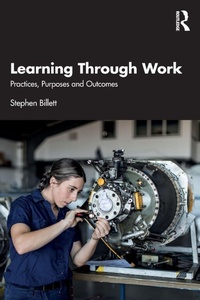
Learning Through Work
Practices, Purposes and Outcomes
1st Edition
Published on 8. September 2025
Book
Paperback/Softback
176 pages
978-1-032-85685-8 (ISBN)
Description
Drawing on three decades of practical investigations, this book establishes new understandings about the importance of learning through work, outlining its purposes, contributions, conceptions and the curriculum, pedagogical and personal practices that shape its effectiveness.
Against views proposing it as being informal and leading to concrete outcomes, this volume presents learning through work as being central to human development, informing individual choices and developing one's capacity for working life and occupational competence. In Part I, Billett makes a case for the value of learning through work and why it should be considered and engaged with as a legitimate mode of learning and model of education. Part II sets out the foundations for the processes of learning through work that have underpinned its utility across human history. Part III sets out bases by which this educational model and mode of learning can be understood through the concepts of practice curriculum, practice pedagogies and personal practices. These are presented based on the kinds of knowledge that they generate and how they can be realised in and through day-to-day work activities in practice settings, including the development of innovations in work settings.
A much-needed resource from a leading expert in the field, this book will be of interest to educators, workplace trainers in a variety of settings, policy-makers and students in professional education courses.
Against views proposing it as being informal and leading to concrete outcomes, this volume presents learning through work as being central to human development, informing individual choices and developing one's capacity for working life and occupational competence. In Part I, Billett makes a case for the value of learning through work and why it should be considered and engaged with as a legitimate mode of learning and model of education. Part II sets out the foundations for the processes of learning through work that have underpinned its utility across human history. Part III sets out bases by which this educational model and mode of learning can be understood through the concepts of practice curriculum, practice pedagogies and personal practices. These are presented based on the kinds of knowledge that they generate and how they can be realised in and through day-to-day work activities in practice settings, including the development of innovations in work settings.
A much-needed resource from a leading expert in the field, this book will be of interest to educators, workplace trainers in a variety of settings, policy-makers and students in professional education courses.
Reviews / Votes
"In this book, Professor Billett provides an exceptionally rich account on the diverse value of workplaces as sites for learning. In our fast-changing world, this book is extremely timely and must-read for all who wish to develop deep understanding of how learning takes place, how it can be facilitated and how it can lead to innovations."Paeivi Tynjaelae, Professor, University of Jyvaeskylae, Finland
"Billett draws on evidence-based knowledge and a well-articulated theory of workplace learning to trace the continuities and adaptive responses of occupational knowledge over time. He shows how societies often privilege declarative knowing over professional or vocational knowing. Rejecting that stance, Billett reconceives occupational knowledge and its effective learning strategies as ... complex, sensory-inclusive, adaptive, and based on an interdependent mix of procedural ("knowing how"), conceptual ("knowing what"), and dispositional ("knowing for") capacities. Organizational leaders will appreciate chapters offering pathways for developing sequenced occupational capacities through work; practice pedagogies; and examples for how to catalyze both learning and innovation by transforming work practices."
Victoria Marsick, Professor, Adult Learning & Leadership, Columbia University, Teachers College, New York
"This book makes strong theoretical, epistemological and conceptual contributions to the topic of workplace learning and offers empirically grounded and explicit pedagogical resources for sustaining learning through practice. It advances an explicit conceptual frame for understanding and sustaining learning through practice and is a must-read for students, researchers and practitioners. The author is one of most cited and renowned authors in the field of adult education and learning through work."
Laurent Filliettaz, Professor of Adult Education, Language and Work, University of Geneva, Switzerland
More details
Language
English
Place of publication
London
United Kingdom
Publishing group
Taylor & Francis Ltd
Target group
College/higher education
Professional and scholarly
Academic, Postgraduate, and Professional Reference
Illustrations
2 s/w Abbildungen, 2 s/w Zeichnungen, 6 s/w Tabellen
6 Tables, black and white; 2 Line drawings, black and white; 2 Illustrations, black and white
Dimensions
Height: 234 mm
Width: 156 mm
Thickness: 11 mm
Weight
301 gr
ISBN-13
978-1-032-85685-8 (9781032856858)
Copyright in bibliographic data and cover images is held by Nielsen Book Services Limited or by the publishers or by their respective licensors: all rights reserved.
Schweitzer Classification
Other editions
Additional editions
Book
09/2025
1st Edition
Routledge
€207.30
Shipment within 10-20 days
E-Book
09/2025
Routledge
€41.99
Available for download
E-Book
09/2025
Routledge
€41.99
Available for download
Person
Stephen Billett is Professor of Adult and Vocational Education at Griffith University, Australia, a fellow of Social Science Academy of Australia, National Teaching fellow, Australian Research Council Future fellow and Fulbright scholar and was awarded honorary doctorates from the universities of Jyvaeskylae (Finland), Geneva (Switzerland) and West (Sweden). He has worked in manufacturing as a vocational educator, teacher educator, professional developer, teacher and researcher at Griffith University, and held policy roles in vocational education.
Content
Part I: Learning through work
1. Learning through work
2. Occupations, occupational knowledge and its learning: origins and legacies
Part II: Foundations of learning through work
3. Learning through work: personal processes and social contributions
4. Occupations, situations and knowledge required for work
5. Being innovative: aligning learning and workplace innovations
Part III: Practice-based learning and educative experiences
6. Practice curriculum
7. Practice pedagogies
8. Personal (epistemological) practices at work
9. Prospects for learning through work
1. Learning through work
2. Occupations, occupational knowledge and its learning: origins and legacies
Part II: Foundations of learning through work
3. Learning through work: personal processes and social contributions
4. Occupations, situations and knowledge required for work
5. Being innovative: aligning learning and workplace innovations
Part III: Practice-based learning and educative experiences
6. Practice curriculum
7. Practice pedagogies
8. Personal (epistemological) practices at work
9. Prospects for learning through work