

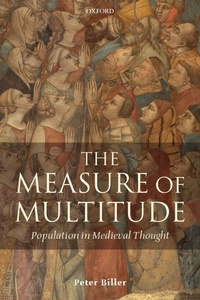
The Measure of Multitude
Population in Medieval Thought
Published on 16. October 2003
Book
Paperback/Softback
496 pages
978-0-19-926559-6 (ISBN)
Description
By 1300, medieval men and women were beginning to measure multitude, counting, for example, numbers of boys and girls being baptized. Their mental capacity to grapple with population, to get its measure, was developing and this book describes how medieval people thought about population through both the texts which contained their thought and the medieval realities which shaped it. They found many topics, such as the history of population and variations between polygamy, monogamy and virginity, through theology. Crusade and travel literature supplied the themes of Muslim polygamy, military numbers, the colonization of the Holy Land,and the populations of Mongolia and China. Translations of Aristotle provided not only new themes but also a new vocabulary with which to think about population.
In this innovative new study Peter Biller challenges the view that medieval thought was fundamentally abstract. He investigates medieval thought's capacity to deal with concrete contemporary realities, and sets academic discussions of population alongside the medieval facts of 'birth, and copulation, and death'.
In this innovative new study Peter Biller challenges the view that medieval thought was fundamentally abstract. He investigates medieval thought's capacity to deal with concrete contemporary realities, and sets academic discussions of population alongside the medieval facts of 'birth, and copulation, and death'.
Reviews / Votes
Review from previous edition Peter Biller ends his book with a question: is medieval demographic thought recognisably there? He has left his readers with only one possible answer - and in doing so changed the way we must think not just about the medieval past but about what has come after in terms of understanding the world. * Janet Nelson, History Today * a trail-blazing book, packed with intellectual fireworks. It fuses diverse sources and scraps of information to detonate an explosion of insights. * Medical History * There are many strengths to this book, not least the imaginative lateral thinking required to conceive the topic in the first place ... an outstanding and original study, which approaches the high middle ages (in its reality as well as its thought worlds) from an unexpected but remarkably productive direction. Its heterogeneous interests should inspire a wide readership. * History * an impressive piece of scholarship. * Social History of Medicine *More details
Language
English
Place of publication
Oxford
United Kingdom
Target group
Professional and scholarly
Scholars and students of society and intellectual thought in medieval Europe
Dimensions
Height: 234 mm
Width: 156 mm
Thickness: 27 mm
Weight
752 gr
ISBN-13
978-0-19-926559-6 (9780199265596)
Copyright in bibliographic data and cover images is held by Nielsen Book Services Limited or by the publishers or by their respective licensors: all rights reserved.
Schweitzer Classification
Other editions
Additional editions
Book
12/2000
Oxford University Press
€73.04
Shipment within 15-20 days
Person
PETER BILLER, Senior Lecturer, Department of History, University of York
Content
1. Introduction to Medieval Demographic Thought ; PART 1: THE CHURCH AND GENERATION ; 2. Marriage and the Church's Marriage-Texts ; 3. William of Auvergne ; 4. Equal or Unequal Numbers of Men and Women ; 5. The Precept of Marriage and Sufficient Multiplication ; 6. Avoidance of Offspring (i): The General Picture ; 7. Avoidance of Offspring (ii): Canon Law and Sentences Commentaries ; 8. Avoidance of Offspring (iii): The Pastoral Picture ; PART 2: THE MAP OF THE WORLD ; 9. Inhabitation of the World ; PART 3: ARISTOTLE AND MULTITUDE ; 10. Animals and Life-span ; 11. The Politics (i): Reception ; 12. The Politics (ii): Age at Marriage ; 13. The Politics (iii): Multitude ; THE LIGHT OF COMMON DAY ; 14. The Bulging Circuit of Florence ; Epigraph: The Climate of Thought ; Bibliography ; Index of Manuscripts ; General Index