

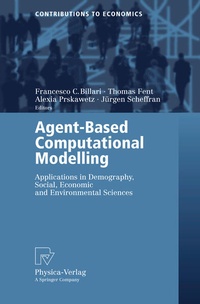
Agent-Based Computational Modelling
Applications in Demography, Social, Economic and Environmental Sciences
1st Edition
Published on 13. March 2006
Book
Paperback/Softback
X, 226 pages
978-3-7908-1640-2 (ISBN)
Description
This book is the outcome of a project that started with the organisation of theTopicalWorkshopon"Agent-BasedComputationalModelling. AnInst- ment for Analysing Complex Adaptive Systems in Demography, Economics and Environment" at the Vienna Institute of Demography, December 4-6, 2003. The workshop brought together scholars from several disciplines, all- ing both for serious scienti?c debate and for informal conversation over a cup co?ee or during a visit to the wonderfulmuseums of Vienna. One of the nicest features of Agent-Based Modelling is indeed the opportunity that scholars ?nd a common language and discuss from their disciplinary perspective, in turn learning from other perspectives. Given the success of the meeting, we found it important to pursue the purpose of collecting these interdisciplinary contributions in a volume. In order to ensure the highest scienti?c standards for the book, we decided that all the contributions (with the sole exception of the introductory chapter) should have been accepted conditional on peer reviews. Generoushelpwasprovidedbyreviewers,someofwhomwereneither directly involved in the workshop nor in the book.
All this would not have been possible without the funding provided by the Complex Systems N- work of Excellence (Exystence) funded by the European Union, the Vienna Institute of Demography of the Austrian Academy of Sciences, Universit' a Bocconi, and ARC Systems Research GmbH, and the help of the wonderful sta? ofthe Vienna Institute of Demography(in particular,Ani Minassianand Belinda Aparicio Diaz). Agent-Based Modelling is important, interesting and also fun-we hope this book contributes to showing that. Milano Francesco C.
All this would not have been possible without the funding provided by the Complex Systems N- work of Excellence (Exystence) funded by the European Union, the Vienna Institute of Demography of the Austrian Academy of Sciences, Universit' a Bocconi, and ARC Systems Research GmbH, and the help of the wonderful sta? ofthe Vienna Institute of Demography(in particular,Ani Minassianand Belinda Aparicio Diaz). Agent-Based Modelling is important, interesting and also fun-we hope this book contributes to showing that. Milano Francesco C.
Reviews / Votes
From the reviews:
"Presenting and combining different approaches, the aim of the book is to describe the motivation for setting-up agent-based models and for studying emerging patterns in complex adaptive systems. . is well written and contains much useful information for scholars not familiar with agent-based modelling." (Petra Ahrweiler, Journal of Artificial Societies and Social Simulation, April, 2007)
More details
Series
Language
English
Place of publication
Heidelberg
Germany
Target group
Professional and scholarly
Research
Illustrations
95 s/w Abbildungen
X, 226 p. 95 illus.
Dimensions
Height: 235 mm
Width: 155 mm
Thickness: 14 mm
Weight
371 gr
ISBN-13
978-3-7908-1640-2 (9783790816402)
DOI
10.1007/3-7908-1721-X
Schweitzer Classification
Other editions
Additional editions
Francesco C. Billari | Thomas Fent | Alexia Prskawetz
Agent-Based Computational Modelling
Applications in Demography, Social, Economic and Environmental Sciences
E-Book
06/2006
1st Edition
Physica
€96.29
Available for download
Content
Microsimulation of household cycles.- Agent-Based Computational Modelling: An Introduction.- Socio-Economics.- Agent-Based Modelling - A Methodology for the Analysis of Qualitative Development Processes.- On the Analysis of Asymmetric Directed Communication Structures in Electronic Election Markets.- Population and Demography.- The Role of Assortative Mating on Population Growth in Contemporary Developed Societies.- An Agent-Based Simulation Model of Age-at-Marriage Norms.- The Strength of Social Interactions and Obesity among Women.- Ecology and Environment.- Agent-Based Models in Ecology: Patterns and Alternative Theories of Adaptive Behaviour.- Agent-Based Modelling of Self-Organisation Processes to Support Adaptive Forest Management.- Vampire Bats & The Micro-Macro Link.- General Aspects.- How Are Physical and Social Spaces Related? - Cognitive Agents as the Necessary "Glue".- Agent Design for Agent-Based Modelling.