

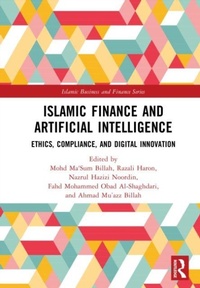
Islamic Finance and Artificial Intelligence
Ethics, Compliance, and Digital Innovation
1st Edition
Will be published approx. on 2. October 2026
Book
Hardback
262 pages
978-1-041-19786-7 (ISBN)
Description
As Islamic finance evolves in the digital era, artificial intelligence (AI) stands out as both a disruptor and an enabler. Islamic Finance and Artificial Intelligence: Ethics, Compliance, and Digital Innovation provides a pioneering examination of how AI technologies can be integrated into Islamic financial systems while maintaining adherence to Shari'ah principles and ethical governance.
The book explores AI-driven tools and their implications for Shari'ah-compliant operations. It critically examines issues of algorithmic transparency, accountability, and the governance of digital financial services within Islamic ethical frameworks. By combining rigorous conceptual analysis with contemporary industry developments, the book demonstrates how digital innovation can enhance efficiency, financial inclusion, and responsible financial practices in Muslim-majority and emerging markets. Presenting a technical deep dive into AI development, the book showcases methodologies, tools, and innovative applications tailored to Islamic financial products and services, with a discussion on blockchain, smart contracts, and other technologies designed to uphold Shari'ah compliance. Further, it provides a comprehensive risk analysis of AI adoption in Islamic finance that relates to ethical challenges, operational risks and systemic threats.
The book bridges academia, industry, and policy, offering practical insights and forward-looking strategies for leveraging AI to build a more inclusive, ethical, and innovative future. Situating Islamic finance within the broader digital transformation of the global financial sector, it is essential reading for academics, policymakers, fintech professionals, regulators, and students engaged with financial technology, Islamic economics, and the ethics of algorithmic governance.
The book explores AI-driven tools and their implications for Shari'ah-compliant operations. It critically examines issues of algorithmic transparency, accountability, and the governance of digital financial services within Islamic ethical frameworks. By combining rigorous conceptual analysis with contemporary industry developments, the book demonstrates how digital innovation can enhance efficiency, financial inclusion, and responsible financial practices in Muslim-majority and emerging markets. Presenting a technical deep dive into AI development, the book showcases methodologies, tools, and innovative applications tailored to Islamic financial products and services, with a discussion on blockchain, smart contracts, and other technologies designed to uphold Shari'ah compliance. Further, it provides a comprehensive risk analysis of AI adoption in Islamic finance that relates to ethical challenges, operational risks and systemic threats.
The book bridges academia, industry, and policy, offering practical insights and forward-looking strategies for leveraging AI to build a more inclusive, ethical, and innovative future. Situating Islamic finance within the broader digital transformation of the global financial sector, it is essential reading for academics, policymakers, fintech professionals, regulators, and students engaged with financial technology, Islamic economics, and the ethics of algorithmic governance.
More details
Series
Language
English
Place of publication
London
United Kingdom
Publishing group
Taylor & Francis Ltd
Target group
College/higher education
Professional and scholarly
Academic and Postgraduate
Illustrations
20 s/w Tabellen, 17 s/w Zeichnungen, 2 s/w Photographien bzw. Rasterbilder, 19 s/w Abbildungen
20 Tables, black and white; 17 Line drawings, black and white; 2 Halftones, black and white; 19 Illustrations, black and white
Dimensions
Height: 246 mm
Width: 174 mm
ISBN-13
978-1-041-19786-7 (9781041197867)
Copyright in bibliographic data and cover images is held by Nielsen Book Services Limited or by the publishers or by their respective licensors: all rights reserved.
Schweitzer Classification
Other editions
Additional editions

Mohd Ma'sum Billah | Razali Haron | Nazrul Hazizi Noordin
Islamic Finance and Artificial Intelligence
Ethics, Compliance, and Digital Innovation
E-Book
approx. 10/2026
Routledge
€60.49
Not yet available
Mohd Ma'sum Billah | Razali Haron | Nazrul Hazizi Noordin
Islamic Finance and Artificial Intelligence
Ethics, Compliance, and Digital Innovation
E-Book
approx. 10/2026
Routledge
€60.49
Not yet available
Persons
Mohd Ma'Sum Billah is a Senior Professor of finance at the Islamic Economics Institute, King Abdul Aziz University (KAU), Kingdom of Saudi Arabia.
Razali Haron is a Professor of Finance at the IIUM Institute of Islamic Banking and Finance, International Islamic University Malaysia (IIUM).
Nazrul Hazizi Noordin is an Assistant Professor of Finance at the IIUM Institute of Islamic Banking and Finance, International Islamic University Malaysia (IIUM) and a Visiting Fellow at the Oxford Centre for Islamic Studies, United Kingdom.
Fahd Al-Shaghdari is an Assistant Professor of Finance at the IIUM Institute of Islamic Banking and Finance, International Islamic University Malaysia (IIUM).
Ahmad Mu'azz Billah is a Cybersecurity, Cloud & AI Engineer at ANTAREX Cyber, Kuala Lumpur, Malaysia.
Razali Haron is a Professor of Finance at the IIUM Institute of Islamic Banking and Finance, International Islamic University Malaysia (IIUM).
Nazrul Hazizi Noordin is an Assistant Professor of Finance at the IIUM Institute of Islamic Banking and Finance, International Islamic University Malaysia (IIUM) and a Visiting Fellow at the Oxford Centre for Islamic Studies, United Kingdom.
Fahd Al-Shaghdari is an Assistant Professor of Finance at the IIUM Institute of Islamic Banking and Finance, International Islamic University Malaysia (IIUM).
Ahmad Mu'azz Billah is a Cybersecurity, Cloud & AI Engineer at ANTAREX Cyber, Kuala Lumpur, Malaysia.
Content
Introduction; Part I Emergence of Islamic Finance with Artificial Intelligence; Chapter 1 Transformation of Artificial Intelligence into Islamic Finance: An Impact Analysis; Chapter 2 The SMELT Model: A Systemic Framework for an Ethics of AI; Chapter 3 How Do AI, Cloud and Cybersecurity Facilitate the Advancement of Islamic Financial Industries?; Chapter 4 Acceptance of Artificial Intelligence and Financial Decision Support Systems (AI-FDSS) for Universities' governance; Chapter 5 Beyond Compliance: Shariah-Fintech as a Catalyst for Ethical Innovation and Global Peace; Chapter 6 Artificial Intelligence for Sukuk Governance: Bridging the Gap Between Growth and Inclusion; Chapter 7 Innovation vs. Ethics: Navigating AI's Boundaries; Part II Shariah and Ethical Standard of Application of Artificial Intelligence in Promoting Islamic Financial Products and Services; Chapter 8 How Do AI and Blockchain Technology Lead to Smart Management of Waqf?; Chapter 9 Application of Shariah Principles to Artificial Intelligence (AI) Governance; Chapter 10 Blockchain and Smart Contracts in Malaysian Islamic Banks: Institutional Review and Shari'ah Governance; Chapter 11 Shariah-compliant AI in Wealth Management: Advancing Economic Equity and Global Stability; Chapter 12 Toward ethical AI integration in Islamic finance: a Southeast Asian framework for Shariah-Compliant Innovation; Part III Technical Know-How Transform Islamic Finance into Artificial Intelligence; Chapter 13 Islamic Banking in a Dual System: Efficiency Gaps, Market-Share Prospects, and the Imperative of Digital and Core Banking Modernization; Chapter 14 From Charity to Empowerment: An AI-Enabled Islamic Blended Microfinance for Asnaf and Ultra-Micro-entrepreneurs; Chapter 15 From Human Bias to Machine Signal: Artificial Intelligence, Social Media Sentiment, And Behavioural Bias Mitigation In Islamic Capital Market; Chapter 16 Artificial Intelligence In Islamic Financial Services: Application and the Way Forward; Part IV Risk, Capacity Building & Experience in AI Led-Islamic Finance; Chapter 17 Mitigating AI Risks in Islamic finance: Shariah-aligned Governance; Chapter 18 Capacity Building for AI in Islamic Finance; Chapter 19 Artificial Intelligence in Islamic Finance: Capacity Building and Governance Imperatives; Chapter 20 Application of Artificial Intelligence in Islamic Banks: Evidence from Malaysia; Index