

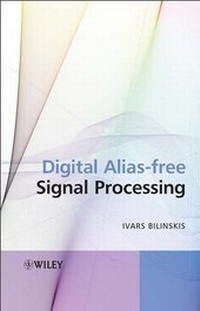
Digital Alias-free Signal Processing
1st Edition
Published on 13. April 2007
Book
Hardback
454 pages
978-0-470-02738-7 (ISBN)
Unfortunately, price unknown
Article exhausted; check different version
Description
As demand for applications working in extended frequency ranges increases, classical digital signal processing (DSP) techniques, not protected against aliasing, are becoming less effective. Digital alias-free signal processing (DASP) is a technique for overcoming the problems of aliasing at extended frequency ranges. Based on non-uniform or randomised sampling techniques and the development of novel algorithms, it creates the capacity to suppress potential aliasing crucial for high frequency applications and to reduce the complexity of designs.
This book provides practical and comprehensive coverage of the theory and techniques behind alias-free digital signal processing.
Digital Alias-free Signal Processing is ideal for practising engineers and researchers working on the development of digital signal processing applications at extended frequencies. It is also a valuable reference for electrical and computer engineering graduates taking courses in signal processing or digital signal processing.
Key features:
* Analyses issues of sampling, randomised and pseudo-randomised quantisation and direct and indirectly randomised sampling.
* Examines periodic and hybrid sampling, including information on processing algorithms and potential limitations imposed by signal dynamics.
* Sets out leading methods and techniques for complexity reduced designs, in particular designs of large aperture sensor arrays, massive data acquisition and compression from a number of signal sources, as well as complexity-reduced processing of non-uniform data.
* Presents examples of engineering applications using these techniques including spectrum analysis, waveform reconstruction and the estimation of various parameters, emphasising the importance of the technique for developing new technologies.
* Links DASP and traditional technologies by mapping them into embedded systems with standard inputs and outputs.
Reviews / Votes
"It is a solid reference book for electronic and computer engineers working in the DSP domain." (Zentralblatt Math 1130, May 2008)More details
Other editions
Additional editions
Ivars Bilinskis
Digital Alias-free Signal Processing
E-Book
09/2007
Wiley
€125.99
Available for download
Person
Ivars Bilinskis is currently a Professor in the Institute of Electronics and Computer Science and Head of the Laboratory for Digital Signal Processing at the Latvian University, Latvia. He has been at the university since 1992, where his research interests include digital signal processing, particularly digital alias-free signal processing (DASP), signal parameter estimation, and digital filtering of irregular data sequences. Previous to this, he has lectured at the University of Westminster, London, and at the Universitat Politecnica de Catalunya, Barcelona, Spain. He is Editor in Chief of the journal Automatic Control and Computer Science (Russian Institute of Electronics and Computer Science), and has co-authored the books Randomized Signal Processing (Prentice Hall, 1992) and Randomized Signal Processing of Continuous Signals (in Russian, Zinatne Press, 1983). He has also written 165 academic publications, including 52 certificates of inventions, and been Head of several European research projects.
Content
Preface.
Frequently Used Symbols and Abbreviations.
1 Introduction: Signal Digitizing and Digital Processing.
Part 1 Digitizing.
2 Randomization as a Tool.
3 Periodic Versus Randomized Sampling.
4 Randomized Quantization.
5 Pseudo-randomized Quantizing.
6 Direct Randomization of Sampling.
7 Threshold-crossing Sampling.
8 Derivatives of Periodic Sampling.
9 Fuzzy Aliasing.
10 Hybrid Sampling.
Part 2 Processing.
11 Data Acquisition.
12 Quantizing-specific Signal Parameter Estimation.
13 Estimation of Correlation Functions.
14 Signal Transforms.
15 DFT of Nonuniformly Sampled Signals.
16 Complexity-reduced DFT.
17 Spatial Data Acquisition and Processing.
18 Adapting Signal Processing to Sampling Nonuniformities.
19 Estimation of Object Parameters.
20 Encapsulating DASP Technology.
Index.