

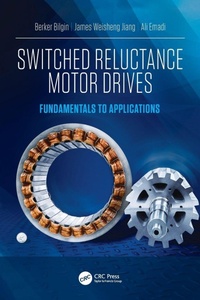
Switched Reluctance Motor Drives
Fundamentals to Applications
1st Edition
Published on 19. November 2018
Book
Hardback
824 pages
978-1-138-30459-8 (ISBN)
Description
Electric motors are the largest consumer of electric energy and they play a critical role in the growing market for electrification. Due to their simple construction, switched reluctance motors (SRMs) are exceptionally attractive for the industry to respond to the increasing demand for high-efficiency, high-performance, and low-cost electric motors with a more secure supply chain.
Switched Reluctance Motor Drives: Fundamentals to Applications is a comprehensive textbook covering the major aspects of switched reluctance motor drives. It provides an overview of the use of electric motors in the industrial, residential, commercial, and transportation sectors. It explains the theory behind the operation of switched reluctance motors and provides models to analyze them. The book extensively concentrates on the fundamentals and applications of SRM design and covers various design details, such as materials, mechanical construction, and controls.
Acoustic noise and vibration is the most well-known issue in switched reluctance motors, but this can be reduced significantly through a multidisciplinary approach. These methodologies are explained in two chapters of the book. The first covers the fundamentals of acoustic noise and vibration so readers have the necessary tools to analyze the problems and explains the surface waves, spring-mass models, forcing harmonics, and mode shapes that are utilized in modeling and analyzing acoustic noise and vibration. The second applies these fundamentals to switched reluctance motors and provides examples for determining the sources of any acoustic noise in switched reluctance motors.
In the final chapter two SRM designs are presented and proposed as replacements for permanent magnet machines in a residential HVAC application and a hybrid-electric propulsion application. It also shows a high-power and compact converter design for SRM drives.
Features:
Comprehensive coverage of switched reluctance motor drives from fundamental principles to design, operation, and applications
A specific chapter on electric motor usage in industrial, residential, commercial, and transportation applications to address the benefits of switched reluctance machines
Two chapters address acoustic noise and vibration in detail
Numerous illustrations and practical examples on the design, modeling, and analysis of switched reluctance motor drives
Examples of switched reluctance motor and drive design
Switched Reluctance Motor Drives: Fundamentals to Applications is a comprehensive textbook covering the major aspects of switched reluctance motor drives. It provides an overview of the use of electric motors in the industrial, residential, commercial, and transportation sectors. It explains the theory behind the operation of switched reluctance motors and provides models to analyze them. The book extensively concentrates on the fundamentals and applications of SRM design and covers various design details, such as materials, mechanical construction, and controls.
Acoustic noise and vibration is the most well-known issue in switched reluctance motors, but this can be reduced significantly through a multidisciplinary approach. These methodologies are explained in two chapters of the book. The first covers the fundamentals of acoustic noise and vibration so readers have the necessary tools to analyze the problems and explains the surface waves, spring-mass models, forcing harmonics, and mode shapes that are utilized in modeling and analyzing acoustic noise and vibration. The second applies these fundamentals to switched reluctance motors and provides examples for determining the sources of any acoustic noise in switched reluctance motors.
In the final chapter two SRM designs are presented and proposed as replacements for permanent magnet machines in a residential HVAC application and a hybrid-electric propulsion application. It also shows a high-power and compact converter design for SRM drives.
Features:
Comprehensive coverage of switched reluctance motor drives from fundamental principles to design, operation, and applications
A specific chapter on electric motor usage in industrial, residential, commercial, and transportation applications to address the benefits of switched reluctance machines
Two chapters address acoustic noise and vibration in detail
Numerous illustrations and practical examples on the design, modeling, and analysis of switched reluctance motor drives
Examples of switched reluctance motor and drive design
More details
Language
English
Place of publication
London
United Kingdom
Publishing group
Taylor & Francis Ltd
Target group
College/higher education
Undergraduate Core
Illustrations
450 s/w Abbildungen, 206 farbige Abbildungen, 97 s/w Tabellen
97 Tables, black and white; 206 Illustrations, color; 450 Illustrations, black and white
Dimensions
Height: 260 mm
Width: 183 mm
Thickness: 48 mm
Weight
1718 gr
ISBN-13
978-1-138-30459-8 (9781138304598)
Copyright in bibliographic data and cover images is held by Nielsen Book Services Limited or by the publishers or by their respective licensors: all rights reserved.
Schweitzer Classification
Other editions
Additional editions
Berker Bilgin | James Weisheng Jiang | Ali Emadi
Switched Reluctance Motor Drives
Fundamentals to Applications
Book
06/2022
1st Edition
CRC Press
€155.70
Shipment within 10-20 days
Berker Bilgin | James Weisheng Jiang | Ali Emadi
Switched Reluctance Motor Drives
Fundamentals to Applications
E-Book
04/2019
CRC Press
€88.49
Available for download
Berker Bilgin | James Weisheng Jiang | Ali Emadi
Switched Reluctance Motor Drives
Fundamentals to Applications
E-Book
04/2019
1st Edition
CRC Press
€88.49
Available for download
Persons
Berker Bilgin (IEEE S'09-M'12-SM'16) is the Research Program Manager of the Canada Excellence Research Chair in Hybrid Powertrain Program in McMaster Institute for Automotive Research and Technology (MacAUTO) at McMaster University, Hamilton, Ontario, Canada. He received his Ph.D. degree in Electrical Engineering from Illinois Institute of Technology in Chicago, Illinois, USA. He is managing many multidisciplinary projects on the design of electric machines, power electronics, electric motor drives, and electrified powertrains. Dr. Bilgin was the General Chair of the 2016 IEEE Transportation Electrification Conference and Expo (ITEC'16). He is now pursuing his MBA degree in DeGroote School of Business at McMaster University.
Ali Emadi (IEEE S'98-M'00-SM'03-F'13) received the B.S. (1995) and M.S. (1997) degrees in electrical engineering with highest distinction from Sharif University of Technology, Tehran, Iran. He also received his Ph.D. degree (2000) in electrical engineering from Texas A&M University, College Station, TX, USA. He is currently the Canada Excellence Research Chair (CERC) in Hybrid Powertrain and a Professor in the Departments of Electrical and Computer Engineering (ECE) and Mechanical Engineering (ME) at McMaster University in Hamilton, Ontario, Canada. The CERC appointment receives up to $10 million in federal funding over seven years in addition to significant support from the university. The appointment also includes a new hybrid vehicle research facility that is part of the new 80,000 square-foot McMaster Automotive Resource Center (MARC) at McMaster Innovation Park. He recently served as the Director of the McMaster Institute for Automotive Research and Technology (MacAUTO) from 2011-2015. Before joining McMaster University, Dr. Emadi was the Harris Perlstein Endowed Chair Professor of Engineering and Director of the Electric Power and Power Electronics Center and Grainger Laboratories at Illinois Institute of Technology in Chicago, where he established research and teaching facilities as well as courses in power electronics, motor drives, and vehicular power systems. In addition, Dr. Emadi was the Founder, Chairman, and President of Hybrid Electric Vehicle Technologies, Inc. (HEVT) - a university spin-off company of Illinois Tech.
James Weisheng Jiang received his bachelor's degree in vehicle engineering from the College of Automotive Engineering, Jilin University, China in 2009. He worked as a research assistant at the Clean Energy Automotive Engineering Research Center, Tongji University, China from 2009 to 2011. He got his PhD degree from McMaster University in 2016. He is currently a principal research engineer at McMaster Automotive Resource Centre (MARC). He has designed and implemented a 60 kW 24/16 switched reluctance motor for traction purpose in HEV. He has also been involved in designs and implementations of traction motors with interior permanent and ferrite magnets. He has also been working on NVH analysis for switched reluctance motors and permanent magnet synchronous motors.
Ali Emadi (IEEE S'98-M'00-SM'03-F'13) received the B.S. (1995) and M.S. (1997) degrees in electrical engineering with highest distinction from Sharif University of Technology, Tehran, Iran. He also received his Ph.D. degree (2000) in electrical engineering from Texas A&M University, College Station, TX, USA. He is currently the Canada Excellence Research Chair (CERC) in Hybrid Powertrain and a Professor in the Departments of Electrical and Computer Engineering (ECE) and Mechanical Engineering (ME) at McMaster University in Hamilton, Ontario, Canada. The CERC appointment receives up to $10 million in federal funding over seven years in addition to significant support from the university. The appointment also includes a new hybrid vehicle research facility that is part of the new 80,000 square-foot McMaster Automotive Resource Center (MARC) at McMaster Innovation Park. He recently served as the Director of the McMaster Institute for Automotive Research and Technology (MacAUTO) from 2011-2015. Before joining McMaster University, Dr. Emadi was the Harris Perlstein Endowed Chair Professor of Engineering and Director of the Electric Power and Power Electronics Center and Grainger Laboratories at Illinois Institute of Technology in Chicago, where he established research and teaching facilities as well as courses in power electronics, motor drives, and vehicular power systems. In addition, Dr. Emadi was the Founder, Chairman, and President of Hybrid Electric Vehicle Technologies, Inc. (HEVT) - a university spin-off company of Illinois Tech.
James Weisheng Jiang received his bachelor's degree in vehicle engineering from the College of Automotive Engineering, Jilin University, China in 2009. He worked as a research assistant at the Clean Energy Automotive Engineering Research Center, Tongji University, China from 2009 to 2011. He got his PhD degree from McMaster University in 2016. He is currently a principal research engineer at McMaster Automotive Resource Centre (MARC). He has designed and implemented a 60 kW 24/16 switched reluctance motor for traction purpose in HEV. He has also been involved in designs and implementations of traction motors with interior permanent and ferrite magnets. He has also been working on NVH analysis for switched reluctance motors and permanent magnet synchronous motors.
Content
1. Electric Motor Industry and Switched Reluctance Machines 2. Electromagnetic Principles of Switched Reluctance Machines 3. Derivation of Pole Configuration in Switched Reluctance Machines 4. Operational Principles and Modeling of Switched Reluctance Machines 5. Switched Reluctance Machines in Generating Mode 6. Materials Used in Switched Reluctance Machines 7. Design Considerations for Switched Reluctance Machines 8. Mechanical Construction of Switched Reluctance Machines 9. Control of Switched Reluctance Machines 10. Power Electronic Converters to Drive Switched Reluctance Machines 11. Position Sensorless Control of Switched Reluctance Motor Drives 12. Fundamentals of Vibrations and Acoustic Noise 13. Noise and Vibration in Switched Reluctance Machines 14. Thermal Management of Switched Reluctance Machines 15. Axial Flux Switched Reluctance Machines 16. Switched Reluctance Motor and Drive Design Examples