

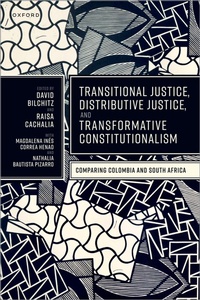
Transitional Justice, Distributive Justice, and Transformative Constitutionalism
Comparing Colombia and South Africa
Published on 21. December 2023
Book
Hardback
512 pages
978-0-19-288762-7 (ISBN)
Description
Emerging from national pasts marred by violence, conflict, and injustice, South African and Colombian societies have sought to establish futures founded on equality, democracy, and constitutionalism. Transitional Justice, Distributive Justice, and Transformative Constitutionalism: Comparing Colombia and South Africa offers the first dedicated scholarly comparison of the two countries in relation to the intersecting ideas of transitional justice, distributive justice, and transformative constitutionalism. Featuring contributions by Colombian and South African authors, this volume richly examines each country from a range of thematic perspectives as the basis for deep reflection and comparison between them.
Transitional Justice, Distributive Justice, and Transformative Constitutionalism brings together three interconnected concepts: the need for redress of past historical wrongs, the imperative to ensure fairness in the distribution of resources, and the commitment to law-governed social change mediated through a constitution. Part one explores innovative approaches to transitional justice that go beyond law, such as novel philosophical approaches to reconciliation, the use of art to address past wrongs, and the role of museums in memorialising the past. Part two considers one of the central components of transformative constitutionalism: socio-economic rights. It addresses the role of history in the interpretation of socio-economic rights and the procedural mechanisms that enable access to these rights. Part three looks at the development of legal structures designed to achieve both transitional and distributive justice in the areas of indigenous people's rights, procedural law, and international law.
A timely work of innovative methodology and rare engagement between two constitutional democracies in the Global South, this title will be of interest to academics working in the fields of transitional justice, distributive justice, and transformative constitutionalism in Colombia and South Africa.
Transitional Justice, Distributive Justice, and Transformative Constitutionalism brings together three interconnected concepts: the need for redress of past historical wrongs, the imperative to ensure fairness in the distribution of resources, and the commitment to law-governed social change mediated through a constitution. Part one explores innovative approaches to transitional justice that go beyond law, such as novel philosophical approaches to reconciliation, the use of art to address past wrongs, and the role of museums in memorialising the past. Part two considers one of the central components of transformative constitutionalism: socio-economic rights. It addresses the role of history in the interpretation of socio-economic rights and the procedural mechanisms that enable access to these rights. Part three looks at the development of legal structures designed to achieve both transitional and distributive justice in the areas of indigenous people's rights, procedural law, and international law.
A timely work of innovative methodology and rare engagement between two constitutional democracies in the Global South, this title will be of interest to academics working in the fields of transitional justice, distributive justice, and transformative constitutionalism in Colombia and South Africa.
More details
Language
English
Place of publication
Oxford
United Kingdom
Target group
College/higher education
Product notice
sewn/stitched
Cloth over boards
Dimensions
Height: 229 mm
Width: 163 mm
Thickness: 53 mm
Weight
998 gr
ISBN-13
978-0-19-288762-7 (9780192887627)
Copyright in bibliographic data and cover images is held by Nielsen Book Services Limited or by the publishers or by their respective licensors: all rights reserved.
Schweitzer Classification
Other editions
Additional editions
David Bilchitz | Raisa Cachalia
Transitional Justice, Distributive Justice, and Transformative Constitutionalism
Comparing Colombia and South Africa
E-Book
12/2023
1st Edition
OUP eBook
€109.99
Available for download
David Bilchitz | Raisa Cachalia
Transitional Justice, Distributive Justice, and Transformative Constitutionalism
Comparing Colombia and South Africa
E-Book
11/2023
1st Edition
OUP eBook
€109.99
Available for download
Persons
David Bilchitz is Professor of Fundamental Rights and Constitutional Law at the University of Johannesburg and Professor of Law at the University of Reading. He is also Director of the South African Institute for Advanced Constitutional, Public, Human Rights and International Law (SAIFAC). He is a member of the Academy of Sciences of South Africa and Vice-President of the International Association of Constitutional Law. In 2017, he was awarded a Georg Forster research fellowship from the Von Humboldt Foundation. He publishes widely on constitutional law and fundamental rights including his latest monograph Fundamental Rights and the Legal Obligations of Business (2022).
Raisa Cachalia is an LLD Candidate at the University of Stellenbosch and a Research Associate in the Faculty of Law at the University of Johannesburg. Her research interests include administrative law and constitutional law. She is an editor at the Constitutional Court Review, a journal dedicated to the judgments of South Africa's highest court.
Raisa Cachalia is an LLD Candidate at the University of Stellenbosch and a Research Associate in the Faculty of Law at the University of Johannesburg. Her research interests include administrative law and constitutional law. She is an editor at the Constitutional Court Review, a journal dedicated to the judgments of South Africa's highest court.
Editor
Professor and DirectorProfessor and Director, University of Johannesburg, University of Reading, and South African Institute for Advanced Constitutional Public, Human Rights, and International Law
Research Associate and LLD CandidateResearch Associate and LLD Candidate, University of Johannesburg and Stellenbosch University
Content
1: David Bilchitz and Raisa Cachalia: Developing a Conceptual Framework for Global South Comparisons: Colombian and South African Contributions
PART I: INNOVATIVE WAYS OF CONCEIVING AND IMPLEMENTING TRANSITIONAL JUSTICE
Theme 1: Re-Conceiving Reconciliation as Relationships: the Role of African and Latin American Values
2: Thaddeus Metz: The Role of Economic Goods in National Reconciliation: Evaluating South Africa and Colombia
3: Nathalia Elena Bautista Pizarro: Building Peace and Restoring Law upon the Ethos: A Comparison between South Africa and Colombia
4: Thaddeus Metz and Nathalia Elena Bautista Pizarro: Joint Reflection - Economic Goods and Communitarian Values
Theme 2: Art and Transitional Justice
5: Kim Berman and Michelle LeBaron: Aesthetic Negotiation and Artefactual Agency: Key Processes for Symbolic Repair in Transitional Justice
6: Yolanda Sierra Leon: Aesthetic Litigation as a Mechanism for Building the Truth in the Colombian Truth Commission
7: Kim Berman, Michelle LeBaron, and Yolanda Sierra Leon: Joint Reflection - How Do Arts Function in Symbolic Reparation? A Comparative Reflection Between Colombia and South Africa
Theme 3: History, Museums and Transitional Justice
8: Emilia Potenza and Adrienne van den Heever: Journey to a New Space: The Apartheid Museum's Truth and Reconciliation Exhibition within the Context of Restorative and Transitional Justice
9: Nancy Rocio Rueda Esteban: Exploring Visitor Expectations and Experiences of Conflict and Transitional Justice Exhibitions in Bogota, Colombia
10: Emilia Potenza, Adrienne van den Heever, and Nancy Rocio Rueda Esteban: Joint Reflection - Journey to a New Space: A Comparative Reflection of Museum Exhibitions within the Context of Restorative and Transitional Justice
PART II: SOCIO-ECONOMIC RIGHTS AND THE RELATIONSHIP BETWEEN TRANSITIONAL AND DISTRIBUTIVE JUSTICE
Theme 4: The Role of History in Socio-Economic Rights Jurisprudence: Linking Transitional and Distributive Justice
11: David Bilchitz: Does History Make a Difference? Exploring the Role of History in the Interpretation of Socio-Economic Rights
12: Magdalena Ines Correa Henao: Historical Injustice and Socio-Economic Rights in Colombia Constitutional Jurisprudence: The Case of Victims of Forced Displacement
13: David Bilchitz and Magdalena Ines Correa Henao: Joint reflection - The Difference History Makes: Comparative Reflections on Socio-Economic Rights and Historical Consciousness in South Africa and Colombia
Theme 5: Collective Mechanisms for the Advancement of Socio-Economic Rights
14: Meghan Finn: Class Actions and the Scarce Resource of the Law
15: Andres Mauricio Gutierrez Beltran: Forced Displacement and Social Change: Light and Shadows in the Implementation of the Judgment T-025 of 2004
16: Meghan Finn and Andres Mauricio Gutierrez Beltran: Joint reflection - Litigating for a Collective: Structural Judgments and Class Actions in Colombia and South Africa
PART III: THE ROLE OF NOVEL LEGAL STRUCTURES IN REALISING TRANSITIONAL AND DISTRIBUTIVE JUSTICE
Theme 6: Indigenous Peoples and Transitional Justice
17: Sindiso Mnisi Weeks: Twenty-five Years of Democracy: The Consequences of South Africa's Post-Apartheid Constitution and Political Economy for Traditional Peoples
18: Diana Carolina Rivera Drago and Filipo Ernesto Burgos Guzman: Evaluating the Impact of the Peace Agreement on the Indigenous Peoples of Colombia: Land Rights and Compensation
19: Sindiso Mnisi Weeks and Diana Carolina Rivera Dragos: Joint reflection - The South African and Colombian 'Peace Agreements': Restoration of Rights or Continuing Difficulties for Indigenous Peoples?
Theme 7: Procedural Justice, the Law and Transitional Justice
20: Raisa Cachalia: Exploring the Relationship between Violent Protest and Procedural Injustice in South Africa's Democratic Transition
21: Julian Andres Pimiento Echeverri and Irit Milkes: Beyond Democracy: Meaningful Public Participation as a New Approach to Public Decision-Making in the Context of Colombia's Transitional Justice Process
22: Raisa Cachalia and Irit Milkes: Joint reflection - Comparative Reflections on Transitional Justice and Political Inclusion in South Africa and Colombia
Theme 8: The Role of International Law in Advancing Transitional Justice
23: Mispa Roux: South Africa and the International Criminal Court: Perpetuating the Legacy of Overlooking the Ergo Omnes Obligation to Prosecute International Crimes by Prioritising Peace
24: Natalia Silva Santaularia: Colombia and the International Criminal Court: A Case of Positive Complementarity in Transitional Justice Contexts
25: Mispa Roux and Natalia Silva Santaularia: Joint reflection - South Africa and Colombia as Transitional Justice Societies
PART I: INNOVATIVE WAYS OF CONCEIVING AND IMPLEMENTING TRANSITIONAL JUSTICE
Theme 1: Re-Conceiving Reconciliation as Relationships: the Role of African and Latin American Values
2: Thaddeus Metz: The Role of Economic Goods in National Reconciliation: Evaluating South Africa and Colombia
3: Nathalia Elena Bautista Pizarro: Building Peace and Restoring Law upon the Ethos: A Comparison between South Africa and Colombia
4: Thaddeus Metz and Nathalia Elena Bautista Pizarro: Joint Reflection - Economic Goods and Communitarian Values
Theme 2: Art and Transitional Justice
5: Kim Berman and Michelle LeBaron: Aesthetic Negotiation and Artefactual Agency: Key Processes for Symbolic Repair in Transitional Justice
6: Yolanda Sierra Leon: Aesthetic Litigation as a Mechanism for Building the Truth in the Colombian Truth Commission
7: Kim Berman, Michelle LeBaron, and Yolanda Sierra Leon: Joint Reflection - How Do Arts Function in Symbolic Reparation? A Comparative Reflection Between Colombia and South Africa
Theme 3: History, Museums and Transitional Justice
8: Emilia Potenza and Adrienne van den Heever: Journey to a New Space: The Apartheid Museum's Truth and Reconciliation Exhibition within the Context of Restorative and Transitional Justice
9: Nancy Rocio Rueda Esteban: Exploring Visitor Expectations and Experiences of Conflict and Transitional Justice Exhibitions in Bogota, Colombia
10: Emilia Potenza, Adrienne van den Heever, and Nancy Rocio Rueda Esteban: Joint Reflection - Journey to a New Space: A Comparative Reflection of Museum Exhibitions within the Context of Restorative and Transitional Justice
PART II: SOCIO-ECONOMIC RIGHTS AND THE RELATIONSHIP BETWEEN TRANSITIONAL AND DISTRIBUTIVE JUSTICE
Theme 4: The Role of History in Socio-Economic Rights Jurisprudence: Linking Transitional and Distributive Justice
11: David Bilchitz: Does History Make a Difference? Exploring the Role of History in the Interpretation of Socio-Economic Rights
12: Magdalena Ines Correa Henao: Historical Injustice and Socio-Economic Rights in Colombia Constitutional Jurisprudence: The Case of Victims of Forced Displacement
13: David Bilchitz and Magdalena Ines Correa Henao: Joint reflection - The Difference History Makes: Comparative Reflections on Socio-Economic Rights and Historical Consciousness in South Africa and Colombia
Theme 5: Collective Mechanisms for the Advancement of Socio-Economic Rights
14: Meghan Finn: Class Actions and the Scarce Resource of the Law
15: Andres Mauricio Gutierrez Beltran: Forced Displacement and Social Change: Light and Shadows in the Implementation of the Judgment T-025 of 2004
16: Meghan Finn and Andres Mauricio Gutierrez Beltran: Joint reflection - Litigating for a Collective: Structural Judgments and Class Actions in Colombia and South Africa
PART III: THE ROLE OF NOVEL LEGAL STRUCTURES IN REALISING TRANSITIONAL AND DISTRIBUTIVE JUSTICE
Theme 6: Indigenous Peoples and Transitional Justice
17: Sindiso Mnisi Weeks: Twenty-five Years of Democracy: The Consequences of South Africa's Post-Apartheid Constitution and Political Economy for Traditional Peoples
18: Diana Carolina Rivera Drago and Filipo Ernesto Burgos Guzman: Evaluating the Impact of the Peace Agreement on the Indigenous Peoples of Colombia: Land Rights and Compensation
19: Sindiso Mnisi Weeks and Diana Carolina Rivera Dragos: Joint reflection - The South African and Colombian 'Peace Agreements': Restoration of Rights or Continuing Difficulties for Indigenous Peoples?
Theme 7: Procedural Justice, the Law and Transitional Justice
20: Raisa Cachalia: Exploring the Relationship between Violent Protest and Procedural Injustice in South Africa's Democratic Transition
21: Julian Andres Pimiento Echeverri and Irit Milkes: Beyond Democracy: Meaningful Public Participation as a New Approach to Public Decision-Making in the Context of Colombia's Transitional Justice Process
22: Raisa Cachalia and Irit Milkes: Joint reflection - Comparative Reflections on Transitional Justice and Political Inclusion in South Africa and Colombia
Theme 8: The Role of International Law in Advancing Transitional Justice
23: Mispa Roux: South Africa and the International Criminal Court: Perpetuating the Legacy of Overlooking the Ergo Omnes Obligation to Prosecute International Crimes by Prioritising Peace
24: Natalia Silva Santaularia: Colombia and the International Criminal Court: A Case of Positive Complementarity in Transitional Justice Contexts
25: Mispa Roux and Natalia Silva Santaularia: Joint reflection - South Africa and Colombia as Transitional Justice Societies