

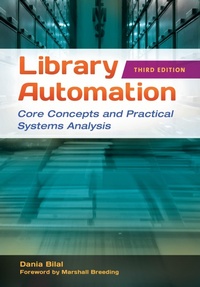
Library Automation
Core Concepts and Practical Systems Analysis
3rd Edition
Published on 26. March 2014
Book
Paperback/Softback
312 pages
978-1-59158-922-8 (ISBN)
Description
Recent advances in technology such as cloud computing, recent industry standards such as RFID, bibliographic standards like RDA and BIBFRAME, the increased adoption of open source integrated library systems (ILS), and continued shift in users' expectations have increased the complexity of the decision regarding ILS for all types of libraries.
Recent advances in technology such as cloud computing, recent industry standards such as RFID, bibliographic standards like RDA and BIBFRAME, the increased adoption of open source integrated library systems (ILS), and continued shift in users' expectations have increased the complexity of the decision regarding ILS for all types of libraries.
In a complete re-envisioning of the previous edition, Automating Media Centers and Small Libraries: A Microcomputer-Based Approach, Dania Bilal conceptualizes library automation in the Library Automation Life Cycle (LALC) that is informed by the systems development lifecycle (SDLC). She explains how the next-generation discovery services supported in the library services platforms (LSPs) provide a single point of access to library content in all types and formats, thereby offering a unified solution to managing library operations. The book covers methods of analyzing user requirements, describes how to structure these requirements in RFPs, and details proprietary and open-source integrated library systems (ILSs) and LSPs for school, public, special, and academic libraries. Up-to-date information is provided about ILS software installation and testing, software and hardware architecture such as single- and multi-tenant SaaS and Paas and IaaS, and usability assessment strategies for evaluating the ILS or LSP. The author concludes by describing what is likely coming next in the library automation arena.
Recent advances in technology such as cloud computing, recent industry standards such as RFID, bibliographic standards like RDA and BIBFRAME, the increased adoption of open source integrated library systems (ILS), and continued shift in users' expectations have increased the complexity of the decision regarding ILS for all types of libraries.
In a complete re-envisioning of the previous edition, Automating Media Centers and Small Libraries: A Microcomputer-Based Approach, Dania Bilal conceptualizes library automation in the Library Automation Life Cycle (LALC) that is informed by the systems development lifecycle (SDLC). She explains how the next-generation discovery services supported in the library services platforms (LSPs) provide a single point of access to library content in all types and formats, thereby offering a unified solution to managing library operations. The book covers methods of analyzing user requirements, describes how to structure these requirements in RFPs, and details proprietary and open-source integrated library systems (ILSs) and LSPs for school, public, special, and academic libraries. Up-to-date information is provided about ILS software installation and testing, software and hardware architecture such as single- and multi-tenant SaaS and Paas and IaaS, and usability assessment strategies for evaluating the ILS or LSP. The author concludes by describing what is likely coming next in the library automation arena.
Reviews / Votes
Bilal's book discusses all aspects of library automation, from gathering user requirements to system implementation to evaluating system use. . . . [A] welcome supplement to many of the textbooks that LIS students are required to purchase. . . . The information in this book is concise; it never becomes boring or difficult to read. . . . [A]n excellent addition to any introductory librarianship course. * VOYA * The third edition of Dania Bilal's Library Automation is a concise and well-organized introduction to library automation, focusing to a significant degree on workflow issues as well as technologies and situating automationwithin the framework of library management. It is written primarily for readers new to the information professions and has been designed to serve as an introductory text for a course on library automation or digital libraries. Its principal strength is its treatment of the planning processes associated with the installation of a new system or migration from an older system to a new one. . . . If your library supports a LIS educational program or a program for staff development, the third edition Bilal's Library Automation is probably worth adding to the collection. * Technical Services Quarterly *
More details
Edition
3rd edition
Language
English
Place of publication
United States
Publishing group
Bloomsbury Publishing Plc
Target group
Professional and scholarly
Dimensions
Height: 254 mm
Width: 178 mm
Thickness: 17 mm
Weight
590 gr
ISBN-13
978-1-59158-922-8 (9781591589228)
Copyright in bibliographic data and cover images is held by Nielsen Book Services Limited or by the publishers or by their respective licensors: all rights reserved.
Schweitzer Classification
Other editions
Additional editions
E-Book
03/2014
3rd Edition
Libraries Unlimited Inc
€49.99
Available for download
E-Book
03/2014
3rd Edition
Libraries Unlimited Inc
€49.99
Available for download
Previous edition
Book
02/2002
2nd Edition
Libraries Unlimited Inc
€68.28
Article exhausted; check for reprint
Persons
Dania Bilal is professor of information sciences at the School of Information Sciences, College of Communication and Information at the University of Tennessee, Knoxville, TN.
Content
Contents
Chapter 1: Integrated Library System (ILS) Defined
Chapter 2: Library Automation Life Cycle (LALC)--Phase I: System Identification and Planning
Chapter 3: Library Automation Life Cycle (LALC)--Phase II: Gathering User Requirements
Chapter 4: Library Automation Life Cycle (LALC)--Phase III: Structure User Requirements and Selecting a System
Chapter 5: Library Automation Life Cycle (LALC)--Phase IV: System Implementation, Part 1: Preparing the Collection for the Integrated Library System
Chapter 6: Library Automation Life Cycle (LALC)--Phase IV: System Implementation, Part 2: Installation, Testing, Facility, Training, and Tracking System Use
Chapter 7: Software, Hardware, and Network Architecture
Chapter 8: System (ILS) Migration
Chapter 9: Library Automation Life Cycle (LALC)--Phase V: Evaluating System Use Through Usability
Chapter 10: Library Automation "On the Move"
Appendix A: Sample Request for Proposal by the Brentwood Library, Brentwood, TN
References
Index
Chapter 1: Integrated Library System (ILS) Defined
Chapter 2: Library Automation Life Cycle (LALC)--Phase I: System Identification and Planning
Chapter 3: Library Automation Life Cycle (LALC)--Phase II: Gathering User Requirements
Chapter 4: Library Automation Life Cycle (LALC)--Phase III: Structure User Requirements and Selecting a System
Chapter 5: Library Automation Life Cycle (LALC)--Phase IV: System Implementation, Part 1: Preparing the Collection for the Integrated Library System
Chapter 6: Library Automation Life Cycle (LALC)--Phase IV: System Implementation, Part 2: Installation, Testing, Facility, Training, and Tracking System Use
Chapter 7: Software, Hardware, and Network Architecture
Chapter 8: System (ILS) Migration
Chapter 9: Library Automation Life Cycle (LALC)--Phase V: Evaluating System Use Through Usability
Chapter 10: Library Automation "On the Move"
Appendix A: Sample Request for Proposal by the Brentwood Library, Brentwood, TN
References
Index