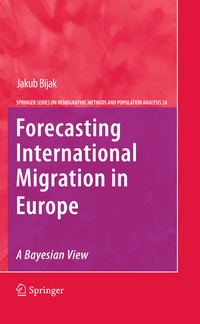
International migration is becoming an increasingly important element of contemporary demographic dynamics and yet, due to its high volatility, it remains the most unpredictable element of population change. In Europe, population forecasting is especially difficult because good-quality data on migration are lacking. There is a clear need for reliable methods of predicting migration since population forecasts are indispensable for rational decision making in many areas, including labour markets, social security or spatial planning and organisation.
In addressing these issues, this book adopts a Bayesian statistical perspective, which allows for a formal incorporation of expert judgement, while describing uncertainty in a coherent and explicit manner. No prior knowledge of Bayesian statistics is assumed. The outcomes are discussed from the point of view of forecast users (decision makers), with the aim to show the relevance and usefulness of the presented methods in practical applications.
Reviews / Votes
From the reviews:
"Forecasters know (or at least should know) that their forecasts never come true and that the magnitude of error increases with the forecast's horizon. Jakub Bijak proposes an elegant solution to this problem, namely an application of Bayesian statistics to migration forecasting. Methodology he proposes allows for quantification of forecast uncertainty, giving the forecast's user an idea of how accurate the forecast is. As in the past a transition form single-regional to multi-regional forecasts constituted a milestone in demographic forecasting, the methodology proposed by Bijak and advocated earlier by other demographers will constitute a similar milestone in the future." Dr Marek Kupiszewski, Director of the Central European Forum for Migration and Population Research in Warsaw
"The book is structured in five parts comprising twelve chapters. . The book is well-addressed to both policy- and theory-oriented readers, demographers and in particular statistical demographers, as well as to postgraduate students of demography and migration." (Christina Diakaki, Zentralblatt MATH, Vol. 1209, 2011)
Series
Edition
Language
Place of publication
Target group
Professional and scholarly
Research
Product notice
sewn/stitched
Cloth over boards
Illustrations
Dimensions
Height: 244 mm
Width: 167 mm
Thickness: 25 mm
Weight
ISBN-13
978-90-481-8896-3 (9789048188963)
DOI
10.1007/978-90-481-8897-0
Schweitzer Classification
List of tables and figures.- Part I. Introduction.- Part II. Explaining and forecasting migration.- Part III. Examples of Bayesian migration predictions.- Part IV. Perspectives of forecast makers and users.- Part V. Conclusion.- Acknowledgements.- References.- Subject Index .- Index of Names.- Annex A. Data sources and the preparatory work.- Annex B. WinBUGS code used in the presented Bayesian forecasts.- Annex C. Bayesian forecasts of selected migration flows in Europe.