

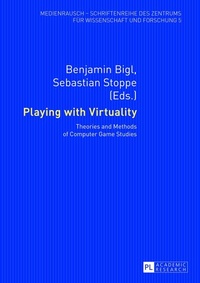
Playing with Virtuality
Theories and Methods of Computer Game Studies
Published on 5. June 2013
Book
Paperback/Softback
423 pages
978-3-631-64060-9 (ISBN)
Description
Computer games have fascinated millions of users for more than 30 years. Today, they constitute the strongest sector in the media-entertainment industry and are part of the experience of digital daily life. Computer Game Studies require a deep understanding of functional and communicational mechanisms of games that support the player's immersion in virtual worlds. Unfortunately, the discussion and the academic research about usage and effects of computer games mostly takes place isolated within different scientific contexts with various theoretical and methodological approaches. Therefore, this anthology combines the perspectives of Media Studies, Game Studies, and Communication Studies, and presents their findings in an interdisciplinary approach.
More details
Other editions
Additional editions
Benjamin Bigl | Sebastian Stoppe
Playing with Virtuality
Theories and Methods of Computer Game Studies
E-Book
10/2013
150th Edition
Peter Lang Verlag
€95.09
Available for download
Persons
Benjamin Bigl is a research assistant at the Institute for Communication and Media Studies at the University of Leipzig.
Sebastian Stoppe is a research associate at the Research Academy of the University of Leipzig.
Both editors are members of the Zentrum für Wissenschaft und Forschung | Medien e. V.
Content
Contents: Florian Kiefer: Involvierung ueber Involvierungsbrueche. Eine Strukturanalyse zur Beschreibung des Involvierungspotenzials von Call of Duty 4. Modern Warfare 21 - Matthias Stork: The spectacle of the interface: post-cinematic aesthetics in action computer games and films - Antonio Jose Planells De La Maza: Sorry, but our princess is in another castle! Towards a theory of video games as ludofictional worlds - Rafael Bienia: Das Computer-Rollenspiel-Genre - Stefan Hoeltgen: Game Circuits. Platform Studies und Medienarchaeologie als Methoden zur Erforschung von Computerspielen - Leticia Perani: Playing for serious reasons: brief notes on the influence of games in early HCI history - Gareth Schott/Jasper Van Vught/Raphael Marczak: Not knowing: locating player experience between ideal and active play - Benjamin Bigl: If the game goes on. Perceived transfer effects from virtual game worlds into everyday life - Sebastian Koch: Is there a blind spot? An empirical study on the awareness for violence in videogames - Anne Mette Thorhauge: Intended and negotiated gameplay: the interpretive power of the player - Danny Pannicke/Ruediger Zarnekow: Post-Adoption virtueller Welten - Claus Wohlgemuth: A qualitative study on immersion in videogames: avatar-identification as a factor influencing immersion - Janina Maric: Gaming at the e-sport event: Mediatized confrontations (re)negotiating sport, body and media - Arne Schroeder: Playing with the avatar: World of Warcraft avatars as play things - David Gause/Volker Gehrau: The effect of real world-cues on the use of online football manager games - Pascaline Lorentz: Video-ludological socialization - Gabriela T. Richard: Gender and gameplay: research and future directions - Juan F. Belmonte: Identity through free choice? The frontiers of sexuality and gender in computer games - Matthew Barr: Computer games and learning: the current state of play - Felix Kronenberg: Computer games as agentive and immersive spaces for language learners - Mirian Checa/Ana Belen Garcia Varela/Natalia Monjelat/David Herrero/Hector Del Castillo: Participatory culture and skills for new media learning - Michael Filsecker/Michael Kerres: Designing and studying educational games: Limitations of current design and research approaches in game-based learning - Jasper A. Friedrich: Computerspiele und Medienethik. Zur Systematik des Forschungsfeldes - Thomas-Gabriel Ruediger: Gamecrime und Metacrime - Kriminogene Aspekte virtueller Welten.