

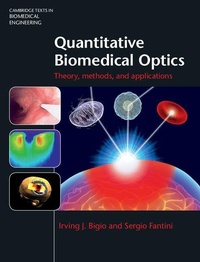
Quantitative Biomedical Optics
Theory, Methods, and Applications
Published on 7. January 2016
Book
Hardback
698 pages
978-0-521-87656-8 (ISBN)
Description
This is the textbook and reference resource that instructors, students, and researchers in biomedical optics have been waiting for. Comprehensive and up to date, it covers a broad range of areas in biomedical optics, from light interactions at the single-photon and single-biomolecule levels, to the diffusion regime of light propagation in tissue. Subjects covered include spectroscopic techniques (fluorescence, Raman, infrared, near-infrared, and elastic scattering), imaging techniques (diffuse optical tomography, photoacoustic imaging, several forms of modern microscopy, and optical coherence tomography), and laser-tissue interactions, including optical tweezers. Topics are developed from the fundamental principles of physical science, with intuitive explanations, while rigorous mathematical formalisms of theoretical treatments are also provided. For each technique, descriptions of relevant instrumentation and examples of biomedical applications are outlined, and each chapter benefits from references and suggested resources for further reading, and exercise problems with answers to selected problems.
Reviews / Votes
'Bigio and Fantini provide a long-needed introduction to the field of biomedical optics and biophotonics, adding spice to the presentation of the basics with historical and etymological gems. The conversational tone of the book is very welcome, and allows room for the clear explanation of subtleties not always clarified in other discussions. The book is a wonderful introduction to the field. It balances rigor with readability. Bravo!' Steven L. Jacques, Oregon Health Sciences University 'This book about biomedical optics provides a remarkably comprehensive introduction to the field. The text is carefully and affectionately developed with quantitative rigor, and it is written in a clear, easy-to-understand style that helps students develop intuition. The subject matter covers basics of linear and nonlinear optical spectroscopy, static and dynamic light scattering and more advanced topics such as light transport through highly scattering tissues, acousto-optics and opto-acoustics, and imaging from microscopy to tomography. The book should prove useful as a textbook for courses targeting both advanced undergraduates and graduate students in science, engineering and medicine. It will also be a valuable reference for researchers working at the frontiers of knowledge.' Arjun G. Yodh, University of Pennsylvania 'Bigio and Fantini's comprehensive text on biomedical optics provides a wonderful blend of accessible theory and practical guidance relevant to the design and application of biomedical optical systems. It should be required reading for all graduate students working in this area.' Rebecca Richards-Kortum, Rice University, Houston 'This textbook provides a broad survey of the field and covers the basics in a remarkably clear and easy to understand style. The authors have used the fundamental principles of physical science to describe subject matter and a quantitative approach for their applications. ... I highly recommend this textbook for upper-level undergraduate courses as well as more advanced graduate-level courses on biomedical optics. The book would also be useful for students of the biological sciences and as a reference resource for researchers in biomedical optics.' Reva Garg, Optics and Photonics News 'Educators in Biomedical Optics and Biophotonics have been long awaiting a comprehensive text to accompany their teaching in this rapidly growing field and this is as good as it gets. Educators may have their own bias, but this text provides a balanced approach giving due weight to the topics within the field and covering them comprehensively for most undergraduate and graduate courses in the field ... There is sufficient depth, detail and reference material for very specialized researchers to use this as their 'bible' and it should be on the desk of every serious educator and researcher in biomedical optics.' Martin Leahy, National University of Ireland, Galway 'Quantitative Biomedical Optics is really an excellent textbook for this course BMEN 360 Biomedical Analysis. It covers many basic and advanced topics for modern optical applications in not only biomedical engineering but also other area. It is very useful for students and researchers who want to use optics for their research.' Guiren Wang, University of South CarolinaMore details
Series
Language
English
Place of publication
Cambridge
United Kingdom
Target group
Professional and scholarly
Product notice
sewn/stitched
Cloth over boards
Illustrations
8 Tables, black and white; 49 Halftones, black and white; 163 Line drawings, black and white
Dimensions
Height: 251 mm
Width: 192 mm
Thickness: 38 mm
Weight
1608 gr
ISBN-13
978-0-521-87656-8 (9780521876568)
Copyright in bibliographic data and cover images is held by Nielsen Book Services Limited or by the publishers or by their respective licensors: all rights reserved.
Schweitzer Classification
Other editions
Additional editions
E-Book
01/2016
Cambridge University Press
€70.99
Available for download
E-Book
01/2016
Cambridge University Press
€60.49
Available for download
Persons
Irving Bigio is Professor of Biomedical Engineering and Electrical Engineering at Boston University. His research activities address the interactions of light with cellular and tissue structures on the microscopic and mesoscopic scales. He pioneered methods of elastic scattering spectroscopy and has developed practical diagnostic and sensing applications that have been demonstrated in large clinical studies. He has co-authored over 200 scientific publications and is an inventor on nine patents. Sergio Fantini is Professor of Biomedical Engineering at Tufts University. His research interests in biomedical optics are in the area of diffuse spectroscopy and imaging of biological tissue. He has contributed to the development of quantitative frequency-domain methods for absolute tissue oximetry, spectral imaging approaches to optical mammography, and the assessment of cerebral hemodynamics in the human brain. He has co-authored about 200 scientific publications and is an inventor on ten patents.
Content
1. Nomenclature; 2. Overview of tissue optical properties; 3. Introduction to biomedical statistics for diagnostic applications; 4. General concepts of tissue spectroscopy and instrumentation; 5. Autofluorescence spectroscopy and reporter fluorescence; 6. Raman and infrared spectroscopy of vibrational modes; 7. Elastic and quasi-elastic scattering from cells and small structures; 8. Diffuse reflectance spectroscopy at small source-detector separations; 9. Transport theory and the diffusion equation; 10. Continuous-wave methods for tissue spectroscopy; 11. Time-domain methods for tissue spectroscopy in the diffusion regime; 12. Frequency-domain methods for tissue spectroscopy in the diffusion regime; 13. Instrumentation and experimental methods for diffuse tissue spectroscopy; 14. Diffuse optical imaging and tomography; 15. In vivo applications of diffuse optical spectroscopy and imaging; 16. Combining light and ultrasound: acousto-optics and opto-acoustics; 17. Modern optical microscopy for biomedical applications; 18. Optical coherence tomography; 19. Optical tweezers and laser-tissue interactions.