

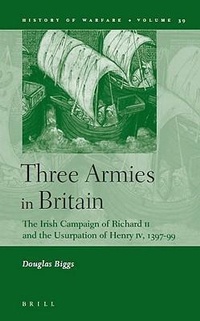
Three Armies in Britain
The Irish Campaign of Richard II and the Usurpation of Henry IV, 1397-99
Published on 29. August 2006
Book
Hardback
300 pages
978-90-04-15215-1 (ISBN)
Description
This work reexamines the political and military aspects of the Revolution of 1399 that removed Richard II and placed Henry of Lancaster on the English throne. It argues that Henry of Lancaster was not the "all conquering" hero of 1399 but was rather the leader of a coalition of disaffected noblemen who had old scores to settle with Richard II. It also proposes that Richard II was not an incompetent king whose personality disorder(s) and/or tyrannical behavior brought about his fall. Rather, it argues that the king was in no worse a political position in 1399 than in 1387 or even 1381. As on the previous two great crises of the reign, the king forwent a military option of dealing with his opponents and decided to let the issues of 1399 play themselves out on the field of politics. Both in 1381 and 1387 this tactic had proven effective and there was nothing to suggest in 1399 that it would not be so again.
Reviews / Votes
"The construction of the book is skillful. Biggs gives ample space to the recruitment and personnel of the armies, drawing extensively on unpublished royal financial records in the National Archives. This results in useful lists of those involved in military service as well as providing "hard data" on army sizes and composition as correctives to chronicle narratives. Biggs also maintains a robust chronological narrative and gives full attention to historiography. He takes us through the movements of each of the armies and their leaders, up to the denouement of Henry's seizure of the crown. He sets these military considerations against a succinct yet well-elucidated political background. ........ Biggs's book is an important contribution to the study of 1399"Anne Curry in American Historical Review 113/1,February 2008
"Dependent as it is on a close and considered analysis of a wide range of primary and secondary sources, this judgement will remain one that scholars must reckon with for some time to come....An authoritative revision of the traditional view of Richard [II]'s deposition. ...Biggs has thrown down a gauntlet that anyone working on the Lancastrian revolution will have to pick up....."
Jonathan Good in Speculum 83/1, Jan 2008
"Three Armies in Britain is a welcome addition to scholarship on the period and will undoubtedly go far in enlivening the debates surrounding the actions and motivations of the key figures involved in events between 1397- Biggs provides meticulous and carefully researched detail on the formation and deployment of the armies raised in the last year of Richard's reign, and his conclusions will have a valuable bearing on military history well beyond the immediate circumstances of the deposition of 1399."
Gwilym Dodd in Journal of Military History 72/1, Jan 2008
More details
Series
Language
English
Place of publication
Leiden
Netherlands
Target group
College/higher education
Product notice
sewn/stitched
Cloth over boards
Weight
694 gr
ISBN-13
978-90-04-15215-1 (9789004152151)
Copyright in bibliographic data and cover images is held by Nielsen Book Services Limited or by the publishers or by their respective licensors: all rights reserved.
Schweitzer Classification
Other editions
Additional editions

Douglas Biggs
Three Armies in Britain
The Irish Campaign of Richard II and the Usurpation of Henry IV, 1397-99
Software
09/2006
Brill
Unfortunately, price unknown
Available (delivery time upon request)
Person
Douglas L Biggs, Ph.D. (1996) in History, University of Minnesota, is Associate Professor of History at University of Nebraska - Kearney. He has published extensively on late medieval English political and military history including co-editing, Henry IV: The Establishment of the Regime, 1399-1406 (Woodbridge, 2003).
Content
Acknowledgements
Abbreviations
List of Illustrations
List of Maps
Chapter One: Historiographical Problems, and Perspectives, and the English Experience of War in the Late Fourteenth Century
Chapter Two: Richard II and the "Irish Question," 1390-99
Chapter Three: Henry of Lancaster and his Invasion of England, April-August 1399
Chapter Four: Edmund of Langley and the Defense of the Realm, June-July 1399
Chapter Five: Henry of Lancaster, the North, and his March to Berkeley, 28 June-27 July 1399
Chapter Six: The Choices of King Richard, June-August 1399
Chapter Seven: Henry of Lancaster: From Rebel to King, August-September, 1399
Chapter Eight: Conclusions: The Effect of the Lancastrian Revolution on the English Political Landscape
Select Bibliography
Index
Abbreviations
List of Illustrations
List of Maps
Chapter One: Historiographical Problems, and Perspectives, and the English Experience of War in the Late Fourteenth Century
Chapter Two: Richard II and the "Irish Question," 1390-99
Chapter Three: Henry of Lancaster and his Invasion of England, April-August 1399
Chapter Four: Edmund of Langley and the Defense of the Realm, June-July 1399
Chapter Five: Henry of Lancaster, the North, and his March to Berkeley, 28 June-27 July 1399
Chapter Six: The Choices of King Richard, June-August 1399
Chapter Seven: Henry of Lancaster: From Rebel to King, August-September, 1399
Chapter Eight: Conclusions: The Effect of the Lancastrian Revolution on the English Political Landscape
Select Bibliography
Index