


Teaching for Quality Learning at University
3rd Edition
Published on 16. November 2007
Book
Paperback/Softback
360 pages
978-0-335-22126-4 (ISBN)
Description
"This book is a sophisticated and insightful conceptualization of outcomes-based learning developed from the concept of constructive alignment. The first author has already made a significant contribution to the scholarship and practice of teaching and learning in universities...Together with the second author, there is now added richness through the practical implementation and practices. The ideas in this book are all tried and shown to contribute to more successful learning experience and outcome for students."
Denise Chalmers, Carrick Institute of Education, AustraliaTeaching for Quality Learning at University focuses on implementing a constructively aligned outcomes-based model at both classroom and institutional level. The theory, which is now used worldwide as a framework for good teaching and assessment, is shown to:
Assist university teachers who wish to improve the quality of their own teaching, their students' learning and their assessment of learning outcomes Aid staff developers in providing support for teachers Provide a framework for administrators interested in quality assurance and enhancement of teaching across the whole university
The book's "how to" approach addresses several important issues: designing high level outcomes, the learning activities most likely to achieve them in small and large classes, and appropriate assessment and grading procedures. It is an accessible, jargon-free guide to all university teachers interested in enhancing their teaching and their students' learning, and for administrators and teaching developers who are involved in teaching-related decisions on an institution-wide basis. The authors have also included useful web links to further material.
Denise Chalmers, Carrick Institute of Education, AustraliaTeaching for Quality Learning at University focuses on implementing a constructively aligned outcomes-based model at both classroom and institutional level. The theory, which is now used worldwide as a framework for good teaching and assessment, is shown to:
Assist university teachers who wish to improve the quality of their own teaching, their students' learning and their assessment of learning outcomes Aid staff developers in providing support for teachers Provide a framework for administrators interested in quality assurance and enhancement of teaching across the whole university
The book's "how to" approach addresses several important issues: designing high level outcomes, the learning activities most likely to achieve them in small and large classes, and appropriate assessment and grading procedures. It is an accessible, jargon-free guide to all university teachers interested in enhancing their teaching and their students' learning, and for administrators and teaching developers who are involved in teaching-related decisions on an institution-wide basis. The authors have also included useful web links to further material.
More details
Edition
3rd edition
Language
English
Place of publication
Milton Keynes
United Kingdom
Target group
Professional and scholarly
Dimensions
Height: 229 mm
Width: 152 mm
Thickness: 22 mm
Weight
640 gr
ISBN-13
978-0-335-22126-4 (9780335221264)
Copyright in bibliographic data and cover images is held by Nielsen Book Services Limited or by the publishers or by their respective licensors: all rights reserved.
Schweitzer Classification
Other editions
New editions
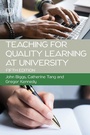
John Biggs | Catherine Tang | Gregor Kennedy
Teaching for Quality Learning at University 5e
What the Student does
Book
11/2022
5th Edition
Open University Press
€48.14
Available immediately
Persons
John Biggs held academic posts at the University of New England, NSW, Monash University, Melbourne and the University of Alberta, Edmonton, Canada before being appointed Professor of Education at the University of Newcastle, NSW, then Professor of Education at the University of Hong Kong. He retired early to develop his work on constructive alignment and to write fiction. He returned to Hong Kong in 1999, this time to the Department of Psychology and is currently Honorary Professor in that Department.
Catherine Tang obtained her PhD in Education from the University of Hong Kong in 1991, her dissertation focusing on assessment practices that aligned directly to course objectives. She has been engaged in staff development ever since, holding the posts of Deputy Director, later Head, of the Educational Development Centre at the Hong Kong Polytechnic University and Head of the Centre for Learning, Teaching and Supervision at the Hong Kong Institute of Education. She now works as an educational consultant in Hobart, Australia.
Catherine Tang obtained her PhD in Education from the University of Hong Kong in 1991, her dissertation focusing on assessment practices that aligned directly to course objectives. She has been engaged in staff development ever since, holding the posts of Deputy Director, later Head, of the Educational Development Centre at the Hong Kong Polytechnic University and Head of the Centre for Learning, Teaching and Supervision at the Hong Kong Institute of Education. She now works as an educational consultant in Hobart, Australia.
Content
The changing scene in university teaching
Teaching according to how students learn
Setting the stage for effective teaching
Using constructive alignment in outcomes-based teaching and learning
Designing intended learning outcomes
Contexts for effective teaching and learning
Teaching/learning activities for declarative knowledge
Teaching/learning activities for functioning knowledge
Aligning Assessment with Intended Learning Outcomes: Principles
Assessment and grading for declarative knowledge
Assessment and grading for functioning knowledge
Implementing constructive alignment
Constructive alignment as implemented: Some examples
Index
Teaching according to how students learn
Setting the stage for effective teaching
Using constructive alignment in outcomes-based teaching and learning
Designing intended learning outcomes
Contexts for effective teaching and learning
Teaching/learning activities for declarative knowledge
Teaching/learning activities for functioning knowledge
Aligning Assessment with Intended Learning Outcomes: Principles
Assessment and grading for declarative knowledge
Assessment and grading for functioning knowledge
Implementing constructive alignment
Constructive alignment as implemented: Some examples
Index