

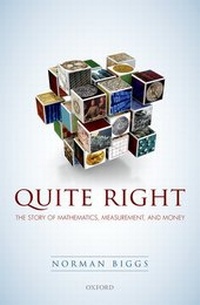
Quite Right
The Story of Mathematics, Measurement, and Money
Published on 11. February 2016
Book
Hardback
186 pages
978-0-19-875335-3 (ISBN)
Description
Mathematics did not spring spontaneously into life, with rules set in stone for all time. Its story is closely linked with the problems of measurement and money that have often driven its progress. Quite Right explains how mathematical ideas have gradually emerged since prehistoric times, so that they pervade almost every aspect of life in the twenty-first century.
Many histories of mathematics focus on the activities of those for whom mathematics itself was the motivation. Professor Biggs adopts a wider viewpoint. Making use of new discoveries of artefacts and documents, he explains the part that mathematics has played in the human story, and what that tells us about the nature of mathematics. The story reveals the power and beauty of mathematical concepts, which often belie their utilitarian origins. The twin paradigms of logical justification and algorithmic calculation recur throughout the book. No other book tells the story of mathematics, measurement, and money in this way.
Includes secontions on:
-- The origins of calculation in ancient and medieval times
-- How mathematics provides answers that are right, and what that means
-- The impact of trade and the use of money on the development of mathematical algorithms
-- The use of mathematics for secure communications
-- How money and information are linked in our electronic world
Quite Right is a fascinating story, suitable for anyone interested in the mathematical foundations of the world we live in.
Norman Biggs is Professor (Emeritus) of Mathematics at the London School of Economics. He is the author of 12 books, including a perennial best-selling book Discrete Mathematics (Oxford University Press). He has a special interest in measurement and was Chair of the International Society of Weights and Scales Collectors from 2009-14. He served as a Vice President of the British Society for the History of Mathematics in 2014 and is an active member of the British Numismatic Society.
'This is a history of mathematics book with a difference. Instead of the usual chronological sequence of events, presented with mathematical hindsight (interpreting mathematical achievements from a modern point of view), this book tries to see things more from the context of the time - presenting the topics thematically rather than strictly chronologically, and including results and problems only when they fit into the themes ... the level of exposition is first-rate, with a far greater fluency than most mathematical writers can attain ... I am very happy to recommend it wholeheartedly.' Professor Robin Wilson, University of Oxford
Many histories of mathematics focus on the activities of those for whom mathematics itself was the motivation. Professor Biggs adopts a wider viewpoint. Making use of new discoveries of artefacts and documents, he explains the part that mathematics has played in the human story, and what that tells us about the nature of mathematics. The story reveals the power and beauty of mathematical concepts, which often belie their utilitarian origins. The twin paradigms of logical justification and algorithmic calculation recur throughout the book. No other book tells the story of mathematics, measurement, and money in this way.
Includes secontions on:
-- The origins of calculation in ancient and medieval times
-- How mathematics provides answers that are right, and what that means
-- The impact of trade and the use of money on the development of mathematical algorithms
-- The use of mathematics for secure communications
-- How money and information are linked in our electronic world
Quite Right is a fascinating story, suitable for anyone interested in the mathematical foundations of the world we live in.
Norman Biggs is Professor (Emeritus) of Mathematics at the London School of Economics. He is the author of 12 books, including a perennial best-selling book Discrete Mathematics (Oxford University Press). He has a special interest in measurement and was Chair of the International Society of Weights and Scales Collectors from 2009-14. He served as a Vice President of the British Society for the History of Mathematics in 2014 and is an active member of the British Numismatic Society.
'This is a history of mathematics book with a difference. Instead of the usual chronological sequence of events, presented with mathematical hindsight (interpreting mathematical achievements from a modern point of view), this book tries to see things more from the context of the time - presenting the topics thematically rather than strictly chronologically, and including results and problems only when they fit into the themes ... the level of exposition is first-rate, with a far greater fluency than most mathematical writers can attain ... I am very happy to recommend it wholeheartedly.' Professor Robin Wilson, University of Oxford
Reviews / Votes
Recommended. * CHOICE * The author writes with a clear and engaging style, enriched here and there with witty comments. * Peter Giblin, The Mathematical Gazette * This is an excellent popular history of mathematics. * Charles Ashbacher, Mathematical Association of America Reviews * It is the different view on the history of mathematical ideas as compared to other books which renders this book a gem. * Thomas Sonar, Zentralblatt MATH * [A]n excellent history of mathematics ... A lot of territory is covered very well in a relatively short read. Thus, if you want an brief introduction to the history of mathematics, either for yourself, or to use as part of a first course on the subject for students, then you would be Quite Right to make this book your choice. * Mark McCartney, London Mathematical Society Newsletter * The text is quite accessible ... The useful illustrations and schemes are in gray-scale and to the point. * Adhemar Bultheel, EMS Newsletter * I would recommend this book to those who are interested in a unique perspective of the history of mathematics. * Marsha Nicol Guntharp, Mathematics Teacher *More details
Language
English
Place of publication
Oxford
United Kingdom
Target group
College/higher education
Professional and scholarly
Product notice
sewn/stitched
Cloth over boards
Dimensions
Height: 241 mm
Width: 159 mm
Thickness: 22 mm
Weight
454 gr
ISBN-13
978-0-19-875335-3 (9780198753353)
Copyright in bibliographic data and cover images is held by Nielsen Book Services Limited or by the publishers or by their respective licensors: all rights reserved.
Schweitzer Classification
Other editions
Additional editions
E-Book
02/2016
1st Edition
OUP eBook
€18.99
Available for download
E-Book
02/2016
1st Edition
OUP eBook
€16.99
Available for download
Person
Norman Biggs has been a university lecturer for over 50 years. After graduating from the University of Cambridge he became an Assistant Lecturer at Southampton University in 1963, and subsequently taught at Royal Holloway and the London School of Economics. Since 2006 he has been Emeritus Professor at the LSE and has continued to give lectures on information theory and the history of mathematics.
Content
1. The Unwritten Story ; 2. The Dawn of Civilization ; 3. From Tax and Trade to Theorems ; 4. The Age of Algorithms ; 5. The End of the Middle Ages ; 6. A New World of Mathematics ; 7. Mathematics Ascending ; 8. Taking a Chance ; 9. Modelling and Measuring ; 10. Mathematics and Money in the Age of Information ; 11. Can Mathematics Keep Us Safe