

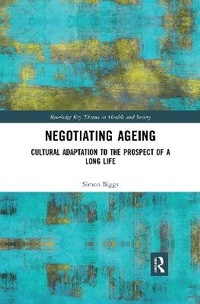
Negotiating Ageing
Cultural Adaptation to the Prospect of a Long Life
1st Edition
Published on 11. September 2019
Book
Paperback/Softback
178 pages
978-0-367-43101-3 (ISBN)
Description
The world is growing older and this is a historically unprecedented phenomenon. Negotiating such change, personally, socially and for governments and international organisations requires an act of cultural adaptation. Two key questions arise: What is the purpose of a long life? and How do we adapt to societies where generations are of approximately the same size? A number of pre-existing narratives can be identified; however, it is argued that contemporary policies have produced a premature answer which may eclipse the potential arising from lifecourse change.
In this book Simon Biggs discusses ways of interrogating these questions and the adaptations we make to them. Four major areas, all of which have been suggested as solutions to population ageing, are critically assessed, including work as an answer, the relationship between work, ageing and health, narratives of spirit, belief and wisdom, the body and the natural, anti-ageing medicine, critical approaches to dementia, plus family and intergenerational relations.
This book is particiularly useful for those trying to make sense of population ageing and negotiate solutions. It describes a number of concepts that can be used to assess what we are told about a long life and how generations can adapt together.
With the cultural landscape moving away from traditional interpretations of old age, the question of adult ageing is of growing interest to a number of groups. This book is essential reading for social and health-care workers, other helping professionals, policy makers, social scientists and all who encounter the prospect of a long life.
In this book Simon Biggs discusses ways of interrogating these questions and the adaptations we make to them. Four major areas, all of which have been suggested as solutions to population ageing, are critically assessed, including work as an answer, the relationship between work, ageing and health, narratives of spirit, belief and wisdom, the body and the natural, anti-ageing medicine, critical approaches to dementia, plus family and intergenerational relations.
This book is particiularly useful for those trying to make sense of population ageing and negotiate solutions. It describes a number of concepts that can be used to assess what we are told about a long life and how generations can adapt together.
With the cultural landscape moving away from traditional interpretations of old age, the question of adult ageing is of growing interest to a number of groups. This book is essential reading for social and health-care workers, other helping professionals, policy makers, social scientists and all who encounter the prospect of a long life.
More details
Series
Language
English
Place of publication
London
United Kingdom
Publishing group
Taylor & Francis Ltd
Target group
College/higher education
Professional and scholarly
Dimensions
Height: 234 mm
Width: 156 mm
Weight
294 gr
ISBN-13
978-0-367-43101-3 (9780367431013)
Copyright in bibliographic data and cover images is held by Nielsen Book Services Limited or by the publishers or by their respective licensors: all rights reserved.
Schweitzer Classification
Other editions
Additional editions
E-Book
11/2017
Routledge
€69.99
Available for download
E-Book
11/2017
Routledge
€69.99
Available for download
Book
11/2017
1st Edition
Routledge
€222.84
Shipment within 10-20 days
Person
Simon Biggs, PhD. Professor of Gerontology & Social Policy
School of Social & Political Sciences, Melbourne University, Australia.
School of Social & Political Sciences, Melbourne University, Australia.
Content
Foreword; Acknowledgements; Chapter 1: The Promise of a Long Life; Chapter 2: Interrogating Personal and Intergenerational Ageing; Chapter 3: Work to the Rescue?; Chapter 4 Is Work Good or Bad for Health?; Chapter 5: Spirit, Belief and the In-between; Chapter 6: Lifecourse, Gerotranscendence and Wisdom; Chapter 7: The Ageing Body, the Social and the Natural; Chapter 8: Anti Ageing; Chapter 9: Dementia; Chapter 10: Family and Generations; Conclusions; Index