

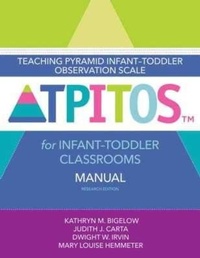
Teaching Pyramid Infant-Toddler Observation Scale (TPITOS (TM)) for Infant-Toddler Classrooms
Manual
Published on 30. November 2018
Book
Paperback/Softback
120 pages
978-1-68125-242-1 (ISBN)
Description
A child's early teachers and caregivers play a vital role in supporting social-emotional development-and that's why more and more center-based infant and toddler programs are adopting the evidence-based Pyramid Model for Promoting Social Emotional Competence in Infants and Young Children. If your program is one of them, TPITOS (TM) is the essential tool you need to ensure that infant-toddler teachers are using the Pyramid Model practices with fidelity.
Modeled after the Teaching Pyramid Observation Tool (TPOT (TM)) for Preschool Classrooms, TPITOS is for early childhood settings caring for infants and toddlers from birth to 3 years of age. Focusing on teacher practices and classroom environment variables, TPITOS measures how well your program's staff is fostering responsive, nurturing relationships with children and promoting strong social-emotional development in their earliest years.
How It Works :
A trained TPITOS administrator conducts a 2-hour classroom observation, followed by an interview with the teacher being observed. The observer completes three types of items:
1) Observational Items (practices and environmental factors noted during the observation),
2) Interview Items (practices scored based on the teacher's responses during the interview), and
3) Red Flags (practices that are not consistent with the Pyramid Model). Results of TPITOS show your program which Pyramid Model practices are being implemented effectively-and what teachers need to focus on to ensure positive social-emotional outcomes for infants and toddlers.
Modeled after the Teaching Pyramid Observation Tool (TPOT (TM)) for Preschool Classrooms, TPITOS is for early childhood settings caring for infants and toddlers from birth to 3 years of age. Focusing on teacher practices and classroom environment variables, TPITOS measures how well your program's staff is fostering responsive, nurturing relationships with children and promoting strong social-emotional development in their earliest years.
How It Works :
A trained TPITOS administrator conducts a 2-hour classroom observation, followed by an interview with the teacher being observed. The observer completes three types of items:
1) Observational Items (practices and environmental factors noted during the observation),
2) Interview Items (practices scored based on the teacher's responses during the interview), and
3) Red Flags (practices that are not consistent with the Pyramid Model). Results of TPITOS show your program which Pyramid Model practices are being implemented effectively-and what teachers need to focus on to ensure positive social-emotional outcomes for infants and toddlers.
More details
Edition
Research Edition
Language
English
Place of publication
Baltimore
United States
Target group
Primary & secondary/elementary & high school
Product notice
Paperback (trade)
Unsewn / adhesive bound
Dimensions
Height: 277 mm
Width: 213 mm
Thickness: 8 mm
Weight
295 gr
ISBN-13
978-1-68125-242-1 (9781681252421)
Copyright in bibliographic data and cover images is held by Nielsen Book Services Limited or by the publishers or by their respective licensors: all rights reserved.
Schweitzer Classification
Persons
Kathryn Bigelow, Ph.D., is an Assistant Research Professor at the Juniper Gardens Children's Project in the Institute for Life Span Studies at the University of Kansas. Her research focuses on interventions for culturally and linguistically diverse children and families experiencing multiple risks. Specifically, her work has addressed early childhood language and social-emotional development and the translation of evidence-based interventions for parents, care providers, home visitors, and early intervention providers within both center-based and home-based early childhood education programs. Dr. Bigelow's work in these areas maintains an emphasis on implementation fidelity, and how technology can promote engagement and enhance the implementation of evidence-based intervention. She has been the PI or Co-PI on projects focusing on child language promotion, and on parent engagement in home visiting. Currently, she directs, with Drs. Carta, Irvin, and Hemmeter, an Institute of Education Sciences-funded (IES) research project focused on developing the Infant-Toddler Pyramid Model, a three-tiered model to promote social-emotional outcomes for infants and toddlers, based on the TPITOS.
Judith J. Carta, Ph.D., is a Senior Scientist in the Institute for Life Span Studies, Professor of Special Education, and the Interim Director of the Juniper Gardens Children's Project at the University of Kansas. Her research focuses on developing strategies to minimize the effects of poverty on children's outcomes, designing practices that teachers and parents can use to promote children's early learning and social-emotional development, methods for monitoring the progress of young children, and strategies for promoting family engagement in early intervention programs. She has been the PI of several multi-site research projects and centers funded by the National Institutes of Health, the Institute of Educational Sciences, and the Administration on Children and Families. She currently co-directs an IES-funded project to develop the Infant-Toddler Pyramid Model, a three-tiered model to promote social-emotional outcomes for infants and toddlers, based on the TPITOS. She was a member of the Federal Advisory Panel on Head Start Research and Evaluation, Division of Early ChildhoodaEUR (TM)s Commission on Recommended Practices, and served as the Editor of Topics in Early Childhood Special Education as well as the boards of numerous scientific journals. She received the Mary E. McEvoy Service to the Field Award from the Division for Early Childhood.
Dwight W. Irvin, Ph.D., is an Assistant Research Professor in the Life Span Institute at the University of Kansas Medical Center. He was a Response to Intervention (RTI) in Early Childhood Postdoctoral Fellow at Juniper Gardens Children's Project and a Postdoctoral Scholar in Department of Education Leadership at the University of Kentucky. His research focuses on the use of wearable sensors to better understand the link between adult-child and child-peer interactions and the social competence of young children at-risk for or with identified disabilities in the classroom, home and community.
Mary Louise Hemmeter, Ph.D., is a professor in the Department of Special Education at Vanderbilt University. She teaches courses, advises students, and conducts research on early childhood issues. She is the cofaculty director of the Susan Gray School for Children, which is an early childhood program for children with and without disabilities. Her research focuses on effective instruction, social-emotional development and challenging behavior, translating research to practice, and effective approaches to professional development.
Currently, she directs an Institute of Education Sciences-funded research project focused on the efficacy of implementing the Teaching Pyramid in classrooms, and she works on the National Center on Quality Teaching and Learning and the Office of Special Education Programs-funded Technical Assistance Center on Social Emotional Interventions. She is a coeditor of the Journal of Early Intervention and serves on the editorial boards of other major journals in early childhood special education. She served as President of the Council for Exceptional Children's Division for Early Childhood (DEC) and received the Merle B. Karnes award from DEC.
Judith J. Carta, Ph.D., is a Senior Scientist in the Institute for Life Span Studies, Professor of Special Education, and the Interim Director of the Juniper Gardens Children's Project at the University of Kansas. Her research focuses on developing strategies to minimize the effects of poverty on children's outcomes, designing practices that teachers and parents can use to promote children's early learning and social-emotional development, methods for monitoring the progress of young children, and strategies for promoting family engagement in early intervention programs. She has been the PI of several multi-site research projects and centers funded by the National Institutes of Health, the Institute of Educational Sciences, and the Administration on Children and Families. She currently co-directs an IES-funded project to develop the Infant-Toddler Pyramid Model, a three-tiered model to promote social-emotional outcomes for infants and toddlers, based on the TPITOS. She was a member of the Federal Advisory Panel on Head Start Research and Evaluation, Division of Early ChildhoodaEUR (TM)s Commission on Recommended Practices, and served as the Editor of Topics in Early Childhood Special Education as well as the boards of numerous scientific journals. She received the Mary E. McEvoy Service to the Field Award from the Division for Early Childhood.
Dwight W. Irvin, Ph.D., is an Assistant Research Professor in the Life Span Institute at the University of Kansas Medical Center. He was a Response to Intervention (RTI) in Early Childhood Postdoctoral Fellow at Juniper Gardens Children's Project and a Postdoctoral Scholar in Department of Education Leadership at the University of Kentucky. His research focuses on the use of wearable sensors to better understand the link between adult-child and child-peer interactions and the social competence of young children at-risk for or with identified disabilities in the classroom, home and community.
Mary Louise Hemmeter, Ph.D., is a professor in the Department of Special Education at Vanderbilt University. She teaches courses, advises students, and conducts research on early childhood issues. She is the cofaculty director of the Susan Gray School for Children, which is an early childhood program for children with and without disabilities. Her research focuses on effective instruction, social-emotional development and challenging behavior, translating research to practice, and effective approaches to professional development.
Currently, she directs an Institute of Education Sciences-funded research project focused on the efficacy of implementing the Teaching Pyramid in classrooms, and she works on the National Center on Quality Teaching and Learning and the Office of Special Education Programs-funded Technical Assistance Center on Social Emotional Interventions. She is a coeditor of the Journal of Early Intervention and serves on the editorial boards of other major journals in early childhood special education. She served as President of the Council for Exceptional Children's Division for Early Childhood (DEC) and received the Merle B. Karnes award from DEC.
Content
About the Online Materials
About the Authors
Acknowledgments
Chapter 1: Introduction to The Teaching Pyramid Infant-Toddler Observation Scale
Chapter 2: Overview of The Pyramid Model and The Teaching Pyramid Infant Toddler Observation Scale
Chapter 3: Using the Teaching Pyramid Infant-Toddler Observation Scale
Chapter 4: Teaching Pyramid Infant-Toddler Observation Scale Scoring Guidance
Chapter 5: Scoring the Teaching Pyramid Infant-Toddler Observation Scale and Summarizing Results
Chapter 6: Using the Teaching Pyramid Infant-Toddler Observation Scale to Support
Implementation of Effective Practices: Case Studies
Appendix A Key to TPITOS Items and Abbreviations
Appendix B Indicators Which Can Be Scored "Not Applicable"
Appendix C Indicators with Scoring Criteria Regarding Frequency of Observed Behavior
References
Related Readings and Resources
Frequently Asked Questions
Index
About the Authors
Acknowledgments
Chapter 1: Introduction to The Teaching Pyramid Infant-Toddler Observation Scale
Chapter 2: Overview of The Pyramid Model and The Teaching Pyramid Infant Toddler Observation Scale
Chapter 3: Using the Teaching Pyramid Infant-Toddler Observation Scale
Chapter 4: Teaching Pyramid Infant-Toddler Observation Scale Scoring Guidance
Chapter 5: Scoring the Teaching Pyramid Infant-Toddler Observation Scale and Summarizing Results
Chapter 6: Using the Teaching Pyramid Infant-Toddler Observation Scale to Support
Implementation of Effective Practices: Case Studies
Appendix A Key to TPITOS Items and Abbreviations
Appendix B Indicators Which Can Be Scored "Not Applicable"
Appendix C Indicators with Scoring Criteria Regarding Frequency of Observed Behavior
References
Related Readings and Resources
Frequently Asked Questions
Index