

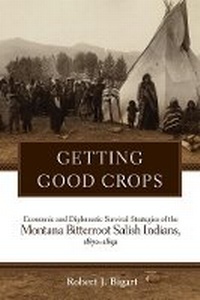
Getting Good Crops
Economic and Diplomatic Survival Strategies of the Montana Bitterroot Salish Indians, 1870-1891
Will be published approx. on 30. September 2010
Book
Hardback
304 pages
978-0-8061-4133-6 (ISBN)
Description
Tells how one American Indian tribe survived despite overwhelming challengesIn 1870, the Bitterroot Salish Indians - called ""Flatheads"" by the first white explorers to encounter them - were a small tribe living on the western slope of the Northern Rocky Mountains in Montana Territory. Pressures on the Salish were intensifying during this time, from droughts and dwindling resources to aggressive neighboring tribes and Anglo-American expansion. In 1891, the economically impoverished Salish accepted government promises of assistance and retreated to the Flathead Reservation, more than sixty miles from their homeland.
In Getting Good Crops, Robert J. Bigart examines the full range of available sources to explain how the Salish survived into the twentieth century, despite their small numbers, their military disadvantages, and the aggressive invasion of white settlers who greedily devoured their land and its natural resources.
Bigart argues that a key to the survival of the Salish, from the early nineteenth century onward, was their diplomatic agility and willingness to form strategic alliances and friendships with non-Salish peoples. In doing so, the Salish navigated their way through multiple crises, relying more on their wits than on force. The Salish also took steps to sustain themselves economically. Although hunting and gathering had been their mainstay for centuries, the Salish began farming - ""getting good crops"" - to feed themselves because buffalo were becoming increasingly scarce.
Raised on the Flathead Reservation himself, the author is seeking to convey the Salish story from their perspective, despite the paucity of written Salish testimony. What emerges is a picture - both inspiring and heartbreaking - of a people maintaining autonomy against all odds.
In Getting Good Crops, Robert J. Bigart examines the full range of available sources to explain how the Salish survived into the twentieth century, despite their small numbers, their military disadvantages, and the aggressive invasion of white settlers who greedily devoured their land and its natural resources.
Bigart argues that a key to the survival of the Salish, from the early nineteenth century onward, was their diplomatic agility and willingness to form strategic alliances and friendships with non-Salish peoples. In doing so, the Salish navigated their way through multiple crises, relying more on their wits than on force. The Salish also took steps to sustain themselves economically. Although hunting and gathering had been their mainstay for centuries, the Salish began farming - ""getting good crops"" - to feed themselves because buffalo were becoming increasingly scarce.
Raised on the Flathead Reservation himself, the author is seeking to convey the Salish story from their perspective, despite the paucity of written Salish testimony. What emerges is a picture - both inspiring and heartbreaking - of a people maintaining autonomy against all odds.
More details
Language
English
Place of publication
Oklahoma
United States
Target group
Professional and scholarly
Illustrations
10 black & white illustrations, 1 map
Dimensions
Height: 229 mm
Width: 152 mm
Thickness: 26 mm
Weight
596 gr
ISBN-13
978-0-8061-4133-6 (9780806141336)
Copyright in bibliographic data and cover images is held by Nielsen Book Services Limited or by the publishers or by their respective licensors: all rights reserved.
Schweitzer Classification
Person
Robert J. Bigart is Librarian Emeritus at Salish Kootenai College, Pablo, Montana. He is the author or editor of numerous publications, including A Pretty Village: Documents of Worship and Culture Change, St. Ignatius Mission, Montana, 1880-1889.