


Handbook of Web Surveys
Published on 5. July 2021
Book
Hardback
528 pages
978-1-119-37168-7 (ISBN)
Description
Handbook of Web Surveys, Second Edition provides a theoretical yet practical approach to creating and conducting web surveys. This revised edition contains new and expanded topical coverage. Major new features of this edition include actualization of the context in which web surveys are taking place, consideration of new methods and results, and new sections on mobile survey and adaptive survey design. This book also includes an extended revision of coverage of web panels, R-indicators, and the framework of the survey process. The introduction contains a new description of the environment in which web surveys are administered and problems and opportunities arising from the recent trends in the digital context. Next is a thorough coverage of web surveys, followed by a chapter on a framework for steps and errors in web surveys. Sampling for web surveys is discussed, followed by coverage of errors in web surveys. Web surveys and other modes of data collection are examined. Next is a chapter on designing a web survey questionnaire. Other topics covered include adaptive and responsive design, mixed-mode surveys, the problem of undercoverage, and weighting adjustment techniques. The book concludes with a discussion on the use of response propensities and web panels. Each chapter includes updated examples and exercises that incorporate real survey data. This book is appropriate for academics and practitioners in the fields of business, government, economics, and the social sciences who apply survey methods or construct, conduct, or analyze data from surveys in their everyday work.
More details
Series
Edition
2nd Edition
Language
English
Place of publication
Hoboken
United States
Publishing group
John Wiley and Sons Ltd
Target group
Professional and scholarly
Dimensions
Height: 233 mm
Width: 158 mm
Thickness: 31 mm
Weight
1152 gr
ISBN-13
978-1-119-37168-7 (9781119371687)
Schweitzer Classification
Other editions
Additional editions
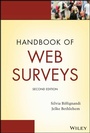
Silvia Biffignandi | Jelke Bethlehem
Handbook of Web Surveys
E-Book
04/2021
2nd Edition
Wiley
€146.99
Available for download
Silvia Biffignandi | Jelke Bethlehem
Handbook of Web Surveys
E-Book
04/2021
2nd Edition
Wiley
€146.99
Available for download
Previous edition
Jelke Bethlehem | Silvia Biffignandi
Handbook of Web Surveys
Book
12/2011
Wiley
€177.50
Shipment within 10-20 days
Persons
Jelke Bethlehem, PhD, is Professor by special appointment in survey methodology at Leiden University, Netherlands. He is also senior methodological advisor at Statistics Netherlands in The Hague. He is coauthor of Handbook of Nonresponse in Household Surveys, Handbook of Web Surveys (First Edition), and Applied Survey Methods: A Statistical Perspective, published by Wiley. Dr. Bethlehem is also coeditor of Online Panel Research: A Data Quality Perspective and Computer Assisted Survey Information Collection, also published by Wiley.
Silvia Biffignandi is Professor of Economic and Business Statistics at the University of Bergamo in Italy, where she is also Director of the Centre for Statistical Analyses and Survey Interviewing (CASI). Dr. Biffignandi is coauthor of Handbook of Web Surveys (First Edition), published by Wiley.
Content
1 THE ROAD TO WEB SURVEYS
1. Introduction
2. Theory
1.2.1 Everlasting Demand for Statistical Information
1.2.2 The Dawn of Sampling Theory
1.2.3 Traditional Data Collection
1.2.4 The Era of Computer-Assisted Interviewiing
1.2.5 The Conquest of Web
1.2.6 Toward integration of web sources or to web-multisources
1.3 Application
1.4 Summary
Key Terms
Execises
References
2. ABOUT WEB SURVEYS
2.1 introduction
2.2. Theory
2.2.1 Typical Survey Situation
2.2.2 Why On line Data Collection?
2.2.3 Areas of Application
2.2.4 Trends in Web Surveys
2.3 Application
2.4 Summary
Key Terms
Execises
References
2. A FRAMEWORK FOR STEPS AND ERRORS IN WEB SURVEYS
3.1 Introduction
3.2 Theory
3.2.1 Steps
3.2.2 Steps
3.2.3 Steps
3.2.4 Comments for an expanded framework
3.3 Application
3.4 Summary
Key Terms
Execises
References
4 SAMPLING FOR WEB SURVEYS
4.1 Introduction
4.2 Theory
4.2.1 Target Population
4.2.2 Sampling Frames
4.2.3 Basic Concepts of Sampling
4.2.4 Simple Random Sampling
4.2.5 Determining the Sample Size
4.2.6 Some Other Sampling Designs
4.2.7 Estimation Procedures
4.3 Application
4.4 Summary
Key Terms
Exercises
References
5 ERRORS IN WEB SURVEYS
4.1 Introduction,
4.2 Theory
4.2.1 Measurement Errors
4.2.2 Nonresponse
4.3 Application
4.3.1 The Safety Monitor
4.3.2 Measurement Errors
4.3.3 Nonresponse
4.4 Summary
Key Terms
Exercises
References
6 WEB SURVEYS AND OTHER MODES OF DATA COLLECTION
6.1 Introduction
6.1.1 Modes of Data Collection
6.1.2 The Choice of the Modes of Data Collection
6.2 Theory
6.2.1 Face-To-Face Surveys
6.2.2 Telephone surveys
6.2.3 Mail Surveys
6.2.4 Web surveys
6.2.5 Mobile surveys
6.3 Application
5.4 Summary
Key Terms
Exercises
References
7 DESIGNING A WEB SURVEY QUESTIONNAIRE
7.1 Introduction
7.2 Theory
7.2.1 The Road Map Toward a Web Questionnaire
7.2.2 The Language of Questions
7.2.3 Basic Concepts of Visualization
7.2.4 Aswers types (response format)
7.2.5 Web Questionnaires and Paradata
7.2.6 Trends in Web Questionnaire Design and Visualization
7.3 Application
7.4 Summary
Key Terms
Exercises
References
8 ADAPTIVE AND RESPONSIVE DESIGN
8.1 Introduction,
8.2 Theory
8.2.1 Terminology and rationale
8.2.2 Quality and costs functions
8.2.3 Strategy allocation and optimization
8.3 Application
8.4 Summary
Key Terms
Exercises
References
9 MIXED-MODE SURVEYS
9.1 Introduction,
9.2 Theory
9.2.1 Types of Mixed Mode designs
9.2.2 Mode and device effect
9.2.3 Preventing mode effects through questionnaire design
9.2.4 Avoiding mode effects b data collection design
9.2.5 Adjusting for mode effects
9.3 Application
9.4 Summary
Key Terms
Exercises
References
10 THE PROBLEM OF UNDER-COVERAGE
10.1 Introduction
10.2 Theory
10.2.1 The Internet Population
10.2.2 A Random Sample From the Internet Population
10.2.3 Reducing the Noncoverage Bias
10.2.4 Mixed-Mode Data Collection
10.3 Application
10.4 Summary
Key Terms
Exercises
References
11 THE PROBLEM OF SELF-SELECTION
11.1 Introduction
11.2 Theory,
11.2.1 Basic Sampling Theory
11.2.2 A Self-Selection Sample from the Internet Population
11.2.3 Reducing the Self-Selection Bias
11.3 Application
11.4 Summary
Key Terms
Exercises
References
12 WEIGHTING ADJUSTMENT TECHNIQUES
12.1 Introduction
12.2 Theory
12.2.1 The Concept of Representativity
12.2.2 Poststratification
12.2.3 Generalized Regression Estimation
12.2.4 Raking Ratio Estimation
12.2.5 Calibration Estimation
12.2.6 Constraining the Values of Weights
12.2.7 Correction Using a Reference Survey
12.3 Application
12.4 Summary
Key Terms
Exercises
References
13 USE OF RESPONSE PROPENSITIES
13.1 Introduction
13.2 Theory
13.2.1 A Simple Random Sample with Nonresponse
13.2.2 A Self-Selection Sample
13.2.3 The Response Propensity Definition
13.2.4 Models for Response Propensities
13.2.5 Correction Methods Based on Response Propensities
13.3 Application
13.3.1 Generation of the Population
13.3.2 Generation of Response Probabilities
13.3.3 Generation of the Sample
13.3.4 Computation of Response Propensities
13.3.5 Matching Response Propensities
13.3.6 Estimation of Population Characteristics
13.3.7 Evaluating the Results
13.3.8 Model Sensitivity
13.4 Summary
Key Terms
Exercises
References
14 WEB PANELS
14.1 Introduction
14.2 Theory
14.2.1 Web Panel Definition and Recruitment
14.2.2 Use of Web Panels
14.2.3 Web Panel Management
14.2.4 Response Rates
14.2.5 Representativity
14.3 Application
14.4 Summary
Key Terms
Exercises
References