

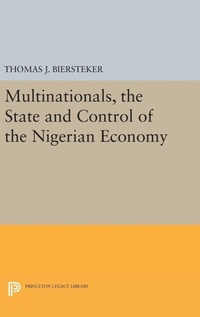
Multinationals, the State and Control of the Nigerian Economy
Will be published approx. on 19. April 2016
Book
Hardback
366 pages
978-0-691-63789-1 (ISBN)
Description
Thomas Biersteker evaluates the sources of Third World economic nationalism and assesses the significance of the changes that have taken place between North and South since the early 1970s. Neo-classical and neo-Marxist approaches to international and comparative political economy are explored to develop methods and select criteria for the assessment of major change. Originally published in 1987. The Princeton Legacy Library uses the latest print-on-demand technology to again make available previously out-of-print books from the distinguished backlist of Princeton University Press. These editions preserve the original texts of these important books while presenting them in durable paperback and hardcover editions. The goal of the Princeton Legacy Library is to vastly increase access to the rich scholarly heritage found in the thousands of books published by Princeton University Press since its founding in 1905.
More details
Series
Language
English
Place of publication
New Jersey
United States
Target group
College/higher education
Professional and scholarly
Product notice
Trade binding
Dimensions
Height: 240 mm
Width: 161 mm
Thickness: 24 mm
Weight
713 gr
ISBN-13
978-0-691-63789-1 (9780691637891)
Copyright in bibliographic data and cover images is held by Nielsen Book Services Limited or by the publishers or by their respective licensors: all rights reserved.
Schweitzer Classification
Other editions
Additional editions
Thomas J. Biersteker
Multinationals, the State and Control of the Nigerian Economy
E-Book
07/2014
1st Edition
Princeton University Press
€65.49
Available for download
Person
Thomas J. Biersteker
Content
*FrontMatter, pg. i*CONTENTS, pg. vii*FIGURES, pg. ix*TABLES, pg. xi*ACKNOWLEDGMENTS, pg. xv*ABBREVIATIONS, pg. xix*INTRODUCTION, pg. 1*CHAPTER ONE. Assessments of Indigenization: A Critical Review of Six Theoretical Approaches, pg. 11*CHAPTER TWO. The State as Collaborator: The First Indigenization Decree, pg. 52*CHAPTER THREE. Fronting, Commercial Consolidation, and Inequality, pg. 97*CHAPTER FOUR. The State as Initiator: The Second Indigenization Decree, pg. 159*CHAPTER FIVE. Maintaining Control: Multinational Responses to the Second Decree, pg. 199*CHAPTER SIX. The Control of Finance and the Development of Capitalism in Nigeria, pg. 245*CHAPTER SEVEN. The Dialectics of Indigenization: Stagnation and Transformation at Alternative Levels ofAnalysis, pg. 284*APPENDIX A. Research Methods and Sampling of Companies of Individuals Interviewed, pg. 300*APPENDIX B. Methodology and Codebook for Data Set Assembled on Incorporated Enterprises in Nigeria, pg. 313*APPENDIX C. Microeconomic Data Gathered about the Operations of Manufacturing Firms, pg. 322*APPENDIX D. Chronology of Economic Nationalism in Nigeria, pg. 324*BIBLIOGRAPHY, pg. 327*INDEX, pg. 337