

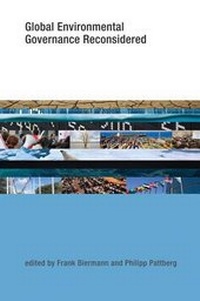
Global Environmental Governance Reconsidered
Published on 6. July 2012
Book
Hardback
318 pages
978-0-262-01766-4 (ISBN)
Description
The notion of global governance is widely studied in academia and increasingly
relevant to politics and policy making. Yet many of its fundamental elements remain unclear in both
theory and practice. This book offers a fresh perspective by analyzing global governance in terms of
three major trends, as exemplified by developments in global sustainability governance: the
emergence of nonstate actors; new mechanisms of transnational cooperation; and increasingly
segmented and overlapping layers of authority. The book, which is the synthesis of a ten-year
"Global Governance Project" carried out by thirteen leading European research
institutions, first examines new nonstate actors, focusing on international bureaucracies, global
corporations, and transnational networks of scientists; then investigates novel mechanisms of global
governance, particularly transnational environmental regimes, public-private partnerships, and
market-based arrangements; and, finally, looks at fragmentation of authority, both vertically among
supranational, international, national, and subnational layers, and horizontally among different
parallel rule-making systems. The implications, potential, and realities of global environmental
governance are defining questions for our generation. This book distills key insights from the past
and outlines the most important research challenges for the future.
relevant to politics and policy making. Yet many of its fundamental elements remain unclear in both
theory and practice. This book offers a fresh perspective by analyzing global governance in terms of
three major trends, as exemplified by developments in global sustainability governance: the
emergence of nonstate actors; new mechanisms of transnational cooperation; and increasingly
segmented and overlapping layers of authority. The book, which is the synthesis of a ten-year
"Global Governance Project" carried out by thirteen leading European research
institutions, first examines new nonstate actors, focusing on international bureaucracies, global
corporations, and transnational networks of scientists; then investigates novel mechanisms of global
governance, particularly transnational environmental regimes, public-private partnerships, and
market-based arrangements; and, finally, looks at fragmentation of authority, both vertically among
supranational, international, national, and subnational layers, and horizontally among different
parallel rule-making systems. The implications, potential, and realities of global environmental
governance are defining questions for our generation. This book distills key insights from the past
and outlines the most important research challenges for the future.
More details
Series
Language
English
Place of publication
Cambridge, Mass.
United States
Publishing group
MIT Press Ltd
Target group
Professional and scholarly
Interest Age: From 18 years
Dimensions
Height: 229 mm
Width: 152 mm
Thickness: 0 mm
Weight
454 gr
ISBN-13
978-0-262-01766-4 (9780262017664)
Copyright in bibliographic data and cover images is held by Nielsen Book Services Limited or by the publishers or by their respective licensors: all rights reserved.
Schweitzer Classification
Other editions
Additional editions
Frank Biermann | Philipp Pattberg
Global Environmental Governance Reconsidered
Book
07/2012
MIT Press
€40.85
Article exhausted; check different version
Persons
Frank Biermann is Professor of Political Science and of Environmental Policy at VU University Amsterdam and Visiting Professor of Earth System Governance at Lund University, Sweden.
Philipp Pattberg is Associate Professor of Transnational Governance in the Department of Environmental Policy Analysis, Institute for Environmental Studies, VU University.
Philipp Pattberg is Associate Professor of Transnational Governance in the Department of Environmental Policy Analysis, Institute for Environmental Studies, VU University.