

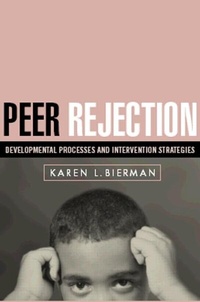
Peer Rejection
Developmental Processes and Intervention Strategies
1st Edition
Published on 22. September 2005
Book
Paperback/Softback
299 pages
978-1-59385-243-6 (ISBN)
Description
Addressing the widespread and painful problem of chronic peer rejection, this book combines up-to-date research with practical strategies for school- and clinic-based intervention. An innovative developmental framework is presented for understanding why certain children face rejection, the peer group dynamics involved, and implications for social-emotional development and mental health. Strategies for assessing rejected children are discussed in detail, and guidelines are provided for implementing social competence coaching programs and other effective interventions. Illustrative case studies and interviews are featured throughout.
Reviews / Votes
'This volume provides an invaluable tool to researchers, theorists, and practitioners interested in peer rejection and peer relations in childhood. Drawing on her combined research and clinical experience, Dr. Bierman has created a richly textured picture of the development of peer rejection and what can be done to reduce it. This is truly a tour de force.' - Mark T. Greenberg, PhD, Prevention Research Center, The Pennsylvania State University, USA'Over the past 20 years, research on peer relations has revealed the importance of rejection. This scholarly book provides a wonderful overview of the developmental literature in this area. In addition, realistic, insightful, and empirically supported interventions are described and discussed. This is essential reading for both researchers and clinicians.' - Thomas J. Dishion, PhD, Child and Family Center, University of Oregon, USA
More details
Series
Language
English
Place of publication
New York
United States
Target group
College/higher education
Professional and scholarly
Postgraduate, Professional, Professional Practice & Development, and Undergraduate
Dimensions
Height: 229 mm
Width: 152 mm
Weight
484 gr
ISBN-13
978-1-59385-243-6 (9781593852436)
Copyright in bibliographic data and cover images is held by Nielsen Book Services Limited or by the publishers or by their respective licensors: all rights reserved.
Schweitzer Classification
Other editions
Additional editions
Book
12/2003
1st Edition
Guilford Publications
€60.84
Article exhausted; check different version
Person
Karen L. Bierman, PhD, is Evan Pugh University Professor, Professor of Psychology and Human Development and Family Studies, and Director of the Child Study Center at Pennsylvania State University. Since the 1980s, her research has focused on social-emotional development and children at risk, with an emphasis on the design and evaluation of school-based programs that promote social competence, school readiness, and positive peer relations, and that reduce aggression and related behavior problems. Currently, she directs the Research-based Developmentally Informed (REDI) classroom and home visiting programs, developed in partnership with Head Start programs in Pennsylvania. A clinical psychologist, Dr. Bierman also directs a predoctoral training program in the interdisciplinary educational sciences. Dr. Bierman has served as an educational advisor to organizations including Head Start and Sesame Workshop.
Content
I. Understanding Problematic Peer Relations
1. The Developmental Significance of Peer Relations
2. Characteristics of Rejected Children
3. Rejection Processes: The Role of Peers
4. Peer Relations and the Developing Self
II. Assessing Social Competence and Peer Relations
5. Assessment Goals and Strategies
6. Assessing Problematic Peer Relations
7. Assessing Social Behavior
8. Observing Peer Interactions
9. Assessing Self-System Processes
III. Intervention Methods
10. Approaches to Intervention
11. The Design of Social Competence Coaching Programs
12. Intervention Process and the Promotion of Self-System Change
13. Collateral Interventions: Providing Support at School and Home
14. Future Directions
Appendix. Description of Exemplar Session Activities
1. The Developmental Significance of Peer Relations
2. Characteristics of Rejected Children
3. Rejection Processes: The Role of Peers
4. Peer Relations and the Developing Self
II. Assessing Social Competence and Peer Relations
5. Assessment Goals and Strategies
6. Assessing Problematic Peer Relations
7. Assessing Social Behavior
8. Observing Peer Interactions
9. Assessing Self-System Processes
III. Intervention Methods
10. Approaches to Intervention
11. The Design of Social Competence Coaching Programs
12. Intervention Process and the Promotion of Self-System Change
13. Collateral Interventions: Providing Support at School and Home
14. Future Directions
Appendix. Description of Exemplar Session Activities