

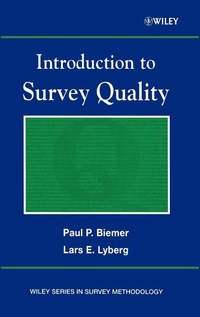
Introduction to Survey Quality
1st Edition
Published on 11. March 2003
Book
Hardback
424 pages
978-0-471-19375-3 (ISBN)
Description
Peruse the history of survey research and the essential conceptsfor data quality. With an emphasis on total survey error, theauthors review principles and concepts in the field and examineimportant unresolved issues in survey methods. Spanning a range oftopics dealing with the quality of data collected through thesurvey process, they focus on such key issues as:
* Major sources of survey error, examining the origins of eacherror source most successful methods for reducing errors from thosesources
* Methods most often used in practice for evaluating the effectsof the source on total survey error
* Implications of improving survey quality for organizationalmanagement and costs
* Major sources of survey error, examining the origins of eacherror source most successful methods for reducing errors from thosesources
* Methods most often used in practice for evaluating the effectsof the source on total survey error
* Implications of improving survey quality for organizationalmanagement and costs
Reviews / Votes
"...a very nice place to begin for anyone who might have an interest in the quality of surveys." (Technometrics, Vol. 45, No. 3, August 2003)More details
Series
Language
English
Place of publication
United States
Publishing group
John Wiley & Sons Inc
Target group
Professional and scholarly
Product notice
sewn/stitched
Cloth over boards
Illustrations
Charts: 34 B&W, 0 Color; Maps: 1 B&W, 0 Color; Tables: 42 B&W, 0 Color; Graphs: 14 B&W, 0 Color
Dimensions
Height: 240 mm
Width: 161 mm
Thickness: 27 mm
Weight
795 gr
ISBN-13
978-0-471-19375-3 (9780471193753)
Copyright in bibliographic data and cover images is held by Nielsen Book Services Limited or by the publishers or by their respective licensors: all rights reserved.
Schweitzer Classification
Other editions
Additional editions
Paul P. Biemer | Lars E. Lyberg
Introduction to Survey Quality
E-Book
05/2003
Wiley
€151.99
Available for download
Persons
PAUL P. BIEMER, PhD, is a distinguished Fellow at RTIInternational, and Assistant Director for Survey Research at theOdum Institute for Research in Social Science at the University ofNorth Carolina at Chapel Hill.
LARS E. LYBERG, PhD, is Chief Scientist at StatisticsSweden. They both have co-edited, with others, Measurement Errorsin Surveys, Survey Measurement and Process Quality, and TelephoneSurvey Methodology (all published by Wiley).
LARS E. LYBERG, PhD, is Chief Scientist at StatisticsSweden. They both have co-edited, with others, Measurement Errorsin Surveys, Survey Measurement and Process Quality, and TelephoneSurvey Methodology (all published by Wiley).
Content
Preface.
Chapter 1. The Evolution of Survey Process Quality.
1.1 The Concept of a Survey.
1.2 Types of Surveys.
1.3 Brief History of Survey Methodology.
1.4 The Quality Revolution.
1.5 Definitions of Quality and Quality in StatisticalOrganizations.
1.6 Measuring Quality.
1.7 Improving Quality.
1.8 Quality in a Nutshell.
Chapter 2. The Survey Process and Data Quality.
2.1 Overview of the Survey Process.
2.2 Data Quality and Total Survey Error.
2.3 Decomposing Nonsampling Error into Its Component Parts.
2.4 Gauging the Magnitude of Total Survey Error.
2.5 Mean Squared Error.
2.6 An Illustration of the Concepts.
Chapter 3. Coverage and Nonresponse Error.
3.1 Coverage Error.
3.2 Measures of Coverage Bias.
3.3 Reducing Coverage Bias.
3.4 Unit Nonresponse Error.
3.5 Calculating Response Rates.
3.6 Reducing Nonresponse Bias.
Chapter 4. The Measurement Process and Its Implications forQuestionnaire Design.
4.1Components of Measurement Error.
4.2 Errors Arising from the Questionnaire Design.
4.3 Understanding the Response Process.
Chapter 5. Errors Due to Interviewers and Interviewing.
5.1 Role of the Interviewer.
5.2 Interviewer Variability.
5.3 Design Factors that Influence Interviewer Effects.
5.4 Evaluation of Interviewer Performance.
Chapter 6. Data Collection Modes and Associated Errors.
6.1 Modes of Data Collection.
6.2 Decision Regarding Mode.
6.3 Some Examples of Mode Effects.
Chapter 7. Data Processing: Errors and Their Control.
7.1 Overview of Data Processing Steps.
7.2 Nature of Data Processing Error.
7.3 Data Capture Errors.
7.4 Post-Data Capture Editing.
7.5 Coding.
7.6 File Preparation.
7.7 Applications of Continuous Quality Improvement: The Case ofCoding.
7.8 Integration Activities.
Chapter 8. Overview of Survey Error Evaluation Methods.
8.1 Purposes of Survey Error Evaluation.
8.2 Evaluation Methods for Designing and Pretesting Surveys.
8.3 Methods for Monitoring and Controlling Data Quality.
8.4 Postsurvey Evaluations.
8.5 Summary of Evaluation Methods.
Chapter 9. Sampling Error.
9.1 Brief History of Sampling.
9.2 Nonrandom Sampling Methods.
9.3 Simple Random Sampling.
9.4 Statistical Inference in the Presence of NonsamplingErrors.
9.5 Other Methods of Random Sampling.
9.6 Concluding Remarks.
Chapter 10.1 Practical Survey Design for Minimizing Total SurveyError.
10.1 Balance Between Cost, Survey Error, and Other QualityFeatures.
10.2 Planning a Survey for Optimal Quality.
10.3 Documenting Survey Quality.
10.4 Organizational Issues Related to Survey Quality.
References.
Index.
Chapter 1. The Evolution of Survey Process Quality.
1.1 The Concept of a Survey.
1.2 Types of Surveys.
1.3 Brief History of Survey Methodology.
1.4 The Quality Revolution.
1.5 Definitions of Quality and Quality in StatisticalOrganizations.
1.6 Measuring Quality.
1.7 Improving Quality.
1.8 Quality in a Nutshell.
Chapter 2. The Survey Process and Data Quality.
2.1 Overview of the Survey Process.
2.2 Data Quality and Total Survey Error.
2.3 Decomposing Nonsampling Error into Its Component Parts.
2.4 Gauging the Magnitude of Total Survey Error.
2.5 Mean Squared Error.
2.6 An Illustration of the Concepts.
Chapter 3. Coverage and Nonresponse Error.
3.1 Coverage Error.
3.2 Measures of Coverage Bias.
3.3 Reducing Coverage Bias.
3.4 Unit Nonresponse Error.
3.5 Calculating Response Rates.
3.6 Reducing Nonresponse Bias.
Chapter 4. The Measurement Process and Its Implications forQuestionnaire Design.
4.1Components of Measurement Error.
4.2 Errors Arising from the Questionnaire Design.
4.3 Understanding the Response Process.
Chapter 5. Errors Due to Interviewers and Interviewing.
5.1 Role of the Interviewer.
5.2 Interviewer Variability.
5.3 Design Factors that Influence Interviewer Effects.
5.4 Evaluation of Interviewer Performance.
Chapter 6. Data Collection Modes and Associated Errors.
6.1 Modes of Data Collection.
6.2 Decision Regarding Mode.
6.3 Some Examples of Mode Effects.
Chapter 7. Data Processing: Errors and Their Control.
7.1 Overview of Data Processing Steps.
7.2 Nature of Data Processing Error.
7.3 Data Capture Errors.
7.4 Post-Data Capture Editing.
7.5 Coding.
7.6 File Preparation.
7.7 Applications of Continuous Quality Improvement: The Case ofCoding.
7.8 Integration Activities.
Chapter 8. Overview of Survey Error Evaluation Methods.
8.1 Purposes of Survey Error Evaluation.
8.2 Evaluation Methods for Designing and Pretesting Surveys.
8.3 Methods for Monitoring and Controlling Data Quality.
8.4 Postsurvey Evaluations.
8.5 Summary of Evaluation Methods.
Chapter 9. Sampling Error.
9.1 Brief History of Sampling.
9.2 Nonrandom Sampling Methods.
9.3 Simple Random Sampling.
9.4 Statistical Inference in the Presence of NonsamplingErrors.
9.5 Other Methods of Random Sampling.
9.6 Concluding Remarks.
Chapter 10.1 Practical Survey Design for Minimizing Total SurveyError.
10.1 Balance Between Cost, Survey Error, and Other QualityFeatures.
10.2 Planning a Survey for Optimal Quality.
10.3 Documenting Survey Quality.
10.4 Organizational Issues Related to Survey Quality.
References.
Index.