

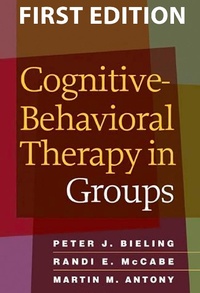
Cognitive-Behavioral Therapy in Groups
1st Edition
Published on 10. August 2009
Book
Paperback/Softback
452 pages
978-1-60623-404-4 (ISBN)
Description
*Practical: includes session outlines, sample dialogues, forms, and checklists.
*Each disorder-specific chapter includes a recommended treatment protocol.
*Evidence based: CBT groups can be as effective as individual treatment.
*Wide appeal to therapists and counselors in a range of settings.
*Each disorder-specific chapter includes a recommended treatment protocol.
*Evidence based: CBT groups can be as effective as individual treatment.
*Wide appeal to therapists and counselors in a range of settings.
Reviews / Votes
. - Provides an excellent and comprehensive discussion of the basic structure and implementation of CBT techniques offered in a group format. The book is a must-read for beginning group therapists, providing in-depth coverage on how to perform behavioral strategies in a group, establish group rules, interact with problem members, work with a cotherapist, and decide between sticking with the agenda versus pursuing unplanned group interaction. Important questions are raised in a thoughtful manner....We wholeheartedly recommend this book to those interested in researching and conducting CBGT and endorse the recommendations regarding future directions to maximize group process integration in CBT groups. --International Journal of Group Psychotherapy, 6/26/2009?? This is the book I would have liked to be able to read when I started running CBT groups sixteen years ago....What I found particularly helpful about this book is that from the start, the authors acknowledge that CBT groups are 'more than techniques delivered simultaneously to multiple clients.' The focus of the book is therefore 'the integration of CBT strategies, and the understanding and enhancement of group process to aid in learning and understanding cognitive and behavioural strategies.' This is a considerably more sophisticated approach to group CBT than has previously been available in the literature....This book will be a very valuable resource for professionals setting up and running CBT groups for a wide range of clients, as well as for professionals supervising CBT groups, and is highly recommended. --Cognitive Behavioral Therapy Book Reviews, 6/26/2009More details
Language
English
Place of publication
New York
United States
Target group
College/higher education
Professional and scholarly
Mental health practitioners, including clinical psychologists, psychiatrists, social workers, counselors, family therapists, and psychiatric nurses; also of interest to graduate students, interns, and residents in these fields. Serves as a supplemental text in graduate-level courses.
Product notice
Paperback (UK-B)
Dimensions
Height: 233 mm
Width: 154 mm
Thickness: 28 mm
Weight
666 gr
ISBN-13
978-1-60623-404-4 (9781606234044)
Copyright in bibliographic data and cover images is held by Nielsen Book Services Limited or by the publishers or by their respective licensors: all rights reserved.
Schweitzer Classification
Other editions
New editions
Peter J. Bieling | Randi E. McCabe | Martin M. Antony
Cognitive-Behavioral Therapy in Groups, Second Edition
Book
10/2022
2nd Edition
Guilford Press
€62.00
Shipment within 15-20 days
Additional editions
Peter J. Bieling | Randi E. McCabe | Martin M. Antony
Cognitive-Behavioral Therapy in Groups
Book
09/2006
1st Edition
Guilford Publications
€106.65
Article exhausted; check for reprint
Persons
Peter J. Bieling, PhD, is Associate Professor in the Department of Psychiatry and Behavioural Neurosciences at McMaster University and Director of Mood and Anxiety Services of St. Joseph's Healthcare, Hamilton, Ontario. He has published widely in the areas of depression and cognitive-behavioral therapy. A Founding Fellow in the Academy of Cognitive and Behavioral Therapies, he is an active therapist, teacher of cognitive-behavioral therapy, and consultant.
Randi E. McCabe, PhD, is Chair of the Clinical Behavioural Sciences Programme in the Faculty of Health Sciences and Assistant Professor in the Department of Psychiatry and Behavioural Neurosciences at McMaster University, and is Associate Director of the Anxiety Treatment and Research Centre at St. Joseph's Healthcare. She has published widely on anxiety, eating disorders, and cognitive-behavioral therapy, and is the author of three books for consumers. An active trainer and workshop presenter, she is on the editorial board of The Clinical Psychologist and maintains a private practice focusing on eating disorders.
Martin M. Antony, PhD, ABPP, is Professor of Psychology at Ryerson University in Toronto, Ontario, Canada. He was founding director of the Anxiety Treatment and Research Clinic and the Psychology Residency Program at St. Joseph's Healthcare Hamilton. The recipient of career awards from the Society of Clinical Psychology, the Canadian Psychological Association (CPA), and the Anxiety and Depression Association of America, Dr. Antony is a Fellow of the Royal Society of Canada and has served as president of the CPA and the Association for Behavioral and Cognitive Therapies. He has published over 30 books and 275 scientific articles and book chapters on cognitive-behavioral therapy, psychological assessment, anxiety disorders, obsessive-compulsive disorder, and perfectionism.
Randi E. McCabe, PhD, is Chair of the Clinical Behavioural Sciences Programme in the Faculty of Health Sciences and Assistant Professor in the Department of Psychiatry and Behavioural Neurosciences at McMaster University, and is Associate Director of the Anxiety Treatment and Research Centre at St. Joseph's Healthcare. She has published widely on anxiety, eating disorders, and cognitive-behavioral therapy, and is the author of three books for consumers. An active trainer and workshop presenter, she is on the editorial board of The Clinical Psychologist and maintains a private practice focusing on eating disorders.
Martin M. Antony, PhD, ABPP, is Professor of Psychology at Ryerson University in Toronto, Ontario, Canada. He was founding director of the Anxiety Treatment and Research Clinic and the Psychology Residency Program at St. Joseph's Healthcare Hamilton. The recipient of career awards from the Society of Clinical Psychology, the Canadian Psychological Association (CPA), and the Anxiety and Depression Association of America, Dr. Antony is a Fellow of the Royal Society of Canada and has served as president of the CPA and the Association for Behavioral and Cognitive Therapies. He has published over 30 books and 275 scientific articles and book chapters on cognitive-behavioral therapy, psychological assessment, anxiety disorders, obsessive-compulsive disorder, and perfectionism.
Content
I. General Principles and Practice of Cognitive-Behavioral Therapy Groups
1. Cognitive-Behavioral Therapy Groups: Possibilities and Challenges
2. Group Processes in CBT: Using Group Dynamics Productively
3. Cognitive Strategies in CBT Groups
4. Behavioral Strategies in CBT Groups
5. Basic Structure and Implementation of CBT Groups
6. Overcoming Obstacles in CBT Groups: Challenges and Problems in Group Structure
II. Cognitive-Behavioral Therapy Groups for Specific Disorders
7. Panic Disorder and Agoraphobia
8. Obsessive-Compulsive Disorder
9. Social Anxiety Disorder
10. Depression
11. Bipolar Disorder
12. Eating Disorders
13. Substance Abuse, Frederick Rotgers and Trinh An Nguyen
14. Personality Disorders, Arthur Freeman and Jessica L. Stewart
15. Schizophrenia, David L. Roberts, Amy E. Pinkham, and David L. Penn
III. Comorbidity and Future Directions
16. Comorbidity and CBT Groups
17. The FAQs of CBT Group Intervention
1. Cognitive-Behavioral Therapy Groups: Possibilities and Challenges
2. Group Processes in CBT: Using Group Dynamics Productively
3. Cognitive Strategies in CBT Groups
4. Behavioral Strategies in CBT Groups
5. Basic Structure and Implementation of CBT Groups
6. Overcoming Obstacles in CBT Groups: Challenges and Problems in Group Structure
II. Cognitive-Behavioral Therapy Groups for Specific Disorders
7. Panic Disorder and Agoraphobia
8. Obsessive-Compulsive Disorder
9. Social Anxiety Disorder
10. Depression
11. Bipolar Disorder
12. Eating Disorders
13. Substance Abuse, Frederick Rotgers and Trinh An Nguyen
14. Personality Disorders, Arthur Freeman and Jessica L. Stewart
15. Schizophrenia, David L. Roberts, Amy E. Pinkham, and David L. Penn
III. Comorbidity and Future Directions
16. Comorbidity and CBT Groups
17. The FAQs of CBT Group Intervention