

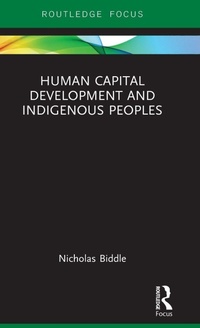
Human Capital Development and Indigenous Peoples
1st Edition
Published on 18. September 2018
Book
Hardback
112 pages
978-1-138-49836-5 (ISBN)
Description
In all countries for which data is available, Indigenous peoples have lower rates of formal educational participation and attainment than their non-Indigenous counterparts. There are many structural reasons for this, but it may in part be related to the perceived relationship between the costs and benefits of education. Human Capital Development and Indigenous Peoples systematically applies a human capital approach to educational policy, to help understand the education and broader development outcomes of indigenous peoples.
The basic Human Capital Model states that individuals, families and communities will invest in education until the benefits of doing so no longer outweigh the costs. This trade-off is often considered in monetary terms. Here the author broadens cost-benefit definitions to include health and wellbeing improvements alongside social costs driven by discrimination and unfair treatment in schools. With coverage of the Americas, Asia, Australia and New Zealand, the book critiques existing approaches, and provides an outlet for the self-described experiences of a diverse set of indigenous peoples on the breadth of educational costs and benefits. Combining new quantitative analysis, cross-national perspectives and an explicit policy focus, this book provides policy actors with a detailed understanding of the education decision and equips them with the knowledge to enhance benefits while minimising costs.
This book will appeal to policy-engaged researchers in the fields of economics, demography, sociology, political science, development studies and anthropology, as well as policy makers or practitioners who are interested in incorporating the most recent evidence into their practice or frameworks.
The basic Human Capital Model states that individuals, families and communities will invest in education until the benefits of doing so no longer outweigh the costs. This trade-off is often considered in monetary terms. Here the author broadens cost-benefit definitions to include health and wellbeing improvements alongside social costs driven by discrimination and unfair treatment in schools. With coverage of the Americas, Asia, Australia and New Zealand, the book critiques existing approaches, and provides an outlet for the self-described experiences of a diverse set of indigenous peoples on the breadth of educational costs and benefits. Combining new quantitative analysis, cross-national perspectives and an explicit policy focus, this book provides policy actors with a detailed understanding of the education decision and equips them with the knowledge to enhance benefits while minimising costs.
This book will appeal to policy-engaged researchers in the fields of economics, demography, sociology, political science, development studies and anthropology, as well as policy makers or practitioners who are interested in incorporating the most recent evidence into their practice or frameworks.
More details
Series
Language
English
Place of publication
London
United Kingdom
Publishing group
Taylor & Francis Ltd
Target group
College/higher education
Illustrations
17 s/w Abbildungen, 17 s/w Zeichnungen
17 Line drawings, black and white; 17 Illustrations, black and white
Dimensions
Height: 222 mm
Width: 145 mm
Thickness: 11 mm
Weight
304 gr
ISBN-13
978-1-138-49836-5 (9781138498365)
Copyright in bibliographic data and cover images is held by Nielsen Book Services Limited or by the publishers or by their respective licensors: all rights reserved.
Schweitzer Classification
Other editions
Additional editions
Nicholas Biddle
Human Capital Development and Indigenous Peoples
Book
03/2020
1st Edition
Routledge
€35.80
Shipment within 15-20 days
Nicholas Biddle
Human Capital Development and Indigenous Peoples
E-Book
10/2018
1st Edition
Routledge
€31.49
Available for download
Person
Nicholas Biddle is Associate Professor in Public Policy at the Australian National University and Associate Director of the ANU Centre for Social Research and Methods. He is also a Senior Fellow at the Centre for Aboriginal Economic Policy Research and a Fellow of the Tax and Transfer Policy Institute.
Content
Preface - Standpoint and position
Part 1: A human capital approach to Indigenous development
1. Introduction - Why human capital, and why Indigenous peoples
2. The human capital model and its application to Indigenous peoples
3. The determinants of Indigenous human capital development and barriers to development
Part 2: Programs that help improve the human capital development of Indigenous peoples
4. Improving the schooling experience of Indigenous peoples
5. Indigenous specific education institutions
6. Programs that impact on Indigenous peoples indirectly - Conditional Cash Transfers and Indigenous peoples in Latin America
Part 3: Using the Human Capital model to improve the outcomes of Indigenous peoples
7. Education for all: Using the Human Capital Model for education equity in the 21st Century
Part 1: A human capital approach to Indigenous development
1. Introduction - Why human capital, and why Indigenous peoples
2. The human capital model and its application to Indigenous peoples
3. The determinants of Indigenous human capital development and barriers to development
Part 2: Programs that help improve the human capital development of Indigenous peoples
4. Improving the schooling experience of Indigenous peoples
5. Indigenous specific education institutions
6. Programs that impact on Indigenous peoples indirectly - Conditional Cash Transfers and Indigenous peoples in Latin America
Part 3: Using the Human Capital model to improve the outcomes of Indigenous peoples
7. Education for all: Using the Human Capital Model for education equity in the 21st Century