

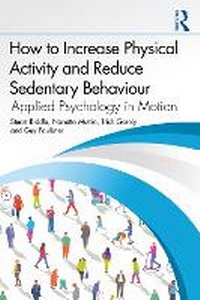
How to Increase Physical Activity and Reduce Sedentary Behaviour
Applied Psychology in Motion
1st Edition
Will be published approx. on 31. December 2025
Book
Paperback/Softback
134 pages
978-1-032-69983-7 (ISBN)
Description
How to Increase Physical Activity and Reduce Sedentary Behaviour: Applied Psychology in Motion is an important source concerning the application of psychology to the promotion of physical activity for health. It serves as a companion to the more detailed research-intensive textbook Psychology of Physical Activity. While comprehensive textbooks have their place, there is also a need for a more succinct and practical book describing important psychological constructs and how they can be applied to increase physical activity and reduce sedentary behaviour.
Behaviour change does not occur in a vacuum. We also need to apply psychology within certain settings and practices. How to Increase Physical Activity and Reduce Sedentary Behaviour: Applied Psychology in Motion presents the '8 best investments' proposed by the International Society for Physical Activity and Health and applies important psychological constructs and issues to each context in an effort to stimulate behaviour change. This cutting edge book has been developed to assist individuals looking to change their activity levels, as well as those attempting to change behaviours in others. It is designed to better understand the psychological principles underpinning sedentary behaviour and physical activity for health.
This new, practical guidebook delivers an applied emphasis on helping those working with individuals in health behaviour change, whilst also being accessible to members of the general public who want to know more about how to increase their physical activity. Including many applied examples, case studies, and scenarios that bring the psychology concepts to life, How to Increase Physical Activity and Reduce Sedentary Behaviour: Applied Psychology in Motion is centred around different settings where behaviour change can take place.
Behaviour change does not occur in a vacuum. We also need to apply psychology within certain settings and practices. How to Increase Physical Activity and Reduce Sedentary Behaviour: Applied Psychology in Motion presents the '8 best investments' proposed by the International Society for Physical Activity and Health and applies important psychological constructs and issues to each context in an effort to stimulate behaviour change. This cutting edge book has been developed to assist individuals looking to change their activity levels, as well as those attempting to change behaviours in others. It is designed to better understand the psychological principles underpinning sedentary behaviour and physical activity for health.
This new, practical guidebook delivers an applied emphasis on helping those working with individuals in health behaviour change, whilst also being accessible to members of the general public who want to know more about how to increase their physical activity. Including many applied examples, case studies, and scenarios that bring the psychology concepts to life, How to Increase Physical Activity and Reduce Sedentary Behaviour: Applied Psychology in Motion is centred around different settings where behaviour change can take place.
More details
Language
English
Place of publication
London
United Kingdom
Publishing group
Taylor & Francis Ltd
Target group
College/higher education
Professional and scholarly
Academic, General, Parents, Professional Practice & Development, and Undergraduate Advanced
Illustrations
9 s/w Photographien bzw. Rasterbilder, 32 s/w Zeichnungen, 21 s/w Tabellen, 30 s/w Abbildungen
21 Tables, black and white; 32 Line drawings, black and white; 9 Halftones, black and white; 41 Illustrations, black and white
Dimensions
Height: 229 mm
Width: 152 mm
Thickness: 8 mm
Weight
228 gr
ISBN-13
978-1-032-69983-7 (9781032699837)
Copyright in bibliographic data and cover images is held by Nielsen Book Services Limited or by the publishers or by their respective licensors: all rights reserved.
Schweitzer Classification
Other editions
Additional editions
Stuart Biddle | Nanette Mutrie | Trish Gorely
How to Increase Physical Activity and Reduce Sedentary Behaviour
Applied Psychology in Motion
Book
approx. 12/2025
1st Edition
Routledge
€221.80
Not yet published
Stuart Biddle | Nanette Mutrie | Trish Gorely
How to Increase Physical Activity and Reduce Sedentary Behaviour
Applied Psychology in Motion
E-Book
12/2025
Routledge
€60.49
Available for download
Stuart Biddle | Nanette Mutrie | Trish Gorely
How to Increase Physical Activity and Reduce Sedentary Behaviour
Applied Psychology in Motion
E-Book
12/2025
Routledge
€60.49
Available for download
Persons
Stuart Biddle is Professor of Physical Activity and Health in the Centre for Health Research at the University of Southern Queensland, near Brisbane, Australia. He is a visiting or honorary professor at The University of Queensland and Baker Heart & Diabetes Institute in Australia, as well as at Loughborough University (UK), and University of Jyvaeskylae (Finland).
Nanette Mutrie is Professor Emerita with the Physical Activity for Health Research Centre at the University of Edinburgh, Scotland.
Trish Gorely is Professor of Physical Activity for Health in the Centre for Rural Health Sciences at the University of the Highlands and Islands, Inverness, Scotland.
Guy Faulkner is Professor and Chair in Applied Public Health and leads the Population Physical Activity (Pop PA) Lab in the School of Kinesiology at the University of British Columbia, Canada.
Nanette Mutrie is Professor Emerita with the Physical Activity for Health Research Centre at the University of Edinburgh, Scotland.
Trish Gorely is Professor of Physical Activity for Health in the Centre for Rural Health Sciences at the University of the Highlands and Islands, Inverness, Scotland.
Guy Faulkner is Professor and Chair in Applied Public Health and leads the Population Physical Activity (Pop PA) Lab in the School of Kinesiology at the University of British Columbia, Canada.
Content
Section 1: Understanding Psychology for Increasing Physical Activity 1. Physical Activity and Sedentary Behaviour: Setting the Scene 2. Physical Activity, Motivation, and Mental Health 3. Physical and Social Environments 4. Behaviour Change: Frameworks and Techniques Section 2: Applying Psychology in Different Settings: Eight Best Investments 5. Active Travel 6. Active Urban Design 7. Healthcare 8. Public Education, Including Mass Media 9. Sport and Recreation for All 10. Workplaces 11. Community-Wide Programmes 12. Whole-of-School Programmes Section 3: Summary 13. Bringing It All Together