

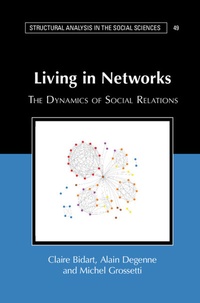
Living in Networks
The Dynamics of Social Relations
Published on 22. October 2020
Book
Paperback/Softback
338 pages
978-1-108-79483-1 (ISBN)
Description
How do personal networks emerge from social contexts? How do these evolve during the course of a lifetime? How are relationships established, maintained, connected, disrupted? How does the structure of a network evolve as people face transitions and events? Based on a classic text originally published in France and that has become the standard on the empirical study of social networks there, for the first time, a network analysis perspective is extended from contexts and social circles to relationships and life events through empirical studies. Following in the tradition of personal network studies, this contribution to the field of structural analysis in Sociology offers both a synthesis of knowledge and original results from two immense surveys carried out in France. This volume proposes an original theory grounded in relational dynamics, offering novel perspectives on individual social relations over the course of a lifetime through the context of personal networks, access to social resources, and inequalities.
Reviews / Votes
'This wonderful book takes networks a giant step further, going beyond one-shot descriptions of personal networks to dynamic analyses of how personal networks change over time as people grow up, leave home, get married and unmarried, work and retire. Through it, we see the networks of France living and breathing. From virus to romance and social capital, the authors show how networks both cluster locally and leap around the world.' Barry Wellman, Director, NetLab Network 'Bidart, Degenne, and Grossetti's Living in Networks is a significant contribution to our understanding of individuals' personal relationships. Through pictures and detailed stories, Bidart and colleagues show how over many years people build, dismantle, and then rebuild their personal ties to the social world. The variety of paths they describe is persuasive and compelling. Living in Networks will have an important place on any network analyst's shelf.' Claude S. Fischer, University of California, Berkeley 'Living in Networks will help you understand you and your personal network. Drawing on two rich sets of data, the authors elaborate on a number of relational concepts like social circles, embedding and dissembedding mechanisms, dissociation, densification, centralization, and decentralization. This book explains convincingly the dynamics of personal relations across the life-course, the influence of education, social class, mobility, internet, and even chance. Read it. You will understand why your world is how it is.' Jose Luis Molina, Universitat Autonoma de BarcelonaMore details
Series
Language
English
Place of publication
Cambridge
United Kingdom
Target group
Professional and scholarly
College/higher education
Product notice
Paperback (trade)
Illustrations
Worked examples or Exercises
Dimensions
Height: 230 mm
Width: 153 mm
Thickness: 15 mm
Weight
520 gr
ISBN-13
978-1-108-79483-1 (9781108794831)
Copyright in bibliographic data and cover images is held by Nielsen Book Services Limited or by the publishers or by their respective licensors: all rights reserved.
Schweitzer Classification
Other editions
Additional editions
Book
10/2020
Cambridge University Press
€122.50
Shipment within 15-20 days
E-Book
10/2020
Cambridge University Press
€23.49
Available for download
Persons
Content
Part I. Foundations of a Sociology of Relational Dynamics: 1. Understanding Relationships; 2: Analyzing Networks; Part II. Networks and their Dynamics: 3. Relationships Do not Come out of Nowhere; 4. The Dynamics of Relationships; 5. Relationships that End, Relationships that Endure; 6. Networks and their Dynamics; 7: As the Years Go By; Part III. Networks and Social Worlds; 8. Networks Have a Spatial Dimension; 9. Soft Segregation; 10. Relationships and Networks as Resources; 11. Unequal Networks; Conclusion.