

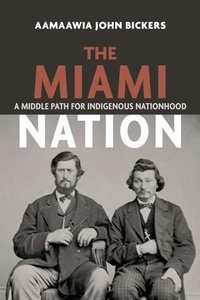
The Miami Nation
A Middle Path for Indigenous Nationhood
Published on 2. June 2026
Book
Paperback/Softback
356 pages
978-0-253-07539-0 (ISBN)
Description
As the United States sought to expand its territorial holdings at the start of the nineteenth century into what is now Ohio and Indiana, the Indigenous Myaamia (Miami) peoples of the Wabash River Valley came together to form a united front to protect their lands and their people. The Miami National Council was designed by its founders to allow the Myaamia people and their leaders to engage with the federal government and American culture on their own terms.
The Miami Nation tells the fascinating history of both politics and people. Skillfully weaving together oral narratives, archival research, existing published histories, and his own family's recollections and stories, Aamaawia John Bickers illustrates the broader strategies and forces that affected how the Miami Nation responded to American imperial expansion, illuminating the challenges, achievements, and occasional missteps taken by individual tribe members along the way. Bickers begins with the formation of the Miami National Council in the early nineteenth century, following their political development through two forced removals, the American Civil War, allotment and the Dawes Act, and finally the ratification of the constitution of the Miami Tribe of Oklahoma in 1939. But throughout these experiences, the Miami Nation maintained its cultural identity and continued to sustain their community.
As the first academic history of the Myaamia people written by a tribal member, The Miami Nation centers Myaamia voices as it contemplates issues of Indigenous power, settler colonialism, and how a community can charter its own path through history.
The Miami Nation tells the fascinating history of both politics and people. Skillfully weaving together oral narratives, archival research, existing published histories, and his own family's recollections and stories, Aamaawia John Bickers illustrates the broader strategies and forces that affected how the Miami Nation responded to American imperial expansion, illuminating the challenges, achievements, and occasional missteps taken by individual tribe members along the way. Bickers begins with the formation of the Miami National Council in the early nineteenth century, following their political development through two forced removals, the American Civil War, allotment and the Dawes Act, and finally the ratification of the constitution of the Miami Tribe of Oklahoma in 1939. But throughout these experiences, the Miami Nation maintained its cultural identity and continued to sustain their community.
As the first academic history of the Myaamia people written by a tribal member, The Miami Nation centers Myaamia voices as it contemplates issues of Indigenous power, settler colonialism, and how a community can charter its own path through history.
Reviews / Votes
"This book represents a sophisticated balance between tribal history and a history of the Myaamia individuals who shaped the Nation. Bickers' biographical approach decolonizes our understanding of Myaamia experiences, restor(y)ing the people at the center of his broader analysis."-Kathryn Magee Labelle, author of Dispersed, But Not Destroyed: A History of the Seventeenth-Century Wendat Diaspora"Aamaawia John Bickers has written an intentionally Myaamia-centered history of the Miami Nation. Emphasizing nineteenth century Myaamia decisions to adapt their political, social, and economic institutions to meet the challenges of multiple forced removals and ongoing American efforts at dispossession, Bickers shows that although Myaamias changed, they did not disappear or cease to be a tribal nation. Myaamias experimented with aspects of American society such as farming and private land ownership, convincing their American contemporaries - and later scholars - that they were well on their way to assimilation and disappearance, but Myaamias remained committed to the survival of their own community. Emphasizing traditional Myaamia understandings that both tribal and individual well-being depended on active participation in community and ceremonial life, they nurtured a strong sense of tribal connection that has carried them through to the present. While earlier studies, like earlier American settler colonists, emphasized Myaamia change meant disappearance, Bickers' emphasis on Myaamia-directed change reveals that change need not be destructive but could be instead be generative."-Rebecca Kugel, author of To Be the Main Leaders of Our People: A History of Minnesota Ojibwe Politics, 1825-1898
"Eschewing comfortable binaries like "traditional" versus "progressive," The Miami Nation is a nuanced political history anchored in Myaamia culture and language. Taking a multivalent approach, Bickers explores how Myaamia people navigated change within their villages, within their nation, and on the international stage. Beautifully written and carefully researched, The Miami Nation offers new perspectives on Indigenous nation-building, diplomacy, and the nature of political power."-Christina Snyder, author of Great Crossings: Indians, Settlers, and Slaves in the Age of Jackson
More details
Language
English
Place of publication
Bloomington, IN
United States
Target group
Professional and scholarly
College/higher education
Product notice
Paperback (trade)
Illustrations
6 color illus., 9 b&w illus., 3 maps
Dimensions
Height: 229 mm
Width: 152 mm
Weight
567 gr
ISBN-13
978-0-253-07539-0 (9780253075390)
Copyright in bibliographic data and cover images is held by Nielsen Book Services Limited or by the publishers or by their respective licensors: all rights reserved.
Schweitzer Classification
Other editions
Additional editions
E-Book
06/2026
Indiana University Press
€48.99
Available for download
Person
Aamaawia John Bickers is Assistant Professor of History at Case Western Reserve University, where he teaches courses in Native American and Early American history. He currently resides with his wife and children in Cleveland, Ohio.
Content
ii meehtohseeniwiyankwi aatotamankwi (How We Talk About Our Lives)
kweehsitawakiki (Acknowledgements)
Note on Language
Introduction
Part I: Ciikaahkwe Waapaahsiki Siipionki (Along the Wabash River)
1. From Peoplehood to Nationhood
2. Annuities, Alcohol, and Aesthetics
3. From Myaamionki to the Miami Reservation
Part II: Ciikaahkwe Waapankiaakamionki (Along the Marais Des Cygnes River)
4. Life on the Miami Reservation
5. Kansans, Confederates, and Conflict
Part III: Ciikaahkwe Noosonke Siipionki (Along the Neosho River)
6. Churches, Schools, and a Town Called Miami
Epilogue
Appendix A: Maawikimaki/Akimaki (Principal Chiefs/Chiefs)
Appendix B: Niisonaminki Akimaki (Second Chiefs)
Notes
Bibliography
Index
kweehsitawakiki (Acknowledgements)
Note on Language
Introduction
Part I: Ciikaahkwe Waapaahsiki Siipionki (Along the Wabash River)
1. From Peoplehood to Nationhood
2. Annuities, Alcohol, and Aesthetics
3. From Myaamionki to the Miami Reservation
Part II: Ciikaahkwe Waapankiaakamionki (Along the Marais Des Cygnes River)
4. Life on the Miami Reservation
5. Kansans, Confederates, and Conflict
Part III: Ciikaahkwe Noosonke Siipionki (Along the Neosho River)
6. Churches, Schools, and a Town Called Miami
Epilogue
Appendix A: Maawikimaki/Akimaki (Principal Chiefs/Chiefs)
Appendix B: Niisonaminki Akimaki (Second Chiefs)
Notes
Bibliography
Index