

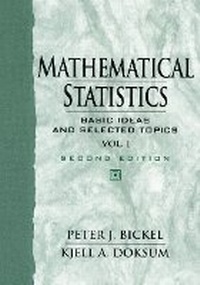
Mathematical Statistics
Basic Ideas and Selected Topics, Vol I
2nd Edition
Published on 18. October 2000
Book
Hardback
556 pages
978-0-13-850363-5 (ISBN)
Description
For graduate-level courses in Statistical Inference or Theoretical Statistics in departments of Statistics, Bio-Statistics, Economics, Computer Science, and Mathematics.
A classic, time-honored introduction to the theory and practice of statistics modeling and inference-revised to reflect the changing focus of Statistics and the mathematics background of today's students. Coverage begins with the more general nonparametric point of view and then looks at parametric models as submodels of the nonparametric ones which can be described smoothly by Euclidean parameters. Although some computational issues are discussed, this is very much a book on theory. A second volume treating more advanced topics is in preparation.
A classic, time-honored introduction to the theory and practice of statistics modeling and inference-revised to reflect the changing focus of Statistics and the mathematics background of today's students. Coverage begins with the more general nonparametric point of view and then looks at parametric models as submodels of the nonparametric ones which can be described smoothly by Euclidean parameters. Although some computational issues are discussed, this is very much a book on theory. A second volume treating more advanced topics is in preparation.
More details
Edition
2nd edition
Language
English
Place of publication
United States
Publishing group
Pearson Education (US)
Target group
Professional and scholarly
Dimensions
Height: 244 mm
Width: 181 mm
Thickness: 26 mm
Weight
978 gr
ISBN-13
978-0-13-850363-5 (9780138503635)
Copyright in bibliographic data and cover images is held by Nielsen Book Services Limited or by the publishers or by their respective licensors: all rights reserved.
Schweitzer Classification
Other editions
Previous edition

Book
05/1991
Prentice-Hall
€42.08
Article exhausted; check different version
Content
(NOTE: Each chapter concludes with Problems and Complements, Notes, and References.)
1. Statistical Models, Goals, and Performance Criteria.
Data, Models, Parameters, and Statistics. Bayesian Models. The Decision Theoretic Framework. Prediction. Sufficiency. Exponential Families.
2. Methods of Estimation.
Basic Heuristics of Estimation. Minimum Contrast Estimates and Estimating Equations. Maximum Likelihood in Multiparameter Exponential Families. Algorithmic Issues.
3. Measures of Performance.
Introduction. Bayes Procedures. Minimax Procedures. Unbiased Estimation and Risk Inequalities. Nondecision Theoretic Criteria.
4. Testing and Confidence Regions.
Introduction. Choosing a Test Statistic: The Neyman-Pearson Lemma. Uniformly Most Powerful Tests and Monotone Likelihood Ratio Models. Confidence Bounds, Intervals and Regions. The Duality between Confidence Regions and Tests. Uniformly Most Accurate Confidence Bounds. Frequentist and Bayesian Formulations. Prediction Intervals. Likelihood Ratio Procedures.
5. Asymptotic Approximations.
Introduction: The Meaning and Uses of Asymptotics. Consistency. First- and Higher-Order Asymptotics: The Delta Method with Applications. Asymptotic Theory in One Dimension. Asymptotic Behavior and Optimality of the Posterior Distribution.
6. Inference in the Multiparameter Case.
Inference for Gaussian Linear Models. Asymptotic Estimation Theory in p Dimensions. Large Sample Tests and Confidence Regions. Large Sample Methods for Discrete Data. Generalized Linear Models. Robustness Properties and Semiparametric Models.
Appendix A: A Review of Basic Probability Theory.
The Basic Model. Elementary Properties of Probability Models. Discrete Probability Models. Conditional Probability and Independence. Compound Experiments. Bernoulli and Multinomial Trials, Sampling with and without Replacement. Probabilities on Euclidean Space. Random Variables and Vectors: Transformations. Independence of Random Variables and Vectors. The Expectation of a Random Variable. Moments. Moment and Cumulant Generating Functions. Some Classical Discrete and Continuous Distributions. Modes of Convergence of Random Variables and Limit Theorems. Further Limit Theorems and Inequalities. Poisson Process.
Appendix B: Additional Topics in Probability and Analysis.
Conditioning by a Random Variable or Vector. Distribution Theory for Transformations of Random Vectors. Distribution Theory for Samples from a Normal Population. The Bivariate Normal Distribution. Moments of Random Vectors and Matrices. The Multivariate Normal Distribution. Convergence for Random Vectors: Op and Op Notation. Multivariate Calculus. Convexity and Inequalities. Topics in Matrix Theory and Elementary Hilbert Space Theory.
Appendix C: Tables.
The Standard Normal Distribution. Auxiliary Table of the Standard Normal Distribution. t Distribution Critical Values. X 2 Distribution Critical Values. F Distribution Critical Values.
Index.
1. Statistical Models, Goals, and Performance Criteria.
Data, Models, Parameters, and Statistics. Bayesian Models. The Decision Theoretic Framework. Prediction. Sufficiency. Exponential Families.
2. Methods of Estimation.
Basic Heuristics of Estimation. Minimum Contrast Estimates and Estimating Equations. Maximum Likelihood in Multiparameter Exponential Families. Algorithmic Issues.
3. Measures of Performance.
Introduction. Bayes Procedures. Minimax Procedures. Unbiased Estimation and Risk Inequalities. Nondecision Theoretic Criteria.
4. Testing and Confidence Regions.
Introduction. Choosing a Test Statistic: The Neyman-Pearson Lemma. Uniformly Most Powerful Tests and Monotone Likelihood Ratio Models. Confidence Bounds, Intervals and Regions. The Duality between Confidence Regions and Tests. Uniformly Most Accurate Confidence Bounds. Frequentist and Bayesian Formulations. Prediction Intervals. Likelihood Ratio Procedures.
5. Asymptotic Approximations.
Introduction: The Meaning and Uses of Asymptotics. Consistency. First- and Higher-Order Asymptotics: The Delta Method with Applications. Asymptotic Theory in One Dimension. Asymptotic Behavior and Optimality of the Posterior Distribution.
6. Inference in the Multiparameter Case.
Inference for Gaussian Linear Models. Asymptotic Estimation Theory in p Dimensions. Large Sample Tests and Confidence Regions. Large Sample Methods for Discrete Data. Generalized Linear Models. Robustness Properties and Semiparametric Models.
Appendix A: A Review of Basic Probability Theory.
The Basic Model. Elementary Properties of Probability Models. Discrete Probability Models. Conditional Probability and Independence. Compound Experiments. Bernoulli and Multinomial Trials, Sampling with and without Replacement. Probabilities on Euclidean Space. Random Variables and Vectors: Transformations. Independence of Random Variables and Vectors. The Expectation of a Random Variable. Moments. Moment and Cumulant Generating Functions. Some Classical Discrete and Continuous Distributions. Modes of Convergence of Random Variables and Limit Theorems. Further Limit Theorems and Inequalities. Poisson Process.
Appendix B: Additional Topics in Probability and Analysis.
Conditioning by a Random Variable or Vector. Distribution Theory for Transformations of Random Vectors. Distribution Theory for Samples from a Normal Population. The Bivariate Normal Distribution. Moments of Random Vectors and Matrices. The Multivariate Normal Distribution. Convergence for Random Vectors: Op and Op Notation. Multivariate Calculus. Convexity and Inequalities. Topics in Matrix Theory and Elementary Hilbert Space Theory.
Appendix C: Tables.
The Standard Normal Distribution. Auxiliary Table of the Standard Normal Distribution. t Distribution Critical Values. X 2 Distribution Critical Values. F Distribution Critical Values.
Index.